
When I think about transformation, a few things come to mind:
I think about transformation in the world around me– how a park becomes an apartment building. A politician leaves office and is replaced by another. Caterpillars become butterflies, roads gain potholes that are sometimes filled in, and trees are knocked down to create other important things like hospitals and schools. The world transforms in complicated ways, and whether we like it or not, the world tomorrow will be very different from the world today, just as today’s world is different than that of yesterday.
I think about transformation in society– certain ideas are originally rejected before, years later, becoming the norm (a prime example is support for marriage equality– just look at the politicians who have changed their stances on the issue since it has become more popular). Demographics of different parts of society transform, so that in 50 years the racial and age breakup of this country will look completely different than it does today.
And I think about transformation in my own life– leaving my home in Minnesota to go to college 1400 miles away in Portland. The death of my mother. Living and studying in South America for five months. Transforming from child to adult, from purely an observer to more of a creator, from unknowing in one way to unknowing in an another way. I feel that transformation in my own life mirrors that of the world and society that surround me. It’s not something that I can control, but it is something that I can (and must) acknowledge and reflect on.
Perhaps my most recent major transformation occurred last spring, when I spent five months studying in Valparaíso, Chile (that is, unless you would count cutting off most of my hair last fall as a major transformation). Living in another country, combined with the raw grief that came from losing my mom five months earlier, led to a definite transformation in the type of person I am; especially in terms of how I express myself to the world. Looking back, I think that my experience abroad helped me transform into someone who takes more time to sit and listen to what’s going on around her, instead of always trying to come up with a response. As I learned, living with a host family that only speaks your second language provides you with a lot of time to sit and listen without always having the ability to respond. I became a person who is able to focus on the small components of life (which I learned is necessary to do, especially while grieving and/or experiencing full-blown culture shock), as well as a person who takes each day where she’s at instead of pretending that she is somewhere else. I have transformed into what I believe to be a more realistic and patient person.
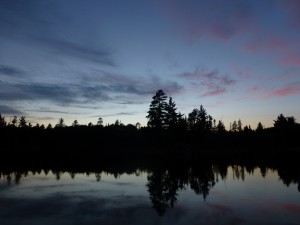
And then there are the constant transformations all around us that often go unnoticed, like sunsets (this one was up in northern Minnesota last summer).
Of course, I do not mean this to be sentimental; rather, I want to illustrate what the word “transformation” means to me. To me, transformation is as much a part of life as breathing is. It is something that everyone must do, both individually as well as as part of a larger society and world. The world transforms in a way beyond human control (though the idea that we are in a new, human-driven geological epoch called the “anthropocene” is coming to be accepted outside of the academic world; see this recent article in the New York Times), and within and beside transformations seemingly unrelated to our own lives, we are transforming ourselves. It is something that we as humans must acknowledge and accept so that we may move forward. This will become increasingly important as we are faced with challenges such as climate change and resource scarcity in the near future.