
Although I’ve always been an environmentally conscious person, I’ve never felt like I was doing ‘it’ quite right. When I applied for the environmental action dorm at Lewis and Clark College, I anticipated a community full of people who knew what being sustainable was all about. I didn’t feel like I was qualified to participate, however I applied anyway. I wanted to learn how to live in a harmony with nature. Sounds cheesy right?
When I started really thinking about what life in this community would be like, I pictured a bathroom without toilet paper and in its place, some type of reusable fabric. The showers would be on a timer so that you couldn’t waste precious water. There wouldn’t be heat or air-conditioning. We’d be stuck with whatever temperature the environment had in store for us. We wouldn’t have washing machines and would have to air-dry all of our clothing. There would be no tolerance for any type of plastic or land-fillable garbage. Re-use and recycle would be the name of the game. As I began to create a vision of what the next year would entail, I began to regret my decision. Maybe I wasn’t ready for this drastic change. I was used to toilet paper, and long showers. In fact, I enjoyed these two conveniences. Was this environmental action community going to be an overwhelming commitment? Was I going to like it? How could I live with myself if I hated it, knowing how much I harmed the environment without these restrictions?
My expectations were a little far-fetched. The dorm has toilet paper, the showers are not on timers, and there is a garbage can. I was relieved, as well as disappointed. My way of life did not change. I still recycle just as much as I had back home, and although I try to take shorter showers, I am still guilty of the occasional long, pruney-hand shower. There is almost no pressure from the community to live differently. How could this be the environmental action dorm if no one is acting in a sustainable way?
The fact is, I believed that the world could completely change based on the actions of individuals. That’s what was hammered into our heads throughout grade school; individual action will save the planet. The biggest shock to my beliefs occurred about a week ago, when my intro to environmental studies teacher explained to us the exact mathematics of our current individual actions and the effects that they actually have on the environment. She used this example:
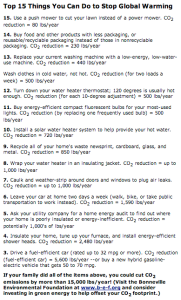
If one million households strictly follow these rules, it would impact the annual U.S. GHG production by less than 0.1%. This realization really affected me. It left me feeling helpless and hopeless. If individual action doesn’t help as much as I though it did, then what can I do? The answer to this question is unknown. Environmental action is one of the most convoluted and frustrating subject I have ever experienced…and I’m only a first-year student. Even by participating and majoring in the environmental studies program here at Lewis and Clark, I still will not hold the answer to the environmental issues at hand. This thought is daunting and disappointing.
I expected to be able to contribute to “saving the planet” throughout my duration in college just by participating in the environmental action community and by majoring in environmental science. This is not the truth that I have come to realize. This expectation was not at all realistic. Although individual action is still something to participate in, it is definitely not the sole solution to the thousands of intricate problems and variables surrounding the environment. How can I contribute? Will I ever be able to contribute? These are the questions that have been haunting me since I arrived on campus. So far, my education in the subject of environmental studies has left me void of all expectation.