
For this post, I have adapted my ideas from an ENVS class last week. The class was about a chapter from Environment and Society: A Critical Introduction by Paul Robbins, John Hintz, and Sarah A. Moore. The focus for the chapter was on the bluefin tuna. As I read through this chapter as well as reflected upon it, I realised that I had a passion for the ocean and its inhabitants.
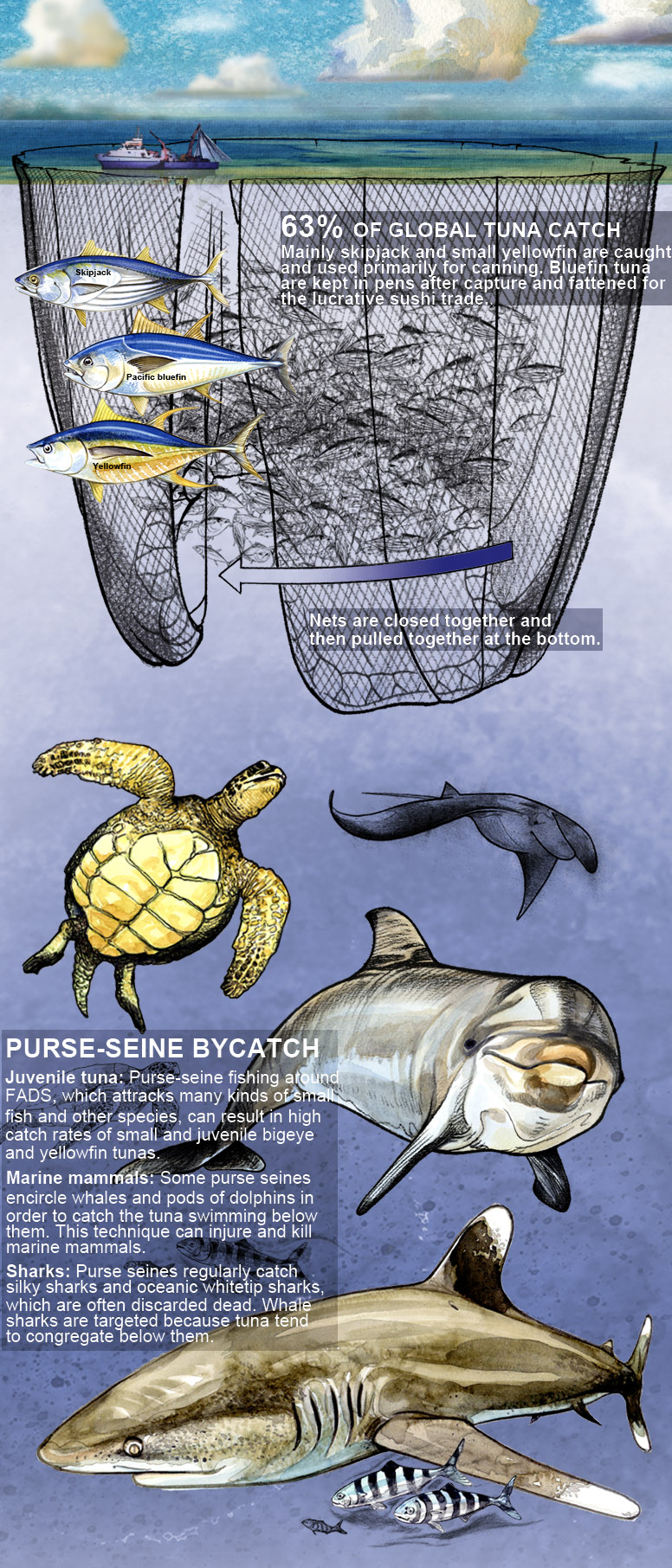
Overfishing has been going on ever since our populations have grown to demand more and more fish. As a result bluefin tuna, along with many other organisms, have greatly suffered. The problem is, fishing techniques have been advancing to gather more and more fish without any thought to the by-catch that comes with it. The techniques they use, such as Purse seine fishing and bottom trawling to name a few, gather up fish as well as a significant amount of by-catch, and the media is paying attention. This is what Sam LaBudde, Goldman Prize winner, successfully captured on video. Although by-catch is definitely an important aspect to consider when thinking about overfishing, I believe that the big picture here is that big populations of fish are dropping significantly. As we continue to fish the bluefin tuna before the populations can renew themselves we are essentially driving it to the point of extinction. Let that sink in.

During my first semester at Lewis and Clark, I took Biology 151. In the class we watched a documentary called The End of the Line by Rupert Murray. During the documentary, they discussed why the bluefin tuna populations were being overfished. A big part of it is supply and demand. The consumer’s demand is so high that the industries tell their fisherman to get more fish even if they are taking the fish before the population can renew itself to its normal size before they extracted them the first time. The fisherman are controlled by the industry, and they are required to meet a specific quota in order to keep their jobs. This means that even though fish populations are dropping, fisherman my fudge the numbers on the amount of fish they were able to catch in order for the industries to think they are still meeting their quota. This gives a false sense of hope of a stable fish population size to the consumer. This means that right now we are using fish as if they are an infinite resource, when in reality it is a finite resource.
Also in the documentary was a rumor about a company in Japan that has been buying a lot of bluefin tuna. Their idea is to buy up all of the blue fin tuna, freeze them, and then keep them in storage. Why would they do this if the tuna populations are dropping? An assumption is that if they buy the tuna now it will be worth so much more when the population is extinct. In 2013 there was an auction that sold a bluefin tuna for $1.76 million dollars.
So how do we battle overfishing? What should the solution be? There are people’s jobs and their livelihoods on the line. One method used to mitigate the decline fish population is called aquaculture.This method allows us to grow our own fish and then send them to the market, eliminating the need to fish them from the open ocean. If we can grow our own fish to bring the populations back to the levels they could be then we should be fine right? Well, there are pros and cons to aquaculture too. Yes, it brings more jobs, and more fish. On the other hand, some of these these fish are most likely genetically modified to have more nutrients, more flesh, bigger size etc. They can also be fed antibiotics to prevent the spread of disease through their cramped living conditions. (Don’t even get me started about the use of antibiotics.)
One of the other documentaries that have made an impact on my passion for the ocean is the documentary Mission Blue by Robert Nixon and Fisher Stevens. The documentary features Sylvia Earle who is a renowned marine biologist. This documentary also had a focus on the bluefin tuna, as well as other problems occurring in the ocean such as pollution. Sylvia explains how she grew up with the ocean, and spent years studying how humans have impacted its waters. She thinks about what we need to do to stop the damage and begin to restore the ocean biomes. It was through her experience-based perspectives of the ocean that I found I could connect to the ocean and its inhabitants. I began to consider my connection with the ocean and what I can do to make a change.For instance, I have never liked seafood, except for the occasional salmon dish, but I intend to stop eating salmon as well. When I go to beaches I always pick up as much trash as possible. My freshman year of highschool I gave a speech to the entire school about ocean gyres and how there are mass amounts of trash accumulating in them. I wanted everyone to hear and learn about our human impacts on the ocean and the damage we have caused. Reflecting upon this now, I want to continue to spread as much knowledge as possible. Hopefully that can be the first step towards making a change.