
The first half of Saturday I zipped over to the Colombia Slough Watershed Council in North Portland, which monitors the water quality in the Willamette and (primarily) Columbia watersheds — all surface water in the Portland Metro. area. They were hosting a “Slough 101” workshop which Jessica Kleiss (one of our ENVS faculty on campus, of whom I’m assisting in some ecoroof research) forwarded me news of. Am I ever glad I made it over there! Every time that I manage to take myself off this campus on a little adventure like this one, I get totally stoked, once again, to be here in Portland and at Lewis & Clark, engaging in connections that excite me.
In this second half of Saturday I have been immersed in trying to make sense of how this experience is helping me to ground my solutions project in the context of a Portland place. Here is a blog-thought about it.
Being able to ponder and produce theoretical models to describe the world is an important and privileged opportunity of the reclusive academic environment. At the same time, it is so important to ‘get out’ and listen and learn from the frictions of what’s going on outside of the Palatine Hill thought bubble. What is the discourse and infrastructure of water pollution control, as dictated by the practices and goals of existing institutions? Who are the people talking about it, and who is making these big decisions?
Informing myself with theoretical models only yields practical benefit when I practice their integration into contemporary situations. When I contextualize a broad, umbrella problem (like anthropogenic pollution of the hydrosphere; what makes up the discourse and identity of pollution?) into a place, it creates the potential for action. Fundamentally, that is probably why the human experience governs itself; the institution of government is our current solution to the problem of creating developments and progress that is of interest to — well, hopefully the plebiscete, but whoever has the authority of decision. Situating my problem means I get to evaluate how my methods and foundations of thought may or may not realistically align with the place of contemporary and local social institutions and their discourses.
Thus, this morning I realized how much more practical my small, ideological solutions project might be if I reach out into the surrounding communities to gather an understanding from their perspective — to listen, and then to consider the local situation by establishing comparisons and striating its component layers.
My theoretical solutions must be informed by present circumstance if it is to be of any potential or desireable impact. A degree of humility is also necessary; although I may sit in an opportunistic space of thought, I am a new and inexperienced mind that might meet a great deal of resistence if I don’t come from a place of inquiry. My best courrse of action is presently non-assertive, and of thoughtful, somewhat neutral examination. Indeed, as I am getting a hang of the ENVS 160 uprooting, I realize that growth of thought requires leaving pre-existing socialized notions at the door, so to speak.
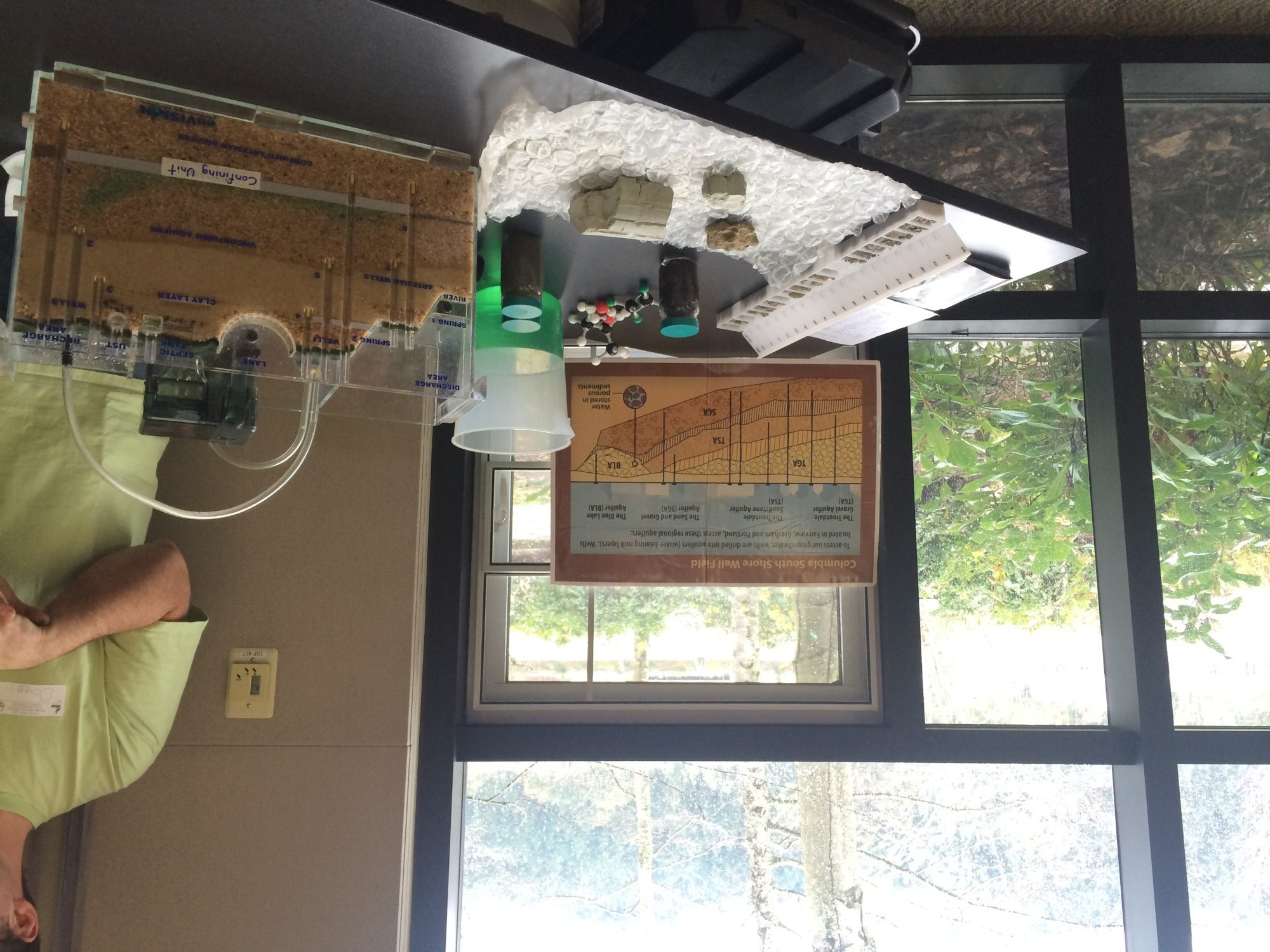
I listened a lot this morning to people from the Watershed Council, the Multnomah County Drainage District Flood Protection, the Bureau of Environmental Services, the Portland Water Bureau, and the Bureau of Planning and Sustainability. We got to learn like the kids of Columbia Watershed elementary school’s do, checking out macroinvertebrates and doing simple visual tests to estimate dissolved water concentrations in Willamette river water samples. I met some awesome people doing cool things — for their work! These people are the ones caring for the Portland watershed by advocating intelligently within the institutional systems of education, political economy, etc.
I absolutely love getting to experience what is going on in my greater Portland community and to talk to people with boots on the ground — I mean, in the sludge! Then, retreating back into the thought bubble of the academy, I am learning the vocabulary and skillset that will allow me to engage in a productive way in this discourse, potentially within these institutions. More importantly, I think, I am gaining the ability to interpret the unspoken theoretical and social undercurrents which structure the ‘issues’ of water pollution, and I am understanding how to examine the behavior of so-called environmentalists; it’s easy enough to say “Bioswales are so great, so glad you’re doing that — I’m in!” But it is so much more gratifying and beneficial if I’ve examined, to the best of my capacity, the role of the bioswale in the discourse of water pollution and, from it, determined that it is indeed a recommendable solution. Who and what might the construction of bioswales change within this part of Portland? In what other other ideas and groups of people might institutional investment be necessary to creating viable and long-lasting solutions — ones that include, but do not stop, at the bioswale?
In a suddenly great revelation, I realize that the very frustration which has been nibbling at my spirit — that I am too steeped in thought, disengaged from the world — is my new source of gratitude and inspiration. My action, my development of solution, can for right now stay in the place of thought.
I am examining non-point source pollution in the Portland metropolitan areas, with a particular interest in how the incorporated watersheds (defined by topography) have been and are recreated, managed and governed by social institutions which populate the urban limits (defined by political district lines, Census Bureau). A (yet malleable) solution is to establish a standard of 15-25% change of land permeability for all new development projects, an initiative which is supported by existing practice and assumptions of pollution prevention and control and will thus offer a realistic ‘stepping stone’ effort towards a system of total containment and processing of non-point source pollution from the Portland urban landscape.
I am also wondering about how different people perceive themselves as a part of the watershed and greater water cycle.
Many thanks to Hannah Smay for brainstorming with me!