Who Rules the Earth by Paul Steinberg portrays that our climate is warming and our forests are being diminished. News with ecological crisis are extremely prevalent and seem to be the main focus as we look towards accomplishing sustainability by doing the little things like recycling and composting. While these are important steps, are they enough?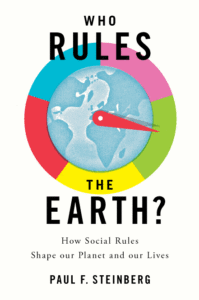 Steinberg shows that a shift towards sustainability requires the world we live in to modify its human behavior and the rules with which we use as a guide for these behaviors to shape the way we interact with the Earth. These rules are portrayed through things like public policies and cultural norms and while these rules might not be explicitly visible, they make a great impact on how we interact with and treat the planet. By changing these rules, we have the ability to make great impacts on the well-being of the Earth for the future generations of humans and wildlife that inhabit the planet we live on. By illuminating the influence of social rules on all levels of society, from private property to dynamics of innovation within corporations and communities, we are able to establish that achieving and talking about sustainability is not just a personal or individual level choice, but is a political struggle that is dealt with worldwide.
In order to move towards a global-scale change, we need to understand who is making these social, cultural, and economic rules we follow and how they might be influenced to make change. Steinberg points out that, “to create lasting change, we need to embed sustainable practice within broader sets of relationships involving people whose principal goals may have little to do with sustainability” (Steinberg, 2015). This means that multiple parties who might have different goals in mind need to come together to have a discussion about sustainability in order for it to be feasible in the future. We also need to acknowledge that in order for change to happen, we need to not only break and reformulate the rules we live by, but we need to create new ones that break our old habits and allow us to be creative (Steinberg, 2015).
As an individual, it is hard to personally change the social rules with which we live by in order to make global change since my scale is personal and individual. I can continue to do small things like recycling and buying organic foods and composting and work within the realm I’m in while making sure to think about how my actions can contribute to a global-scale impact. Academically, we must continue to learn about our social rules impacting the environment in both positive and negative ways so we can think about and alter the confines with which we operate in. If we do this, we might be able to reach out to a wider audience and change these habits we have conformed to in order to create a more sustainable world for the future generations. It is also important to recognize that young people of my generation are getting more involved in politics which means that we are reaching a step forward to bridging that gap between individual and communal when trying to change the both the rules we follow and the rules that regulate those rules. As we bridge the gap, we will be able to make progressive steps to working out our “ruts” as Steinberg calls them, and achieving ecological change that will hopefully better our communities and the natural environment we call home.
Sources
Steinberg, Paul F. 2015. Who Rules the Earth?: How Social Rules Shape our Planet and our Lives. New York, NY: Oxford Univ. Press.