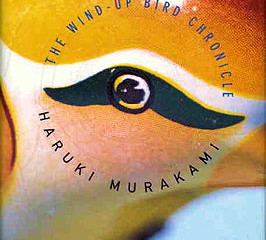
Over the weekend, I finished Haruki Murakami’s wonderful novel, The Wind-Up Bird Chronicle. It is a book about a lot of things, but most importantly it’s a commentary on human suffering and a portrait of modern Japan. This may not directly stand out as an environmental text, but I found several interesting parallels between the novel and how we approach problems in environmentalism. In particular there were interesting parallels to Ken Wilbur’s integral theory.
In the novel, Murakami weaves together several different narratives from different perspectives in order to create Toru’s overarching narrative. On one level is the emasculated Toru spending his days trying to find his cat. On another thread is the mystical, dream-like powers of Malta Kano. Lieutenant Maiyma’s World War II war stories about the well and the manskinner. Creta Kano’s defilement and experience with pain. May Kasahara’s teenage angst and anger with her past. The boy who is led to his father’s death by the eponymous wind-up bird. Nutmeg’s story of her father and killing zoo animals in the war. The guitar playing magician. Noboru Wataya’s rise in power and fame. All of these story threads present a different angle that show this ubiquitous suffering present in every story.
In terms of integral theory, any one perspective isn’t enough. Every angle need to be examined to gain understanding. Wilbur splits this into four quadrants, interior vs exterior and individual vs collective. Starting with exterior collective, this perspective is demonstrated in this novel through the vast historical references. These place Japanese citizens in a historical perspective that grounds every story and provides a basis for direct or indirect suffering for several characters. Moving to the exterior individual perspective, this book uses details to describe how characters dress and project. Toru wears his sweatpants, Malta wears her vinyl red hat, and Cinnamon is always prim and proper. The personal actions of characters also describe how each person expresses their character. The interior individual is where many of the most interesting parts of the book play out. Many of the most important scenes take place in a subconscious, dream-like state where reality is uncertain and the physical and mental are deeply intertwined. This explores how characters self-identify and the power/powerlessness they experience.
Finally is the interior collective. This quadrant is much less explicitly explored, but is evident upon reflection. A prominent figure in the book is the “something” that lives in Creta, Kumiko, Kumiko’s sister, and the patients of Nutmeg. The book doesn’t define what this is, but is seems that it is some interior pain that is collectively shared. My interpretation is that this is the suffering that lives in everyone.
All these perspectives are interesting on their own, but do they work together to create an understanding and a solution? Well, yes and no. They are definitely more than a sum of parts; each perspective enlightens each of the other perspectives, but the book finishes with more questions than answers. A lot of specifics are intentionally left vague, relationships are not defined, and none of the characters get a proper conclusion. Sure the suffering in Kumiko may be lifted, but she remains in jail with no guarantee that she will remain with Toru. May’s future is still undecided. And the rest of the characters just disappear.
This big problem of human suffering is enlightened through a multitude of perspectives, but the solution at the climax doesn’t solve much at all. Environmental problems are similarly complex with hundreds of perspectives that help in understanding, but solving them won’t happen just like that. Yet, a comprehensive understanding can help improve a small part of the whole.