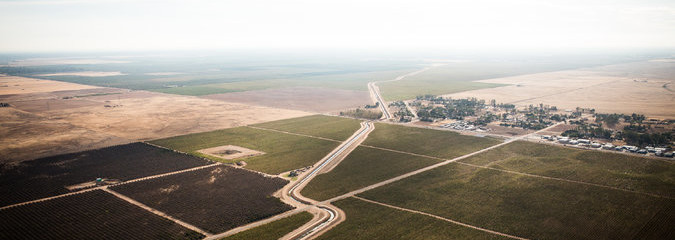
DESPITE the four-year drought that has parched California and led to mandatory restrictions on water use, farmers there have kept feeding the country. California produces more of 66 different food crops than any other state, $54 billion of food annually.
Maintaining this level of productivity has been quite a challenge in recent years and is likely to become more difficult over the next few decades as weather patterns, available water and growing seasons shift further and threats of invasive weeds, pests and pathogens rise.
If agriculture is to have any chance of answering these challenges, we must have new and improved techniques and technologies. The problem is that agricultural innovation has not kept pace.
The last time our nation was in a similar crisis was just after the Dust Bowl years in the 1940s, but the country’s agricultural science enterprise was in much better shape. At that point, almost 40 percent of American research and development spending was focused on agriculture. This ambitious embrace of research was part of the “green revolution” that significantly boosted agricultural output around the world.
Today, farm production has stopped growing in the United States, and agriculture research is no longer a priority; it constitutes only 2 percent of federal research and development spending. And, according to the Department of Agriculture, total agricultural production has slowed significantly since the turn of the century. We need another ambitious surge in agricultural science.
Consider the avian flu epidemic, in which more than 48 million birds were killed — 30 million in Iowa alone — because the only way to control an outbreak is to eradicate a farm’s entire flock. The Agriculture Department recorded only 219 birds that were actually sick with the flu. The $3.3 billion in losses have led to a search for a better method of controlling the virus than killing a farm’s flock because of one sick bird.
History has shown that science can solve the nation’s agriculture and food production problems, but to do so, the American system of food and agricultural research must be substantially reinvigorated. Research can tackle how to grow more food with fewer resources under increasingly difficult growing conditions. But this can be accomplished only if more of the brightest minds are engaged with enough funding to pursue transformative ideas.
While private sector research and development in agriculture have grown over the past decade and now exceed what is federally funded, this financing is focused on shorter term benefits. On the other hand, more than 80 percent of federally funded research is designed to provide the building blocks for long-term production increases to address the many problems we face in the decades ahead. These problems have been amplified by climate change and the demands of a growing global population.
Experience has shown that the best way forward is funding research through a competitive process, with projects selected through a peer-review procedure that excludes politics. There is a program in the Agriculture Department that embraces these tenets, the Agriculture and Food Research Initiative, and its research grants show great promise.
New, hardier varieties of corn are being developed from tropical species that can better withstand heat, drought and changes to the environment. The probiotics found in fermented products like yogurt are being tested toreplace antibiotics used in animal husbandry. And nanotechnology and electrified micro-coatings of water are being applied to some produce, toprevent food poisoning. Government research is even exploring how to double the rate of photosynthesis and eliminate the need for pesticides.
The potential is great, but the program has never been fully funded. Despite a $25 million increase in the omnibus budget agreement, the budget of the department’s research initiative sits at half of what Congress authorized in 2008 when it created the program. In the 2014 fiscal year, the program’s peer-review process identified approximately $1.1 billion in grants as worthy of funding, but the program could dispense only $270 million. We cannot kindle the next green revolution if we treat roughly three-quarters of a billion dollars in worthwhile scientific ideas as if they were table scraps.
Throughout humanity’s existence, farming and food production have always benefited from innovative solutions that solved challenges and looked beyond the horizon. Now more than ever, we need to embrace 21st-century science, fund it and turn it loose so we can develop better methods of putting food on the table. Our world is changing; the way we grow and produce food needs a much richer diet of scientific ingenuity to keep pace.