The ENVS Experience

Blake Slattengren's Student Site

  • Courses
    • ENVS 160
      • Synthesis Posts
      • All Posts
    • ENVS 220
      • Synthesis Posts
      • Lab Posts
      • All Posts
    • ENVS 330
      • Goal Posts
      • Normative Research Project
      • Research Proposals
      • All Posts
    • ENVS 499
      • All Posts
    • SOAN 110
      • All Posts
  • Projects
    • Unsettling Sustainability
    • Urban Green Spaces and Development in Portland
    • Second Hand Stores in Portland: An Analysis of Consumer Values on Yelp
  • Concentration
  • Capstone
    • Portfolio
    • Actor Network Map
    • Annotated Sources
  • All Posts
  • About
You are here: Home / Posts / ENVS 400 / Concept Mapping – What’s In An Actor?

Concept Mapping – What’s In An Actor?

November 2, 2017 By Blake Slattengren

This week I dove into my first situated context: precision agriculture in California. Through this process I created an Actor-Network map:
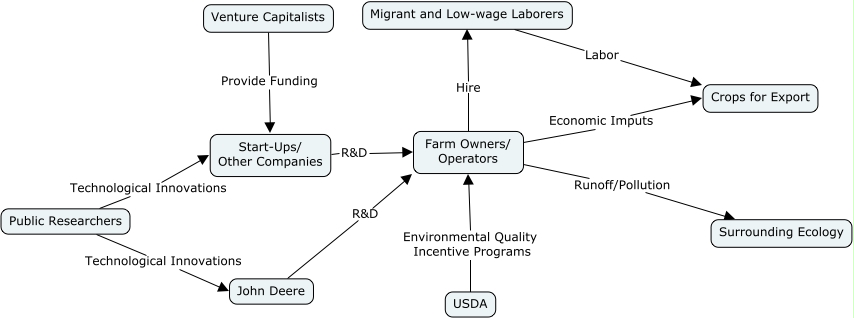
This really helped to organize my thoughts around California agriculture and got me to think about several actors and relationships that I need to research further. A big actor that has currently been mostly absent from my research is the USDA I have also considered policymakers as part of my capstone, but I didn’t really know what that looked like until looking at USDA’s Environmental Quality Incentive Programs (EQUIPs) which provide incentives for precision ag technologies on the basis that they decrease pollution/runoff in the surrounding environment. I plan to look further in this incentive program and look for other applicable regulations or incentives that might encourage or discourage technology adoption.

This concept map also helped to start thinking about the key differences between California and India. One key difference that was highlighted was the relationship between farm owners and laborers. Namely, India has many, many more people involved and willing to be involved in agriculture. This is a huge barrier to precision agriculture adoption, as the technology can replace low-level jobs. In California, this is a plus as there are less migrant laborers than ever, but in India, this may be a big disincentive. Another huge difference to account for is the sustainable development problem of food security, which is much bigger in India. I’m not sure yet what role precision technologies can play in establishing food security, but it will be an important dimension going forward.

Overall, I feel a lot more secure in my situated context after this activity, and it highlighted a number of areas for which I will need to focus my attention. In the near future, I will need to make an actor-network map for India and will continue to update this actor-network map as I learn more through my research.

Share this:

  • Click to share on Facebook (Opens in new window)
  • Click to share on Twitter (Opens in new window)
  • Click to share on Google+ (Opens in new window)

Related

Filed Under: ENVS 400 Tagged With: AgTech, California, Labor, Precision Farming, USDA

About Me

I am an undergrad student at Lewis and Clark college majoring in Environmental Studies and minoring in Chemistry. You can read all about my studies and adventures here.

View My Blog Posts
Mt Rainer, WA
Seattle, WA
Portland, OR
Portland, OR
Mt Defiance, WA
Lookout Mt, WA
Mt Dickerman, WA
Seattle, WA
Portland, OR
Pendelton, OR
Canyonlands, UT
Delicate Arch, UT
Flower in Moab, UT
Parma, ID
Alpine Lakes Wilderness, WA
Seattle, WA

Post Categories

  • Posts (97)
    • Concentration (15)
    • ENVS 160 (13)
    • ENVS 220 (30)
      • 220 Synthesis Posts (19)
      • ENVS Lab (8)
      • PDX Project (6)
    • ENVS 330 (14)
      • Goal Posts (6)
      • Normative Research Project (2)
      • Research Proposals (3)
    • ENVS 400 (12)
    • ENVS 499 (6)
    • Other (12)
    • SOAN 110 (5)

Old Posts

  • December 2017 (3)
  • November 2017 (4)
  • October 2017 (5)
  • September 2017 (2)
  • January 2017 (3)
  • December 2016 (2)
  • October 2016 (1)
  • May 2016 (4)
  • April 2016 (6)
  • March 2016 (7)
  • February 2016 (6)
  • January 2016 (4)
  • December 2015 (5)
  • November 2015 (11)
  • October 2015 (14)
  • September 2015 (7)
  • April 2015 (5)
  • March 2015 (4)
  • February 2015 (4)

Tags

Agriculture AgTech Anthropocene anthropology Autonomous Technology Big Data brainstorming California Capstone Concentration Conducting Research Environment Across Boundaries Environmental Literature Environmental Theory ENVX Equity Food Framing Question GIS GMOs Interviews Kale Lab Report Lewis and Clark Midterm Reflections Nature PDX place Precision Farming Purity Questions Research Outline scale Startups statistics Sustainability Assessment Sustainability in Higher Education Symposium Technology Tech of the Future The World Without Us Urban Greenspaces urbanization western apache Wilderness

Digital Scholarship Multisite © 2018 · Lewis & Clark College · Log in