
Digitizing Agriculture: How Big Data is Changing the Landscape for Sustainable Development in California and India
Blake Slattengren
ENVS 400
2017-18
Agriculture is a dynamic field where technology and sustainable development intersect. Big data is one such technology that is growing in popularity and promises radical changes to agriculture expressed through company advertisement. Through content, statistical, and discourse analysis of agriculture data company websites in California and India, big data has shown potential positive impacts on economic growth, food security, and water availability, but potential negative impacts on equity, labor, and security. I propose these as areas to target for responsible technology adoption.
Outcomes:
Background
In what ways does new technology adoption further or inhibit sustainable development?
The above framing question takes on added relevance when discussing artificial intelligence, 3D printing, advanced synthetic biology, and other technologies that comprise of a new wave technological development, dubbed the fourth industrial revolution. Proposed by economist Klaus Schwab, this revolution promises radical social, economic, and environmental changes that will redefine relationships between people, technology, and environment (Schwab 2017). One particular technology that is already making huge changes in business operations is big data, a technology that collects and analyzes vast amounts of data in order to improve efficiency and decision making (Cukier and Mayer-Schoenberger 2013).
How these new technologies will change the world is a highly contentious topic (Schwab 2017). However, some scholars, business people, and governments present these technologies as ways to meet sustainable development goals. Sustainable development is a concept that suggests ways for nations to develop in a way that acknowledges the connections between human rights, economic growth, and environmental changes (Redclift 2005). The current global standard for sustainable development is the United Nations Sustainable Development Goals, as outlined in the 2015 report, Transforming Our World (Transforming 2015). While these goals are broad, vague, quite optimistic, and maybe not particularly useful for many countries (Holden et al. 2017), they do provide a good framework for understanding our modern world and general, global goals.
The UN’s sustainable development goals are also quite ambitious and will be difficult to meet. New technology, however, is one proven way to meet goals through driving economic growth (Sachs 2015). Beyond economic growth, many new and emerging technologies also promise sustainable development through higher efficiencies and clean energy development. Yet, while the benefits of technology are huge, drawbacks are sure to accompany any new technology (Sachs 2017). With the fourth industrial revolution on its way, it follows to question how new and emerging technologies may help nations meet the UN’s lofty sustainable development goals and what sort of drawbacks may result. As governments, businesses, or engineers, we have the ability, or perhaps even responsibility, to control new technology adoption in a manner that maximizes the positive sustainable development effects while minimizing the negative effects.
Situated Context
I explore this framing question in the particular context of data and analytics technologies in California and India.
Both California and India are an interesting mix of large cities, economic development, and ample space for agriculture. They both are important players in the global AgTech scene, but they represent countries with vastly different development contexts, making them unique places to study sustainable development goals. One currently active field in AgTech is data technologies, such as internet of things and data analytics technologies. Many farms in both of these locations have already adopted these technologies and further adoption is predicted.
Actor Network Map
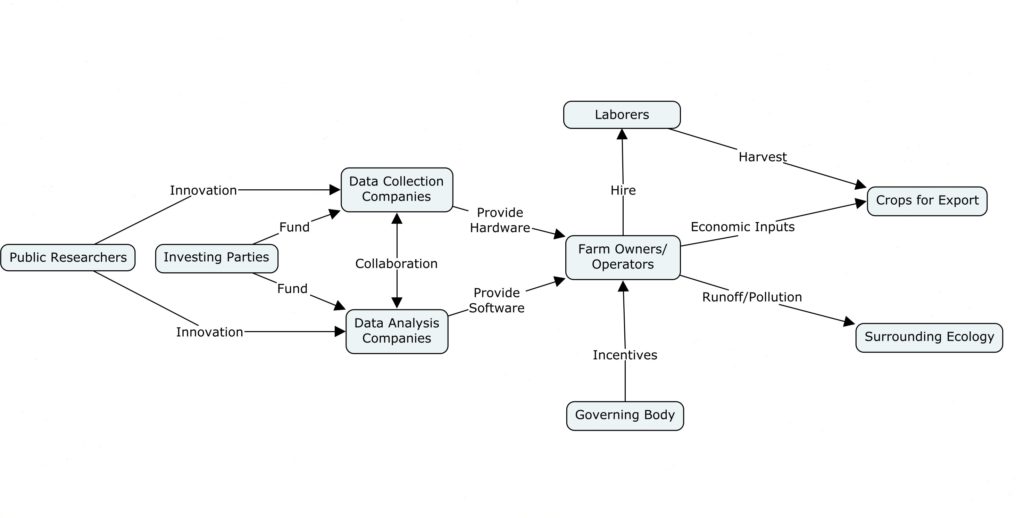
General actor network map for Ag Data development and adoption
California specific map and analysis - Read More
India specific map coming soon
Project Research
Focus question: To what extent are sustainable development goals addressed by big data agriculture companies in California and India?
This question sets out to measure how big data in agriculture is treated as a way to meet sustainable development goals and the following implications. Similar studies have interviewed farmers or conducted ethnography (Carolan 2016; Crane 2014), but I hope to look at this question through the movers and shakers: startups.
Through content, statistical, and discourse analysis of agriculture data company websites in California and India, big data has shown potential positive impacts on economic growth, food security, and water availability, but potential negative impacts on equity, labor, and security.
I first analyzed found ag data startups through the Crunchbase database. Crunchbase itself is a data company that is a crowd-sourced database of companies and investments. Given that it is crowd-sourced, the information I found was not always up-to-date and companies, especially smaller ones, may be missing. However, Crunchbase provided an easy way to search for and analyze ag data companies. Through this database, I found 17 relevant ag data companies in California and 7 in India along with useful statistics on the headquarters location, total funding, year founded, and more. From this information, I was able to create visual representations of where these companies were found and conduct statistical analysis.
Once identifying companies of note, I went through every company’s website and conducted content analysis of advertised sustainable development values. I used the UN’s Sustainable Development Goals framework to count values, with the one exception of splitting up economic growth and decent work into separate values, as I found them to be unique concepts expressed differently by ag data companies with one focused on the farm owner and the other on others laborers. The majority of values were expressed on company’s homepages, but I also went through other relevant, main webpages such as “About”, “Solution”, or “Technology” in order to find all relevant values. I both counted instances of values and also collected all value-expressing phrases to be analyzed through Voyant Tools word analysis software.
Finally, I took a deeper look at two companies of interest: The Climate Corporation in San Francisco and CropIn Technologies in Bengaluru. These two immediately stood out for further analysis because they were among the biggest companies working in ag data and had websites that were full of material for discourse analysis.
Implications
Comparison of Results
Big data is certainly only becoming more of a mainstream practice in agriculture and will continue to influence sustainable development goals. In an ideal world, big data will make agriculture run as efficiently as possible while minimizing inputs and food waste and maximizing farmer profits. However, social, economic, and environmental pressures complicate this perfect situation, and I agree with research highlighting labor and equity as two large concerns with ag data technologies. Labor, I would argue, only seems to be a huge problem if adoption of the technology is rapid, as agricultural labor is already decreasing globally. Ag data could, though, contribute to significant inequities between farmers that can afford the best data technologies and those who can not. Though some companies are addressing this issue, inequalities will serve to further drive division between large, industrial farms and small, more traditional farms. Another concern raised by literature that was fairly absent in my results was data security. Many farmers were concerned about their data getting in the hands of agribusinesses who could take advantage of the data (Carolan 2016). A couple companies in California addressed this, but it was largely absent from the discussion.
Application to Framing Question
Overall, big data is a tool that can help countries work towards sustainable development goals, such as economic growth, food security, and water availability. However, developed countries are likely to be better served by the technology currently due to increased technology infrastructure and having less agricultural labor. Also, equity, labor, and data security are all areas where big data may actively work against sustainable development goals. Businesses, governments, and researchers have a responsibility to promote responsible technology adoption. Several possible ideas for this include increased diversity in the ag data industry, policy that supports equitable access to technology, or development of better encryption software.
In addition, these are not problems exclusive to ag data. Labor, equity, and security are all sustainable development problems that plague technology adoption in general and are predicted to be major drawbacks of the Fourth Industrial Revolution (Schwab 2017). Businesses, governments, and researchers will have to engage directly with these issues moving forward, but through proactive technology adoption, drawbacks can be minimized.
Next Steps
Governments should consider promoting responsible technology adoption by properly incentivizing ag data adoption. Incentive programs for data technologies already exist, such as the Precision Farming Incentive under the the Environmental Quality Incentive Program for the United States Department of Agriculture. This incentive program is great for decreasing pesticide use with GPS-enabled machinery. However, I would recommend expanding this program to include additional technologies, especially data analytics technologies, with additional goals such as decreased water use. I would also recommend increasing incentives to smaller farms with less access to ag data technology and creating the ability for disincentives if labor displacement becomes a larger problem. With these adjustments, this incentive program can address the problems raised in this report.
For ag data companies, labor and equity are concerns that threaten the long-term longevity of their businesses and should be actively engaged with. Most importantly for companies would be ensuring that ag data is accessible to farms of different size, location, and profitability. Programs such as Climate Corporation’s FarmRise Mobile Farm Care app are a great example of ways to engage a greater number of farmers with ag data. In addition, diversity of company location and personnel should be increased in order to bring new perspectives and ideas to ag data.
For farmers, ag data represents a way to save money and run their farm more efficiently, but adoption of the technology should be carefully considered depending on the specifics of both the farm and the technology in order to ensure effective use of the technology. I also encourage increased support and growth of farmers rights and ag data adoption advocacy organizations, such as AgGateway and Open Ag Data Alliance, who successes so far. These two organizations are based in the United States, so creation of additional organizations focused in different locations globally is critical as well.
Further Research
In order to promote the responsible adoption of ag data technologies the following steps can be taken. First, before any practical policy recommendations can be issued, further research should be done to address how companies advertised sustainable development values translate to actually meeting stated goals. This would ground sustainable development discourse with indicators that prove effectiveness of ag data. Different locations should conduct this analysis in order to see the effectiveness in various contexts.
In addition to this, further studies can look at the sustainable development impacts for big data in other industries, such as energy, forestry, or education. Big data is emerging as an important technology in a many contexts and the methodological framework here can be applied to any industry with big data startups. Beyond big data, this framework can also be used for any number of technologies that are coming in the Fourth Industrial Revolution where technology adoption is driven by startups. Research in these different contexts will further explore the relationship between technology adoption and sustainable development and show trends in the sustainable development values that will be benefitted or hindered by emerging technologies.
References
Project Post Archive

Notes From Data Collection
I am currently in the middle of data collection, digging through Crunchbase finding Ag Data and Precision Ag companies. I have just about wrapped up California companies, finding and coding for 24 different companies. However, three of these companies were no longer active or difficult to find data for and four companies focused on something other […]

Time for Data Collection
This past week I have been collecting data and settling on interesting and doable methodology. My focus question is currently set as: To what extent have precision agriculture technologies been successful in achieving sustainable development goals in California and India? This question is driven by sustainable development goals and what current technologies are achieving. However, farming data […]

The Outline of an Outline
This week was focused on creating an outline that will be used for both the 5-page paper at the end of the semester and my final paper/thesis outcome. The following outcome was created with pretty strict adherence to the guideline for situated research as posted on the ENVS page. Outlining was helpful for identifying the […]

Time For a Timeline
As the semester is entering its final third, it is time to reflect on what I have accomplished so far and what else I will need to do for the rest of the semester. So far, I feel that I have a framing question and a solid base of research that forms the basis for […]