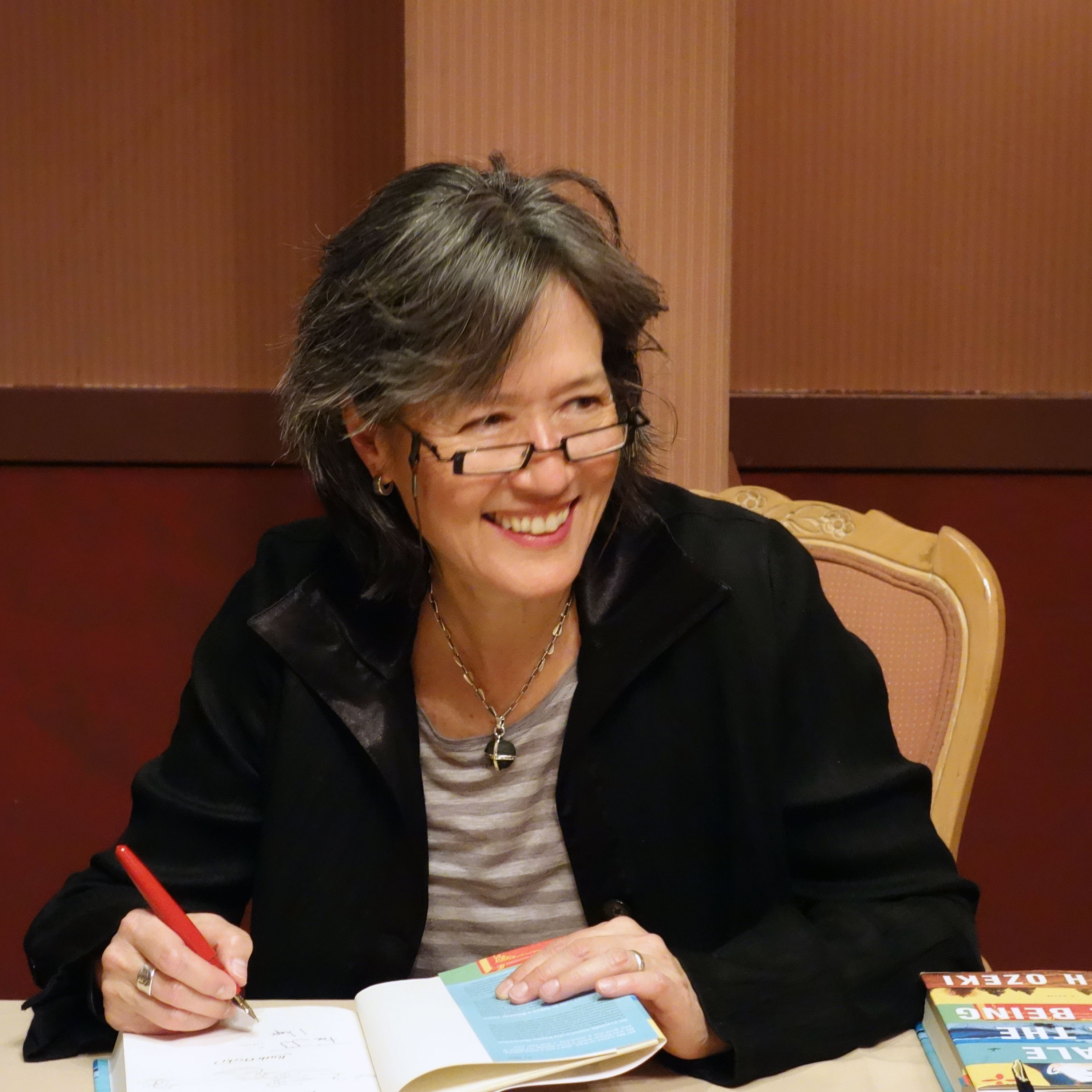
For my goal this week, I collected author statements from Ruth Ozeki from interviews and her biography that inform her work. In Ruth Ozeki’s author statements about her philosophies of writing fiction and the origin of A Tale for the Time Being, she touches on many of the meta-fictional aspects I am interested in for my project.
Perhaps the most relevant part of the interviews was her story of how A Tale for the Time Being came into being. In fact, the book had already been written and submitted to her agent despite not being completely satisfactory. Then the earthquake and tsunami hit Japan and transformed the novel:
It was one of those catastrophic moments that sort of stops time,” said Ozeki. “It was very clear to me that I had written a pre-earthquake, pre-tsunami, pre-Fukushima book. Now we were living in a post world, the book was no longer relevant (OPB 2014)
Ozeki grappled with the question of how, as a fiction writer, she should respond to a catastrophe, even as it was still unfolding. By inserting her own semi-fictional self (complete with her husband and her cat) into the novel, she creates a story that blurs the boundaries between fiction and reality in a very self-aware and intentional way. She claims that the book is ultimately about the reader-writer relationship. I find this underpinning theme fascinating in light of how the book is also about many other things, including a huge seismic disaster that enables the event of the book both within the text and in its origin.
Both in this book and in other of Ozeki’s books, she represents many relevant (environmental topics) such as GMOs and natural disasters, but she claims that she does write as an activist and she does not “take this on with an agenda” (Wheeler Centre). This concept of writing with (or without) an agenda takes me back to an initial conversation I had with Jim Proctor regarding the agendas embedded in the public service announcements that began my interest in earthquake narratives. Instead, Ozeki claims that she writes for herself to understand something that she fears.
In an interview with the LA Review of Book, Ozeki discusses her interdisciplinary approach to writing novels, a statement that places the novel in an actor network. This attitude brings her philosophy of writing in direct engagement with the ENVS model and I suspect it will be a useful aspect of my analysis for this particular text.
Ozeki also discusses how the novel beholds a relationship between a girl and her grandmother, offering a peak into the cycles of time in which human knowledge circulates. This can be connected to the knowledge of the Cascadia event as it has been derived from stories of the past, distant in both space and time.
Ozeki’s statements and life are rich with material that supplements the analysis of her novel.