Natural Disasters
Earthquakes and volcanoes are as old as Earth’s crust, outdating humankind by a grand scale. Instead of human cultures developing towards crises, like in the discourse of classic environmentalisms, many human cultures developed around the natural hazards of their environments. These disaster cultures are the result of knowledge and memory of destabilizing events in the cultural conception of place.
I choose to focus specifically on earthquakes and their literature for three reasons.
- Earthquakes are among the least human-caused, and therefore human-blamed, events that threaten human systems.
- Earthquakes can be felt in human bodies and infrastructure. This infiltration is both threatening, connective, and acutely unpredictable.
- Although earthquakes have affected human culture since its beginning, recent earthquake catastrophes demonstrate a need for better mitigation strategies to address seismic risk.
The Pacific Northwest
Connecting the west coasts of the United States and Canada, the Pacific Northwest tops the list for unexpectedly high seismic risk. The Pacific Northwest stretches from Northern California through Oregon and Washington to British Columbia in Canada. The Pacific Northwest is adjacent to the plate boundary where the Juan de Fuca plate subducts underneath the North American plate. This convergent boundary is a mega-thrust fault, the type of fault that produces the largest earthquakes ever recorded. Because the modern Pacific Northwest has not experienced an earthquake and the historical memory of the indigenous people has been silenced as a result of colonization, the region lacks the earthquake culture to reconcile seismic risk with human lives.
Japan
Japan is located at the convergence of the Pacific Plate, the Philippine Plate, and two slabs of the Eurasian Plate – the Okhtotsk and the Amur Plates. The Pacific Plate subducts underneath both the Okhtotsk and the Philippine Plate, which subducts under the Amur Plate.Unlike the Pacific Northwest, Japan has a strong and historical earthquake culture.
I recognize the limitations of generalizing a culture according to regional or national boundaries. While I use the term “earthquake culture” to describe the societal adaptations to disaster including art and literature, I do not assume that the earthquake culture is homogenous across either Japan or the Pacific Northwest.
Earthquake Literature

Major Works
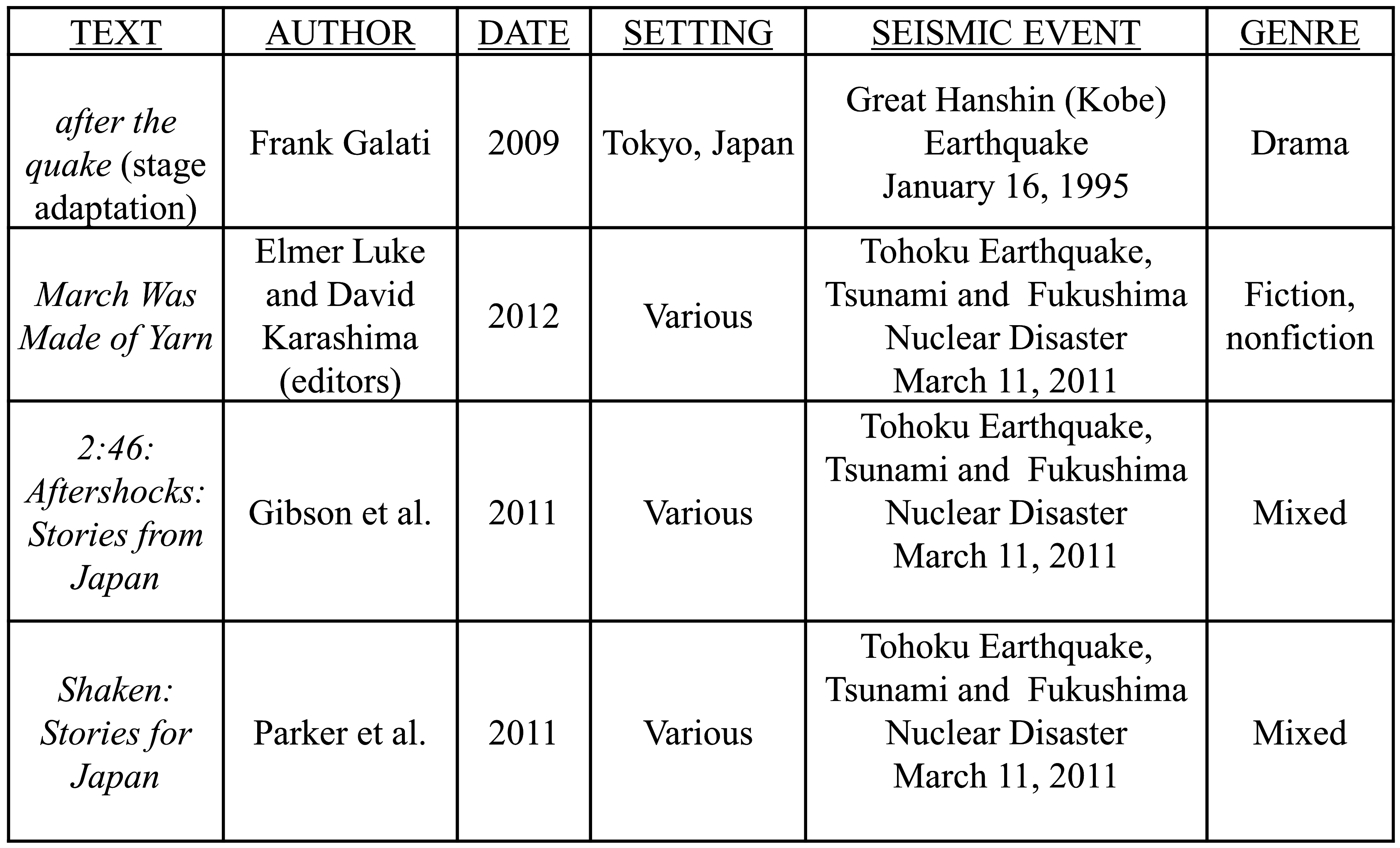
“Earthquake literature” isn’t a genre in the way of science fiction or modernism. My definition of “earthquake literature” considers any work that includes mention, portrayal, representation, or response to an earthquake of any size and sort. However, the texts that I chose to explore are more specific. Certainly, they include an earthquake as an important element of plot, but moreover, they must engage with a real earthquake either experienced or predicted. In this way, I am able track the earthquake’s connections within and without texts, thereby considering fiction part of the larger cultural treatment of earthquakes, and disaster at large.
Minor Works
There is no specific methodology established for the application of ecocriticism. I am guided by the theoretical framework I have defined. I ask: how and why do writers from Japan and the Pacific Northwest render earthquakes in fiction? My reading of each of my chosen texts is steered by two questions developed from my theoretical description of ecocriticism’s aspirations.
- What are the characteristics of the earthquake?
- What connections does the text express between the earthquake and non-humans, human characters, writers/authors, readers, and texts/stories themselves?
The first question addresses the crisis while second question addresses the actor network of connections that texts foster. Because the second question explores the concept of a fictional text as a network, I gathered statements from the authors of the texts regarding their own relationship with their work and the earthquakes they represent.