 Haruki Murakami is one of Japan’s most beloved contemporary writers. The Kobe earthquake stirred him to respond. Murakami wrote six short stories in a collection titled 神の子どもたちはみな踊る Kami no Kodomo-tachi wa Mina Odoru, literally translated as “The children of the gods all dance.” The English version, translated by frequent Murakami collaborator and translator Jay Rubin, was published in 2002 as after the quake.

Settings in after the quake
Though each of the stories takes place in the weeks between the earthquake and the gas attacks, the Kobe earthquake itself is peripheral to the stories. Mentions of the events appear on the television, in newspapers, and in the pasts and memories of the characters. Though several characters are originally from Kobe, only one seems to have strong ties to the place. The locations of the stories are spatially distant from Kobe, as shown on the map. By mapping the locations of the stories alongside the location of the earthquake, I visualize how indirectly the Kobe earthquake figures into the stories. While Murakami’s stories mainly depict either Kobe or a general sensation of an earthquake, super-frog saves tokyo anticipates a major, mythical earthquake on the cusp of tearing Tokyo apart.
My actor network shows how after the quake questions the boundaries between art and artist, blurring the worlds of the fiction. The stories bleed into one another – especially in an American stage version of the stories, shown in the box at the bottom. To draw upon Le Guin’s theory, the stories are each their own carrier bag within a larger carrier bag of the collection, which is within a larger carrier bag including the play. The stories and play are interior containers of narrative each spilling into one another. Like in dreams, the borders between what is real and what is fiction are permeable.
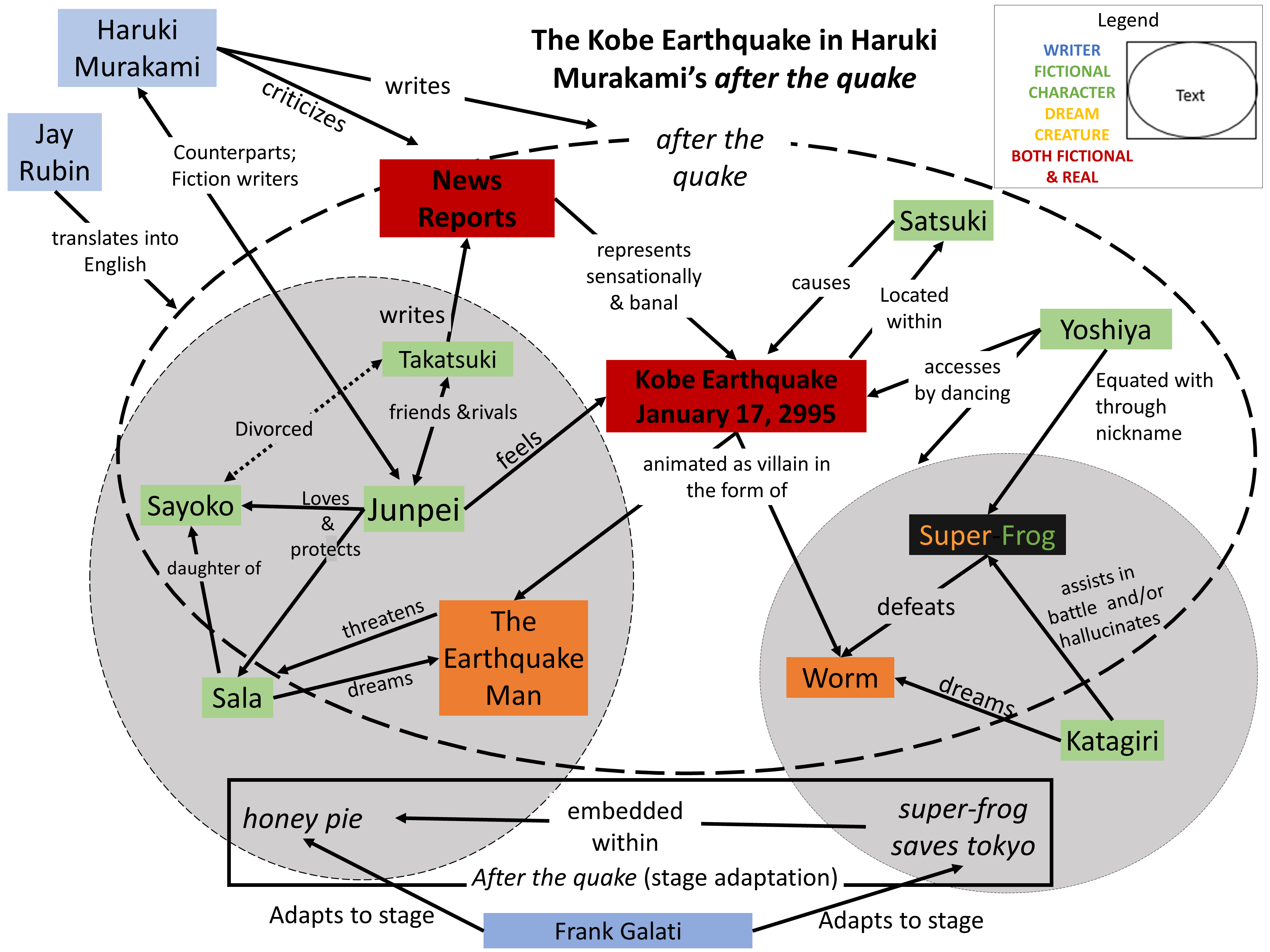
Actor Network of after the quake
Importantly, the most interior narratives are myths of earthquakes, one of a stone lodged in a woman’s body – Satsuki in the top right – and the earthquake-causing Worm. By placing the actual event of an earthquake at the very center of the narrative structure, Murakami reminds us that despite the details of love and ambition, the unsettling event of an earthquake remains at the heart of the art. All of the characters, texts, and authors are constellated around the central event of the Kobe earthquake. The character Junpei, a fiction writer, is an analogue for Murakami himself. He is highly sensitive to the physical and emotional feelings produced by the earthquake and he also narrates his own story in the stage version.
While the stories embed the real event of the earthquake into a fictional format, the art itself also becomes an actor barreling through space impacting other writers and artists. It is altered, adapted, and shaped into new forms for new contexts and different audiences. Like Junpei’s character in the play narrates and lives his life at the same time, Jay Rubin and the playwright Frank Galati are both reading and writing after the quake by translating it to a different language and adapting it to a different medium. This dynamism demonstrates a text essentially revising itself through different readings and readers.