At some point in the process of slogging though data early in this semester, I had an important realization about my proposed method of “The Qualitative Regression.” I realized my thinking that I could gather equivalent data on three separate cities in order that I be able to qualitatively regress them against each other was a flawed assumption. The reality is that I have a far greater level of detailed data available to me around Portland than I do for any other city. This is for two reasons. One, I have access to far more non-digital data about Portland to supplement my research—institutions such as the Oregon Historical Society, the Portland City Archives, and easier access to data collectors like the Oregon Department of Geologic and Mineral Industries has ensured that I have a much higher level of resolution in my Portland data than I can acquire for Ann Arbor or Chicago. Second, my personal familiarity with the city aids me in interpreting this data in a way that I am not able to do for cities that I do not have a personal history with. In a thesis which is fundamentally about the context in which amenities appear, familiarity with the area I am researching is a tremendous boon, as I am much more likely to be able to find relevant contextual information for any given data point.
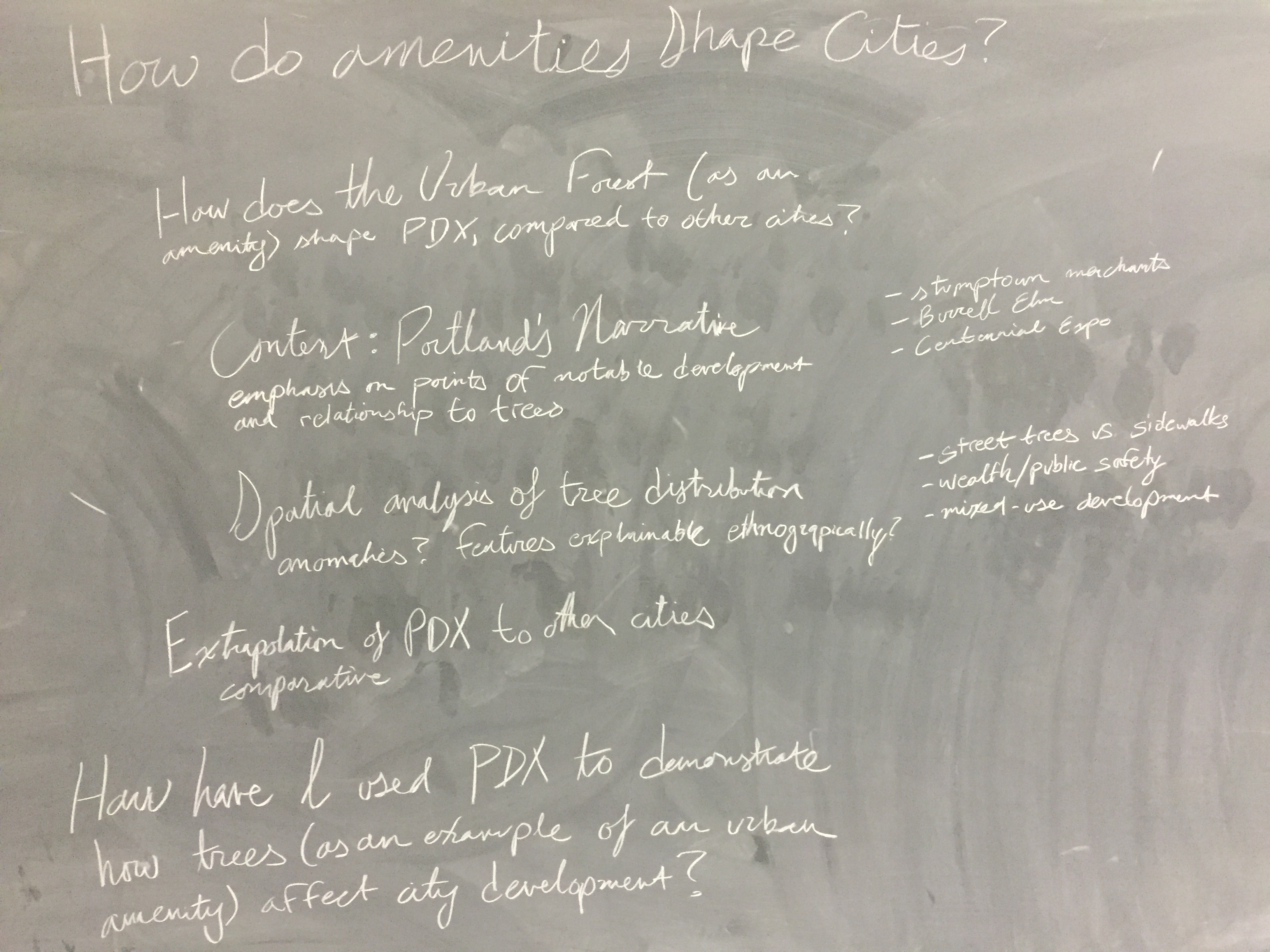
The result of this realization was a re-centering of my situated context. My thesis now centers on Portland, but uses a comparative approach to situate Portland’s relationship with its urban forest within the context of US cities in general. This has several advantages. The major one is being able to play to my strengths, as I discussed in the prior paragraph with the greater level of detail I am able to acquire for Portland. Another important result, however, is my ability to compare phenomena in Portland to other cities beyond my initial three where relevant processes are in place (so far, I have used Sacramento and Boise as additional case studies). It is a little bit opportunistic, to be sure, as I mostly just compare Portland’s development and use of its urban forest to related happenings in other US cities. But being opportunistic in this way allows me to cite the most relevant information, as I am not bound by a particular subset of cities.
With this in mind, I’m continuing my series of white/blackboard pictures with my sketches of the current state of my research. Here, we have a sketch of my new hourglass approach. I look forward to greater success and less frustration with this altered methodology.
