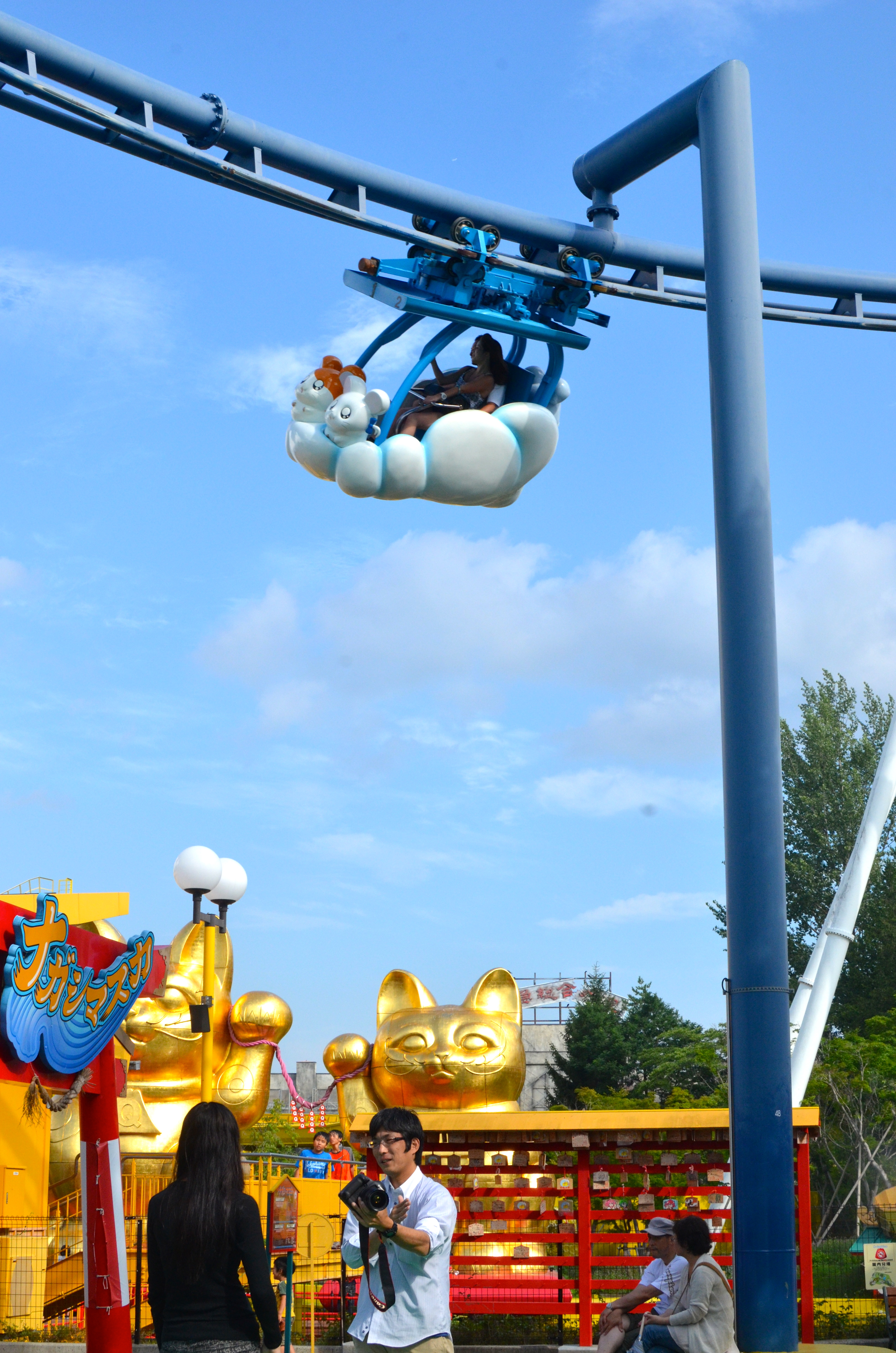
As I write this post I am sitting on a bench surrounded by excited children, massive golden cat sculptures, and a giant blue roller coaster with cars shaped like a ukulele-playing hamster riding on a cloud. In the distance there is a hazy but still majestic Mt. Fuji. Immersed in these sights and sounds, it is almost impossible to imagine it any other way: Fujikyu Highland is its own little world. It’s hard to visualize this area as grassland and forest used for subsistence for the people living around it. But astonishingly, only a few decades ago none of this existed. For centuries this very area was used as iriai lands, or common lands, for local residents. According to McKean’s article, “Management of traditional common lands (iriaichi) in Japan,” Japanese common lands “came into being gradually, essentially between the thirteenth and sixteenth centuries, though the tradition of the commons may well have begun more than a thousand years earlier” (McKean 1992). Since then, it has been the guaranteed right of the residents living around the area to utilize the commons with different but equal rights, or “sato-iriai.” Residents have used the land for “thatch for roofs, fodder for animals, multipurpose bamboo, firewood, charcoal, underbrush and fallen leaves, compost, wood for furniture and tools, medicinal herbs, fowl and game, and edible wild plants” (McKean 1992). More recently, as people are able to buy resources instead of relying on the land around them to survive, the iriai lands are evolving even more to cater to the demands of the present.
A few days ago, while visiting the Onshirin Kumiai, we learned about the governing system designed to manage and protect the common lands north of Mt. Fuji. There, we spoke to Fujiyoshi Takamura, the former head of the common lands association, about how the uses of the common lands have been changing in this modern age. Now the Onshirin Kumiai is renting out more of its land, which is how the world of Fujikyu came to be.
Recently the association has been looking for new ways to profit from the land. People are beginning to thin the forests to make them a more desirable area for hiking and recreation while using the biomass to produce wood pellets for energy. The revenue from wood pellets is then used to further manage the forests that were largely neglected after World War II once importing timber became more economically feasible than using domestic timber.
While conducting field research this past week, we spent an afternoon exploring the Nashigahara grasslands, one of the few remaining non-forested stretches of common land at the foot of Mt. Fuji. Each spring the managers of these grasslands come together to burn the area “not to feed horses or stimulate the growth of edible herbs, but to assert the iriai claims that in turn allow them to collect fees from the government” (Bernstein 2013). Even this continuation of a centuries-old tradition now has a different purpose than it did before.

The iriai officials talked a lot about changing the uses of the commons while still trying to preserve the original respect for the land and each other that is essential to the functioning of the commons. This fine balance between continuing old traditions while adapting to the evolving demands of modern times will be a responsibility for the Onshirin Kumiai to maintain the identity of the iriai lands for future generations.

Sources:
Bernstein, Andrew. Guns and Grass: The Militarization of Fuji’s Common Lands. Conference paper. IASC annual meeting, June 2013.
McKean, Margaret A. “Management of Traditional Common Lands (iriaichi) in Japan.” Making the Commons Work,1992, 63-98.