By: Myles Bridgewater-Jackman, AnaCapri Mauro, and Kara Scherer
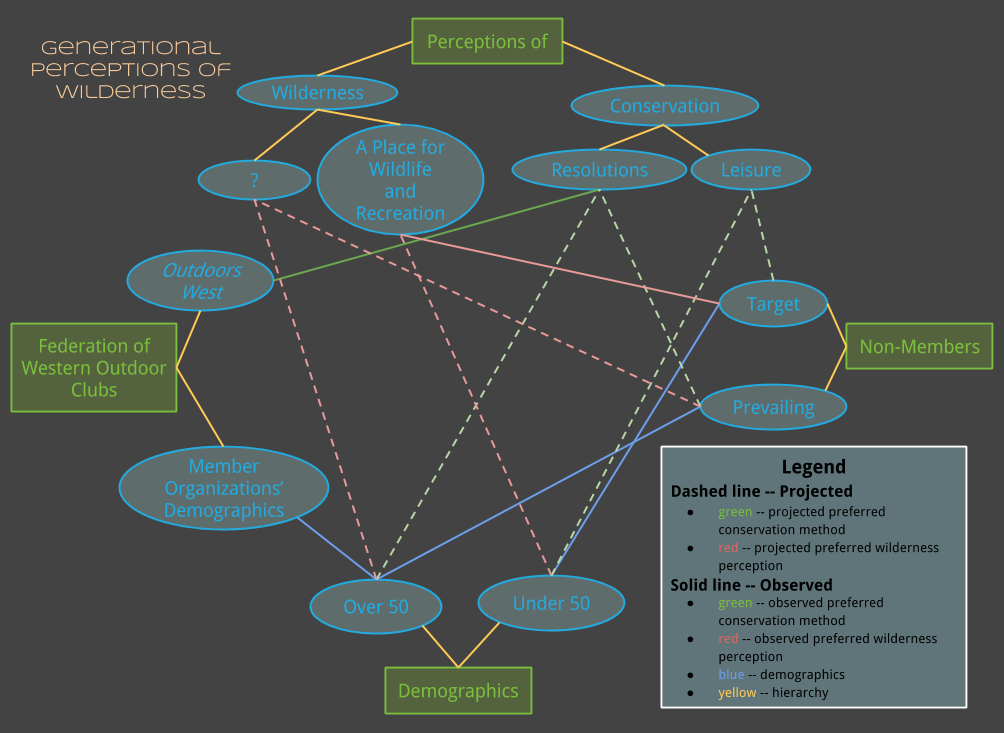
In creating our mind map we first identified the four main actors pertinent to the revitalization of the Federation of Western Outdoor Clubs: the Federation itself, perceptions, non-members, and demographics. FWOC produces the biannually distributed newsletter Outdoors West that details their resolutions as an organization. These resolutions are directly based off of FWOC’s ideas of conservation. Additionally, FWOC has a current member demographic that is predominantly over fifty, and their stances on conservation will attract non-members who also fit into this demographic. The over fifty category, we predict, will strongly favor resolutions as their preferred conservation method, while the under fifty category will prefer leisure activities like hiking. This under fifty group makes up the target demographic that will theoretically contribute to the revitalization of FWOC. There are two subsets of non-members, the target (under 50) and prevailing population that fits with the current dominant demographics of FWOC. The two main ideas that FWOC supports are wilderness and conservation. Conservation encompasses resolutions, what FWOC currently produces, and leisure activities. The underlying themes of wilderness have yet to be determined as they will be decided by our Fulcrum survey.
Our diagram includes our projected findings, illustrated by the dashed lines. Studies have shown that older generations are accustomed to more policy-based conservation methods, such as proposing resolutions and campaigning to change laws. Although younger generations still make political change, many times this change is inspired by an experience they had in “wilderness” by going on a hike or camping trip. As a result, these conservation methods are fueled more by leisure. As illustrated by the red dashed lines, we plan to administer a survey during the poster celebration that will collect data on how FWOC’s target audience perceives wilderness. We also have plans to possibly administer the same survey to a population more representative of FWOC’s current demographic. We understand that the data we collect from administering these surveys won’t be a representative sample of Oregon, but we hope to provide at least an initial comparison.
See our Actor-Network Diagram here!