By Jess Kostka
This reflection helped me think about how place-based education can be incorporated into an English classroom. It also made me think of aspects of my small, rural community that can be incorporated into the classroom – both geographical aspects of the landscape that are obvious to outsiders and events that are nearly invisible to visitors. I also found it useful to reflect on an aspect of my education and think about how it could have been improved.
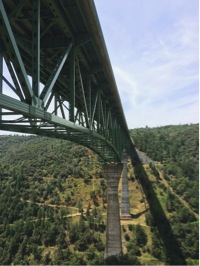
The Foresthill Bridge, the tallest bridge in California, towers over the canyon next to my hometown. It adorns all the postcards. The trails for the world-famous endurance runs wind under it. I often drive across it to the town of Foresthill, where my family’s favorite hiking spot is, where I’ve worked at an aid station at the Western States 100 Mile Race, and where my little brother used to play soccer. Some of the kids I knew in high school liked to climb up on the struts underneath it and take daredevil pictures. The bridge even has an interesting history. For instance, it’s a lot taller than it needs to be, because the American River that runs under it was originally going to be dammed up. The bridge was designed to traverse a deep lake rather than an empty canyon. But the threat of earthquakes in the area halted construction, and the dam was never finished. I can see the concrete remnants when I’m out running. Meanwhile, the bridge remained as tall as originally planned. I’m sure there’s an environmental history project to be done on that.
But the bridge has a darker side too. In 10th grade, my English teacher, Mrs. Besler, had us do something called The Forest Wax Project. Forest Wax was a student a few years above me in high school. In the January of my freshman year, they found his body in the river beneath the bridge. He had committed suicide. I didn’t know him personally, but I knew many who did. The Forest Wax Project’s aim was to celebrate Forest’s life, as well as celebrating life in general. It was a unique, tragic, and immensely powerful foray into place-based education. There were four different components to this project which were all very open-ended. Firstly, there was “Dare to Be Great.” The goal of this component was simply to live life in a new way by trying something we hadn’t done before or learning something new. My teacher hoped that we would get outside of our comfort zone and push our personal boundaries. She challenged us to live powerfully. For my project, I decided to start learning to play the cello. Secondly, there was “Remembrance” which was the most difficult part for me. I decided to write a letter to Forest. I won’t reprint it here, though I still have it. It made me reflect on my own experiences with depression and consider how our actions can have such a huge effect on a community. Other students in my class wrote letters of appreciation to their friends and family members, or letters of remembrance to deceased loved ones.
The third challenge was “It Starts At Home.” This proliferated out from the narrower topics of myself and Forest and began to engage students with their most immediate community – their family. The idea was for students to do a random act of kindness for their families. I chose to get up early and make breakfast for my parents before they went to work. The project reminded us that small things make life worth living at times. They bring people together. They make sure that people know they’re loved. And the fourth and final component was “The Gift of Service.” The idea was to contribute to the community in some way. For my part, I went to a class with my mom to become CPR-certified.
After all of this, we wrote reflections on what we had learned. Overall, the Forest Wax Project Mrs. Besler developed exemplified place-based learning because it commemorated the tragic convergence of a member of our community with a part of our landscape. It brought us together to talk about things I didn’t know needed to be discussed. It brought a relevant issue into the classroom while taking us outside of it. It personalized a tragic part of my home’s recent history. It also allowed for diversity of student interests in that it gave us a lot of freedom to choose what we wanted to learn about. Finally, it was interdisciplinary – though it varied from student to student, it taught me writing, psychology, music, and a vocational/medical skill.
Of course, there were many ways it could have been improved. I did not have the chance to collaborate with any of my classmates with this project. I think that students could have benefited from perhaps doing some sort of group project that made us converse about what had happened. I also think that the project could have been improved by having the class do a big brainstorming session to come up with ways to engage with ourselves, the issue, our families, and the community under those four categories. That way, we could work together in creating the project even if the individual components were personal. Also, although I’m not sure what my classmates did for their projects, mine depended on a certain amount of privilege. For instance, I could only have learned to play a musical instrument if I had time to, and if I had access to one. Also, I’m sure there was a fee to take that CPR class that not everyone would have been able to pay. Moreover, I’m hoping that talking about the event in this way as well as the project itself is not appropriating Forest’s death. I suspect that my teacher had permission from the deceased’s parents to create the project in the first place. Finally, it had no visual relationship to standardized testing, so it was more something we did on the side than a typical educational experience. Yet despite all that, I consider that project to be a very unique, memorable, and powerful instance of place-based education in my life.