

My initial plan to work with Project Lyttelton for my first two weeks to get acquainted with the area blossomed into living there my entire time in New Zealand. I think it’s a testament to place and community that it happened that way — initially I didn’t really expect it to connect to my work with place-based education, but towards the end of my trip I realized Project Lyttelton is the ultimate place-based education in action. Project Lyttelton’s founders, Wendy Everingham and Margaret Jefferies, identified areas of their community that they thought could be improved, and from there they came up with various projects that they put into action.
One of Project Lyttelton’s successes is the ability to sustain the community projects by utilizing social capital instead of money. Social capital makes use of the community’s existing skills and assets, and Project Lyttelton has launched two successful examples of this. The Lyttelton Timebank is famous in New Zealand since it was the first Timebank in the country. A few months ago, the Timebank founder visited from Washington D.C. to celebrate Lyttelton Timebank’s 10th successful year. The Timebank is basically a system that allows its members to exchange time and skills rather than money. For example, if someone loves gardening, they can help someone requesting gardening assistance, and in return they get a time credit. When they need something later on, they can “cash in” that time credit by posting a request for whatever service they need (maybe childcare, painting lessons, a ride somewhere, etc.), and so the cycle continues.
Another social capital experiment in Lyttelton is the savings pool, in which a group of people combine their savings to loan out to each other without having to pay fees to banks. The idea became extremely useful after the 2011 earthquake, when community members needed money to do house repairs and other big projects. Instead of borrowing from banks, people would borrow from the savings pool and pay a certain percentage back to the pool to keep it going and growing.
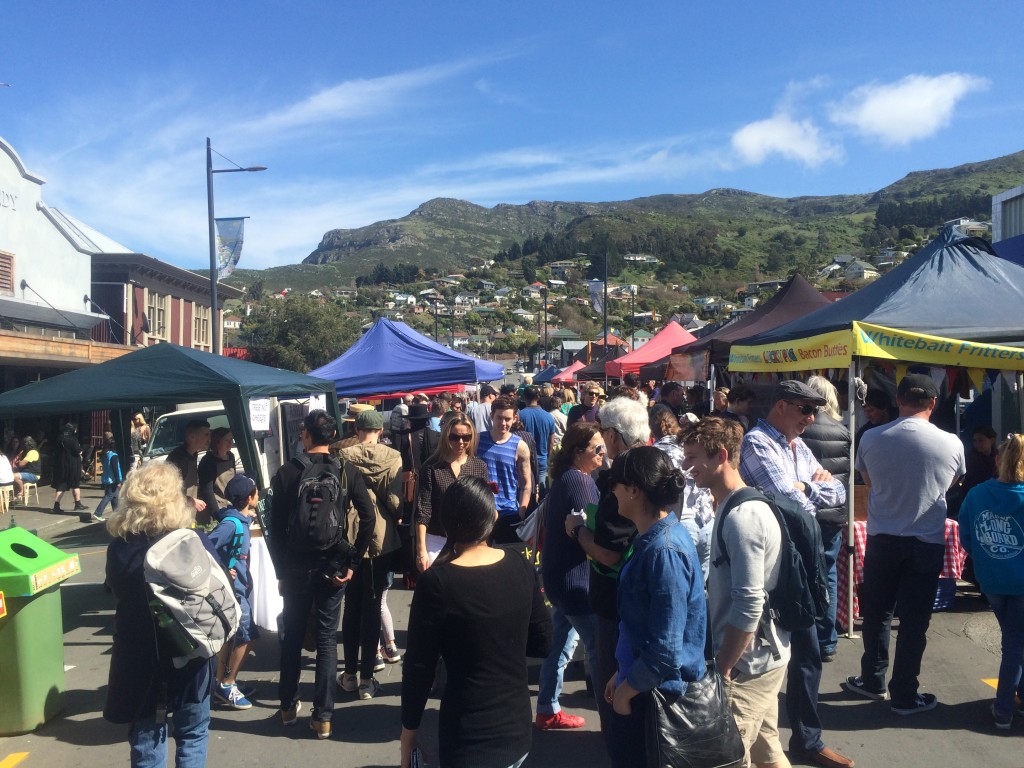
Somewhat related to the use of social capital, but very much related to what I like to call “sustaining sustainability,” Project Lyttelton has programs that are designed to keep their other programs running. The Farmer’s Market, which occurs every Saturday, is one of these programs. It began in the yard of the local school, but has since expanded into the main street of town, which includes a traffic management plan to close the road and divert traffic. It is wildly successful, and is often a recommendation in guide books for tourists visiting Christchurch. This little Farmer’s Market not only provides fresh and many times organic produce to Lytteltonians, but the vendors are all locally sourced (I believe they are all within an hour’s drive of Lyttelton). During the 2011 earthquake, the Farmer’s Market was all people had for about two years, since Lyttelton’s supermarket was shut down. Compostable waste from the market goes into Lyttelton’s Community Garden worm garden. Revenue from the fixed cost each vendor pays to sell at the market goes back into Project Lyttelton’s system to keep it running.
Another program like this is the Lyttelton Garage Sale, a little community thrift store that has a surprisingly great variety of items, including dish ware, clothes, books, DVDs, and toys. Community members donate unwanted items to the Garage Sale, and in return they receive a Timebank time credit, which then encourages even more community involvement when they decide to “cash in” that time credit. Any revenue raised by the Garage Sale either goes back into Project Lyttelton’s community programs, or to an elected community group such as the local swim team.
Project Lyttelton is an inspiring model for place-based models because they utilize so many of their community’s assets, and all programs are focused on helping to run other programs. In terms of place-based education, Lyttelton has very successfully identified itself as a “place” and it’s assets are available for public use.