Background:
Last Monday, we created a survey to explore how prevalent anxiety is amongst Lewis & Clark College students eating at the Fields Dining Hall on campus (also known as “the Bon”). We presumed that many students, particularly freshmen, on campus experience anxiety eating at the Bon (labeled “Bon anxiety”) when sitting alone for meals. Our survey comprised of questions ranging from which meals in particular create more anxiety to what types of accommodations Bon Appetit could supply to students to alleviate this anxiety. More specifically, students surveyed were asked to reflect on whether they feel more external or internal pressure (or no pressure at all) when sitting alone in the Bon.
We defined external pressure as a fear of being judged. In contrast, we defined internal pressure as a fear of being alone. We were interested in how this pressure could create an environment in which students sitting alone partake in phone use, reading, or studying during their meals as a method of distraction or as a display to ensure other students that there is a specified reason for which they are in solitude. Additionally, we were interested in the extent to which students will avoid sitting alone in the Bon. For example, surveyed students were asked what they would do if they were confronted with being unable to view a table with their friends while trying to find a place to sit at the Bon. Answer options were: sit down alone, walk around the Bon to find your friends, call or text your friends to ask them where they are seated, or leave with your food on a napkin. We, then, attempted to find correlations within the answers we received from the fifty students who completed the survey, but this proved difficult.
Additionally, we learned that, students who feel Bon anxiety do not necessarily believe that it should be an issue addressed by the school. Similarly, students who do not feel Bon anxiety do not necessarily believe that it should not be addressed as an issue. Some students who did not experience Bon anxiety felt that enough students suffer from it yearly that it should be addressed. To explore the topic in more depth, each team member conducted audio interviews with two students and transcribed them.
Using word clouds, we explored the consistent themes that arose in our interviews. A word cloud is a visual format in which words of various sizes are displayed in a compilation. The larger words are words that are used most frequently, the smaller words least frequently. Word clouds enabled us to grapple with the most prevalent words in our interviews in order to situate their importance to our overarching topic.
Method:
From the 50 surveys conducted last week, our team chose six willing contributors for the purpose of conducting further research about Bon Anxiety. In each of the six interviews, interviewers utilized a template with seven questions, some of which differed based on their responses in the initial survey. The goal of the survey was to distinguish the causes and effects of Bon Anxiety for LC students, and therefore, interview questions were categorized into cause and effect questions. Each interview lasted from 8-20 minutes and were recorded by voice recording devices. The voice recordings were transcribed word-for-word for further analysis. Fig. X below is the interview template, displayed for replication purposes. After finishing interviews, our team began qualitative analysis of the interviews in order to understand the cause and effect of Bon Anxiety. Our team utilized Wordle.net to create visual representations of the most commonly used words in the answers to specific questions on the interview template. In addition, our team utilized skills gained from Lab 6: Literature Analysis; specifically, we analyzed each interview transcript and asked certain questions about the views of the interviewee 1) whether the interviewees viewed Bon Anxiety positively, negatively, or neutrally 2) Whether the interviewee experiences Bon Anxiety and 3) Whether the survey affected their views about Bon Anxiety. Lastly, we observed patterns of interest (in statement form) through a team discussion of observations of interviews.
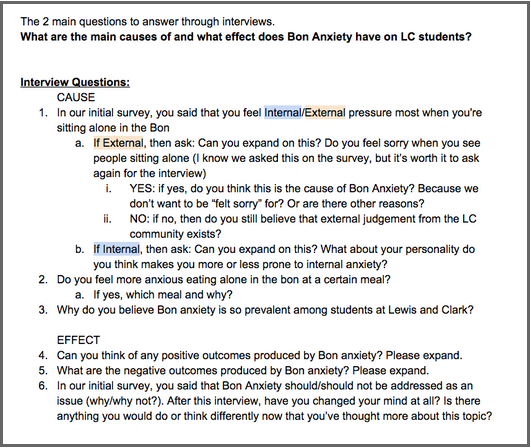
Fig. X
Results:
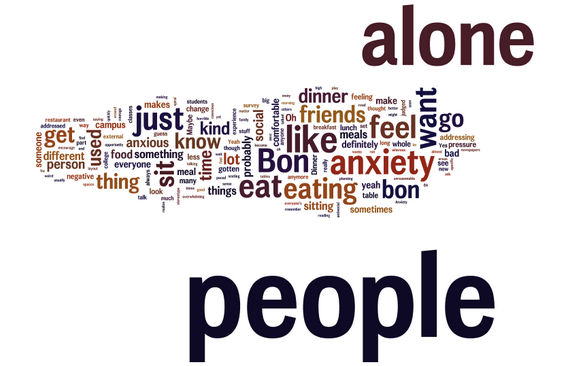
Fig.1
Figure 1 is a word cloud that shows the most common words used by all participants during the interviews. The words with the most for all answers include: people, alone, anxiety, friends, and dinner.
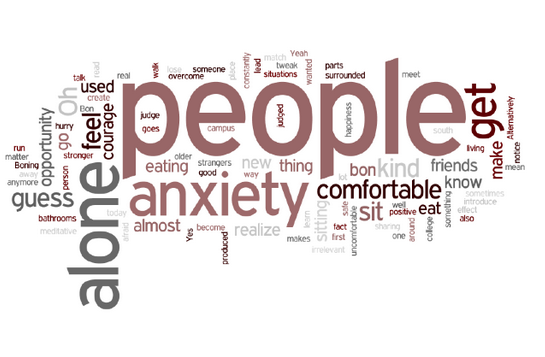
Fig. 2
Figure 2 shows common words from all participants during answers to interview questions regarding the positive outcomes of Bon anxiety. When talking about positive outcomes, interview participants commonly used words such as: people, alone, anxiety, comfortable, opportunity, courage, and friends.
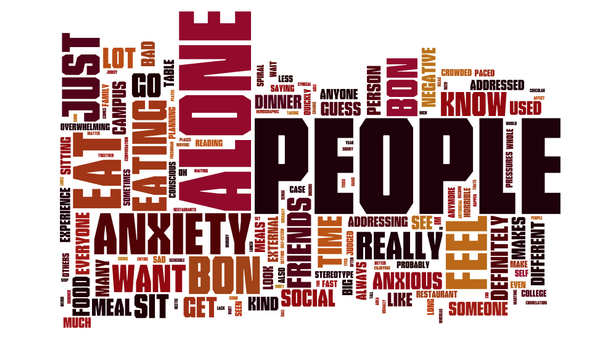
Fig. 3
Figure 3 shows words commonly used by participants when answering the question of what types of negative outcomes come from Bon Anxiety. These common words are: people, alone, anxiety, social, friends, different, dinner, and negative.
| Interviewee | Is BA +/0/-? | Do they experience BA? | Did Survey Affect Views? |
| 1 | – | No | Yes |
| 2 | – | Yes | Yes |
| 3 | + | No | No |
| 4 | – | Yes | No |
| 5 | – | Yes | No |
| 6 | – | No | No |
Table 1
Interviewee viewpoints to these three questions were made by our team to help understand the general feelings about Bon Anxiety (BA) among our sample of LC students.
Discussion:
The interviews that we conducted had a number of different types of questions in order to allow us to take our analysis any way that we found fit. When asking the questions, “what are the positive outcomes of Bon anxiety?” and “what are the negative outcomes of Bon anxiety?” we anticipated finding a general consensus that Bon anxiety does not produce many positive outcomes. During the interviews themselves, we were surprised by the amount of positive outcomes that participants were able to talk about.
All three word clouds produced common words of: people, alone, and anxiety. Commonality between people and answers was understandable regarding the topic of the interview. These three words break apart Bon anxiety perfectly. The who: people (Lewis and Clark Students); the what: anxiety; the why: alone. The common words in answers about negative outcomes were similarly unsurprising. “Social, friends, different, dinner, and negative” all highlight what we anticipated people to associate with this question. Dinner is the most attended and social meal, so there is a widely understood connection between dinner and Bon anxiety.
Our first surprise was when we looked at the first few common words in answers to the question of positive outcomes of BA. “Comfortable, opportunity, courage, and friends” were not selling us the story that we thought the question would lay out. Answers to this question made Bon anxiety feel more like a challenge or a quest that needed to be fought and won. Still, a general consensus among interviewees was that there were positive outcomes of personal growth that come as a result of Bon anxiety.
Through group discussion among team members, we came to a consensus in interpreting our interviewees feelings about Bon anxiety. We echo one interviewee’s claim that “It [Bon anxiety] is a spiral.” Students feel sorry for other students sitting alone and, therefore, assume that others feel sorry for them when they sit alone. Additionally, while there are positives resulting from Bon anxiety, it is viewed by LC students as something that negatively affects their experience dining in the Bon. In examining its cause, we could not draw a conclusion that LC students feel Bon anxiety when they sit alone, rather they feel anxiety most when at dinner, which is the meal where the most social activity occurs. Lastly, we observed that Bon anxiety seems to dissipate as students grow older and spend more time outside of school, suggesting that personal growth (courage, etc.) is a direct result of and nullifies Bon anxiety. Bon anxiety is thought to negatively affect Lewis and Clark students.
Conclusions
The social environment and the physical setup of the Fields Dining Hall at Lewis & Clark College contributes to the presence of Bon Anxiety in LC students, a feeling which results in negative social anxiety consequences but also positive personal growth results.