GIS: ArcMAP
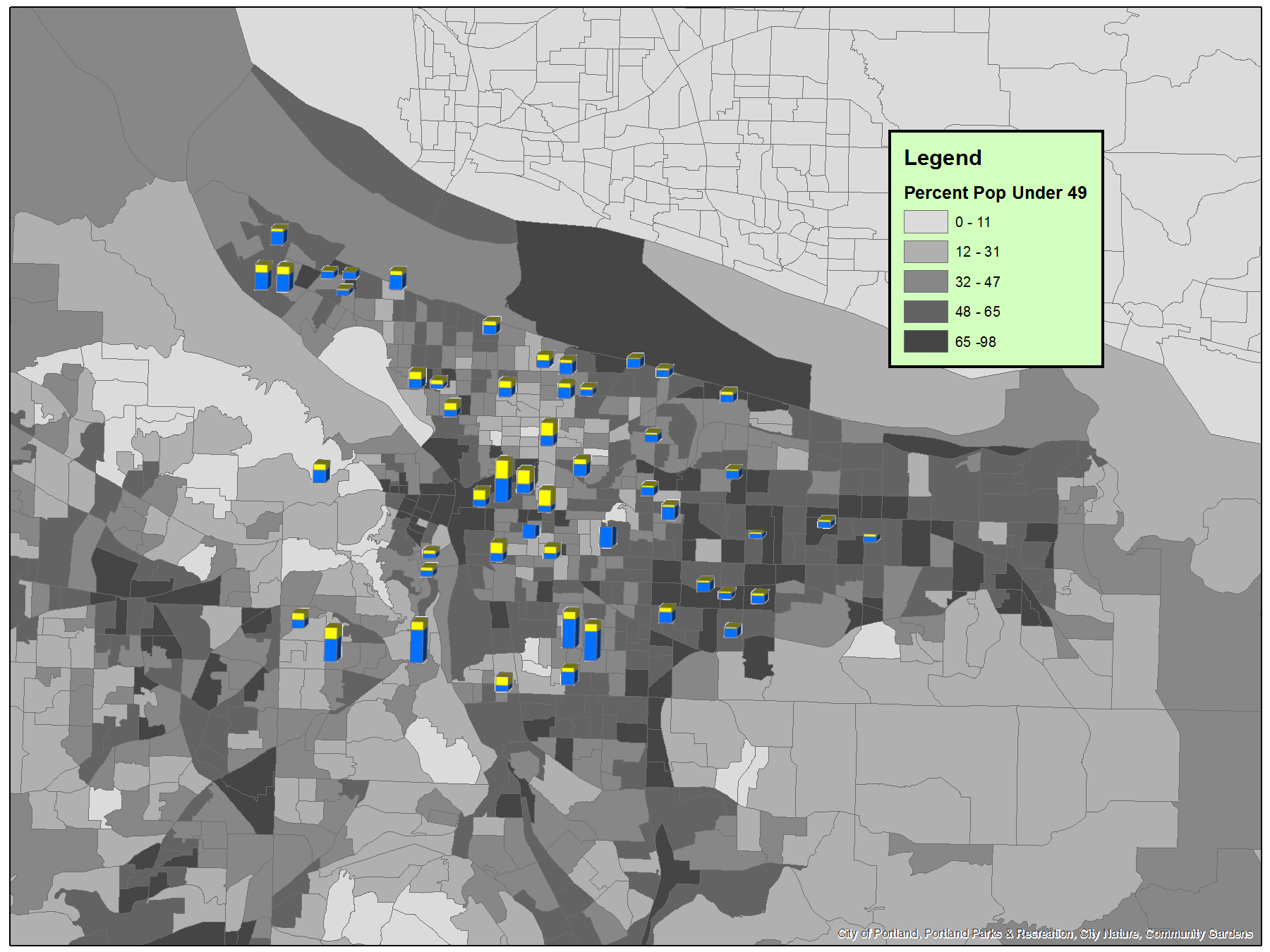
Distribution of Households with <$49,000 Income/year with Number of Community Garden Plots & Waitlisters
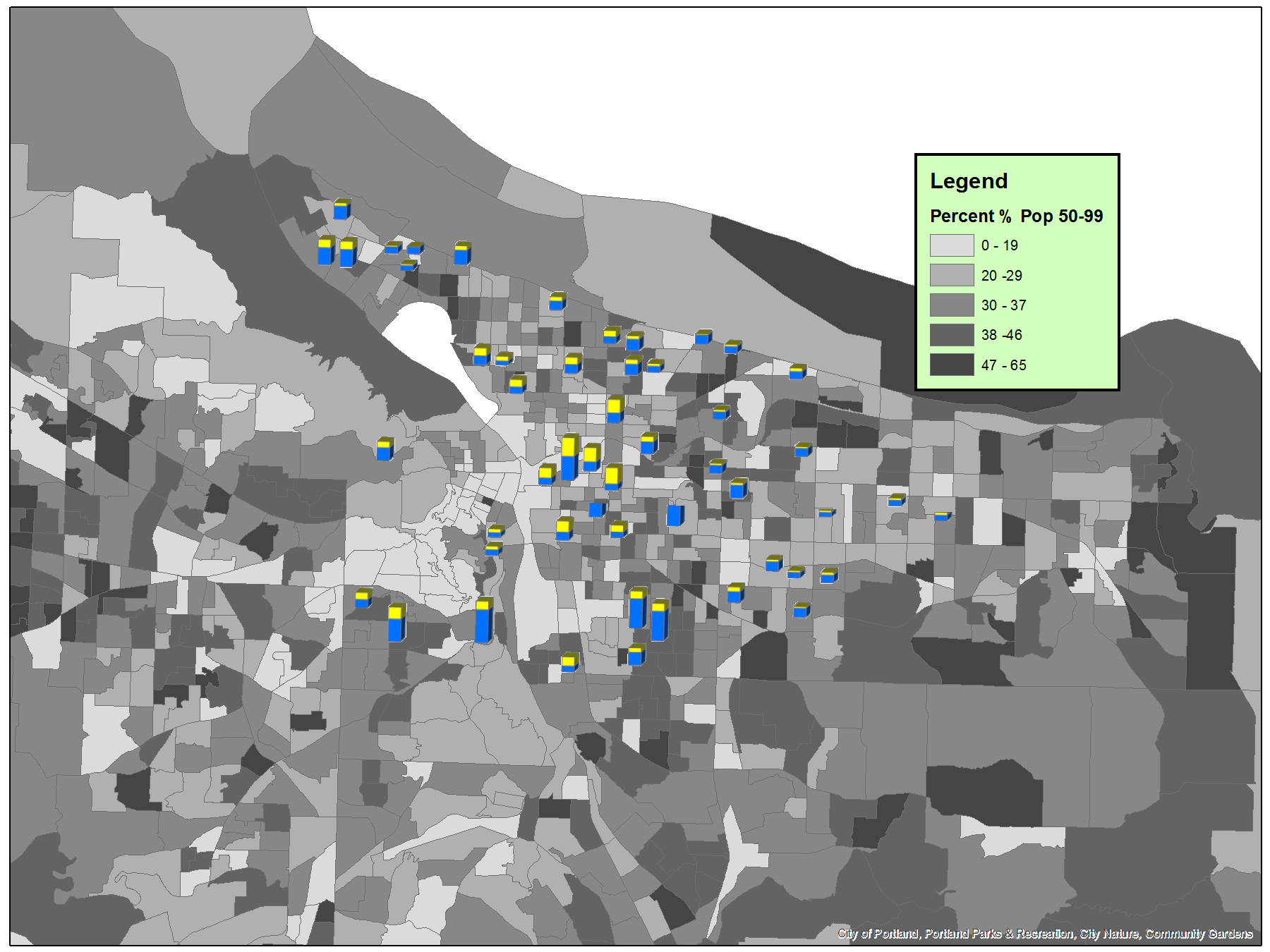
Distribution of Households with $49,000<x<$99,000 Income/year with Number of Community Garden Plots & Waitlisters
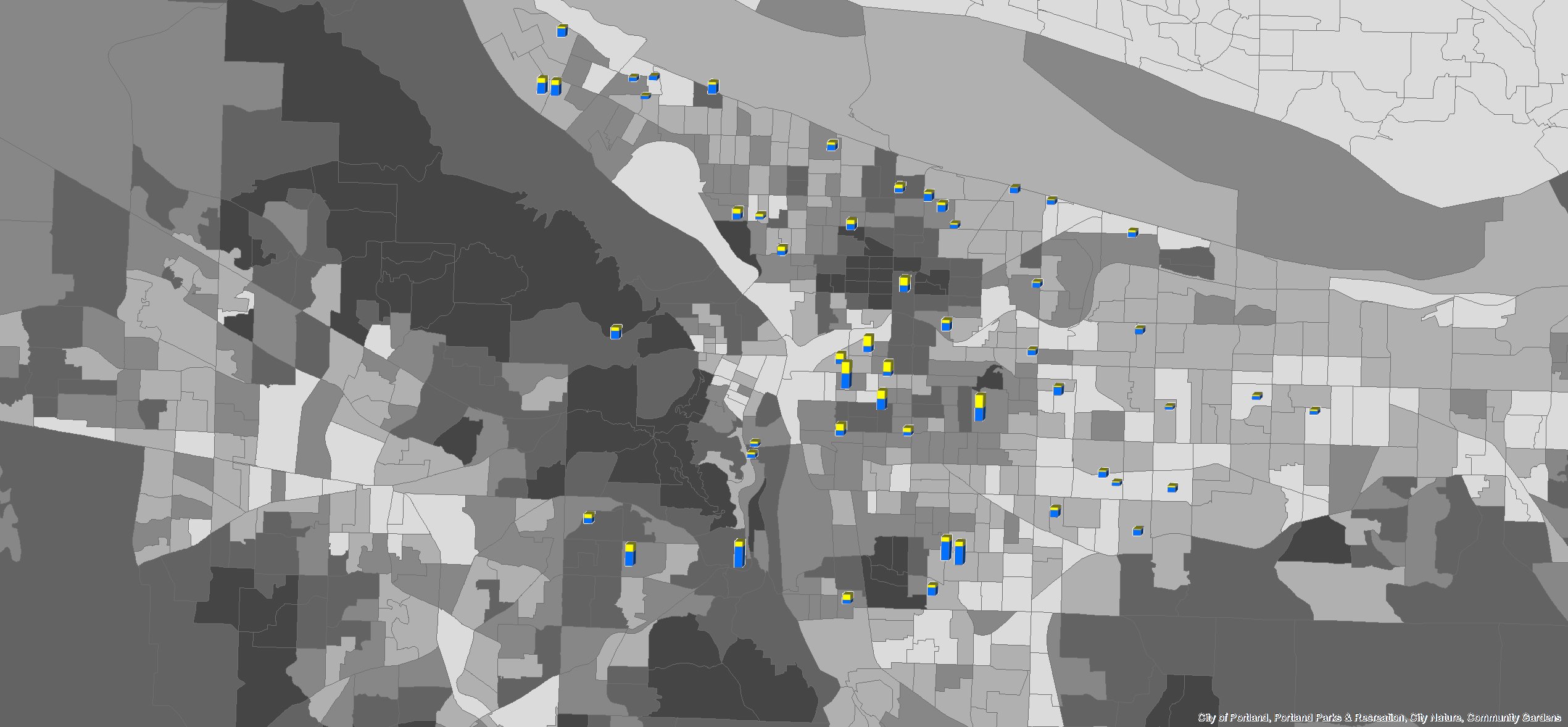
Distribution of Households with >$100,000 Income/year with Number of Community Garden Plots & Waitlisters
Inferential Statistics
1. PEARSON CORRELATION
| Income Level ($1000’s/year) | Pearson-Correlation |
| >100 | 0.36 |
| 50<x<99 | 0.017 |
| <49 | -0.32 |
Two results of interest are the Pearson-Correlation for income levels >100 and <49 thousand $/yr. They show positive correlations between the percentage of a Portland neighborhood with high (>$100k/yr) income and the presence/interest in garden plots. Alternatively, there is a negative correlation between the percentage of a Portland neighborhood with low (<$49k/yr) income and the presence/interest in garden plots. Lastly, there is no strong correlation for the middle income bracket. Conceptually then, the presence/interest of garden plots has a positive correlation with the presence of higher income households.
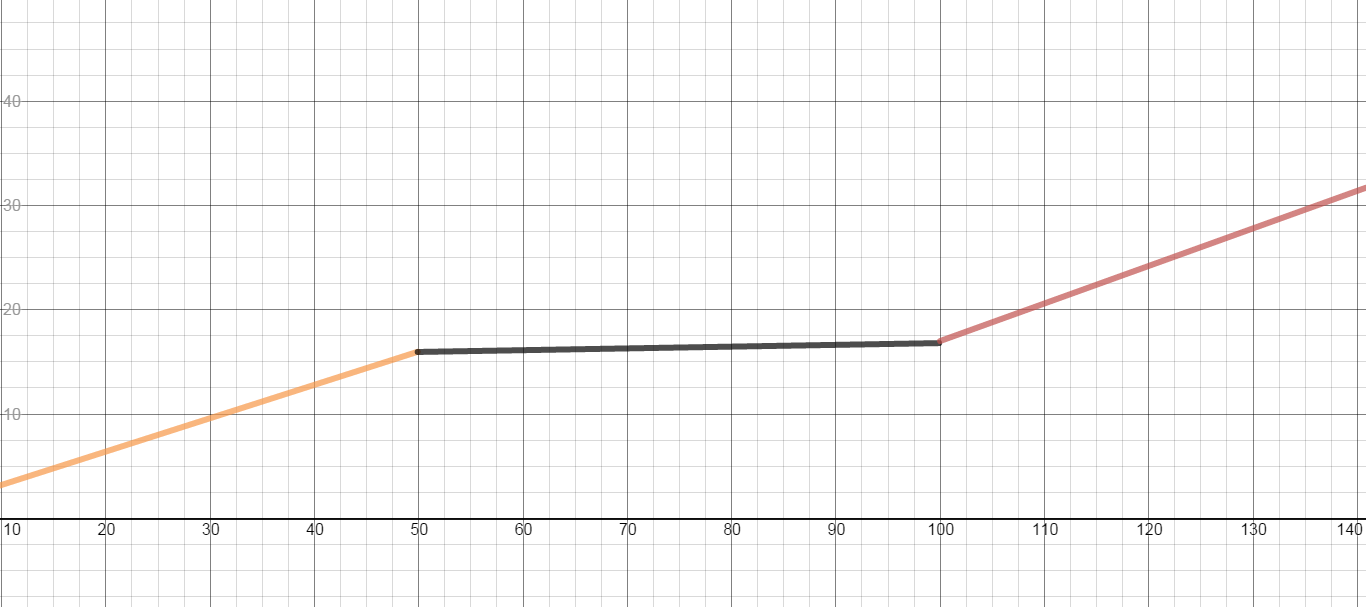
Graphical Representation of the relationship between Communal Garden Interest (Y-axis, not to scale) and Income (X-axis, in $1000/yr)
2. ANOVA
Null Hypothesis: there is no significant relationship between low-income dominated neighborhoods and interest in community gardens.
Alternative Hypothesis: there is a significant relationship between low-income dominated neighborhoods and interest in community gardens.
| Degrees Freedom | Sum Squares | Mean Squares | F-Statistic | P-Value | |
| Majority | 1 | 6968 | 6968 | 4.338 | 0.043 |
| Residuals | 45 | 72286 | 1606 |
Conclusion: Assuming that there is no significant relationship between low-income dominated neighborhoods and interest in community gardens, the probability of finding a result as extreme or more extreme than ours is approximately 0.043 or 4.3%. Thus, we can reject the null hypotheses and accept the alternative. There is a significant relationship between low-income dominated neighborhoods and interest in community gardens. Furthermore, we have found previously that the Pearson Correlation between income and interest is negative, so we can conclude that there is a significant positive relationship between income and interest in community gardens.
Actor Map
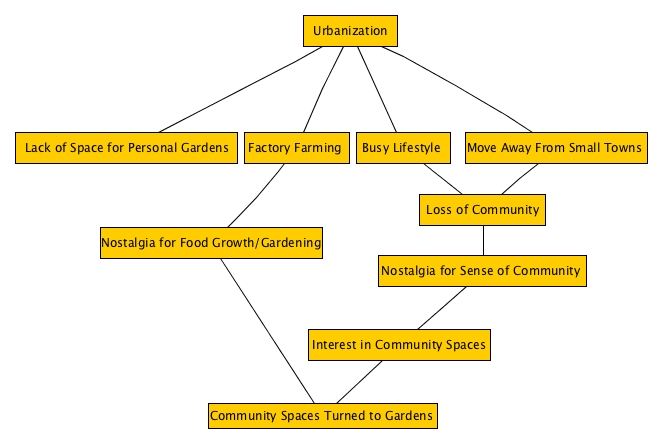
Through reading literature on urban community gardens, we created an actor network map outlining some pertinent factors that have led into their creation and implementation. Starting with urbanization as the overarching driving factor behind urban community gardens, there are multiple reasons, including a sense of nostalgia for a pre-urban way of life, that create the drive behind urban community gardens.
Qualitative Analysis
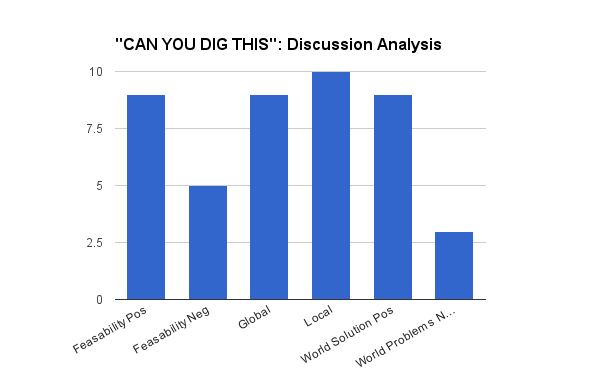
This chart depicts various quotations we gathered from the discussion after the film screening of CAN “YOU DIG THIS” directed by Delila Vallot. These quotations are from four individuals who spoke on a panel after the film screening. We created four classifications to dissect these quotations: opinion on the feasibility of gardening for low income individuals, local applicability of the quotation, global applicability of the quotation, and opinion on whether gardening can save the world’s problems. This enabled us to explore the topics in the quotations further, both visually and numerically.
Conclusion:
Although a significant positive relationship between income and interest in community gardens exists in Portland neighborhoods, we have found that, through our qualitative research and hearing the opinions of those from the “Can you Dig This?” panel, the benefits of community gardens to human well-being can and does transcend socio-economic boundaries.