• Skip to content

Main navigation

  • About
  • Thesis
    • Environmental Studies
    • Economics
  • Projects
    • Ross Island Land Use
    • Portland’s UGB
    • The City Shape of Portland’s Tree Canopy
    • Concentration
  • Courses
    • Situating Environmental Problems & Approaches
    • Global Environmental History
    • First- and Second-Year ENVS Scholarship
  • Posts
  • Contact

Designing Environment

The Stories and Scholarship of Aaron Fellows

Posts

The Relationship Between Trees and Crime Rates?

December 3, 2015 By Aaron Fellows

The Relationship Between Trees and Crime Rates?

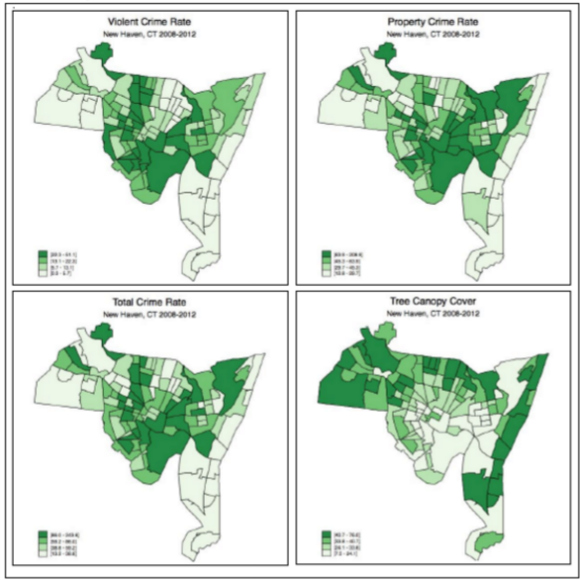
Image Credit: Gilstad-Hayden et. al.

A new study by in Landscape and Urban Planning suggests that tree canopy cover is inversely correlated with crime rates. The study, conducted in New Haven, Connecticut, regresses property crime and violent crime as a function of tree canopy cover in addition to demographic control characteristics, and finds a substantive and significant negative relationship with each. The authors suggest that this may be due to green spaces attracting recreation and other activities which promote “eyes on the street.”

Such a study could be important for cities such as Chicago, with a policy focus on both crime and urban forestry. It would be interesting to extend the authors’ work to more cities and a larger geographic area to test its external validity. If the relationship continues to hold, it could form an important part of city planning going forward.

Filed Under: Posts, Thesis

Settling on Situated Contexts

December 1, 2015 By Aaron Fellows

Settling on Situated Contexts

As I begin to formulate my methodological idea of qualitative regression, I realize that I will need several data points available in order to investigate and generalize trends in the formation of city shape and its relationship with the urban forest. The first contextual data point is easy—besides being my present location and the subject of my already-related research, Portland has a dual focus on urban development policy and urban forestry which makes it particularly amenable to my study. As a medium-sized city of close to 600,000, Portland also functions as a good representative of many similarly-sized american cities.

Some early spring flowering of a plum tree in Takoma Park.
Some early spring flowering of a plum tree in Takoma Park, with some budding oaks in the background.

My next inclination is to look at cities which participate in the Arbor Day Foundation’s Tree City USA program. I spent my teenage years in Takoma Park, Maryland, a small city outside of Washington, DC, which was a member of this program, equipped with a citywide Tree Commission whose role was to oversee permitting and arboreal policy. I witnessed firsthand how a focus on tree value and diversity affected urban form on a minor scale, and think that this would contribute a valuable data point to my analysis.

However, I would like to look at a city which is more self-contained, and less related in a suburban manner to a larger city such as Washington, DC. For this purpose, I would like to use Ann Arbor, Michigan as a case study for the influence of the Tree City USA program. In addition to the standards of Tree City USA, Ann Arbor uses economic incentives to regulate the urban forest, with escrow fees charged for business street frontage and tree maintenance, as well as a canopy removal fees for taking trees down. Using Ann Arbor, a small city of 100,000, as an example of a Tree City USA will provide a useful study to deepen the analysis.

Finally, I want to include a large city with a long history of development. Chicago seems particularly amenable to my purposes, as it has long history of unplanned growth, subject to the influence of western american expansion, first in the form of agricultural trade along the Mississippi River, then by massive growth in railroad infrastructure as a new means to transport agricultural products, as well as people. Chicago has a long history of urban sprawl, with population in the city center declining since the 1950s. Because of the varied nature of Chicago’s suburbs and exurbs, the urban forest likely plays a varied role throughout different parts of the city urban area. Chicago has a bureau of forestry charged with managing its urban trees, indicating an interest in the shape of its urban canopy overall. With a population of 2.7 million, Chicago should represent large urban metropolitan areas well in my study.

Filed Under: Posts, Thesis

Concept Map: The Network of Values Surrounding Urban Trees

November 12, 2015 By Aaron Fellows

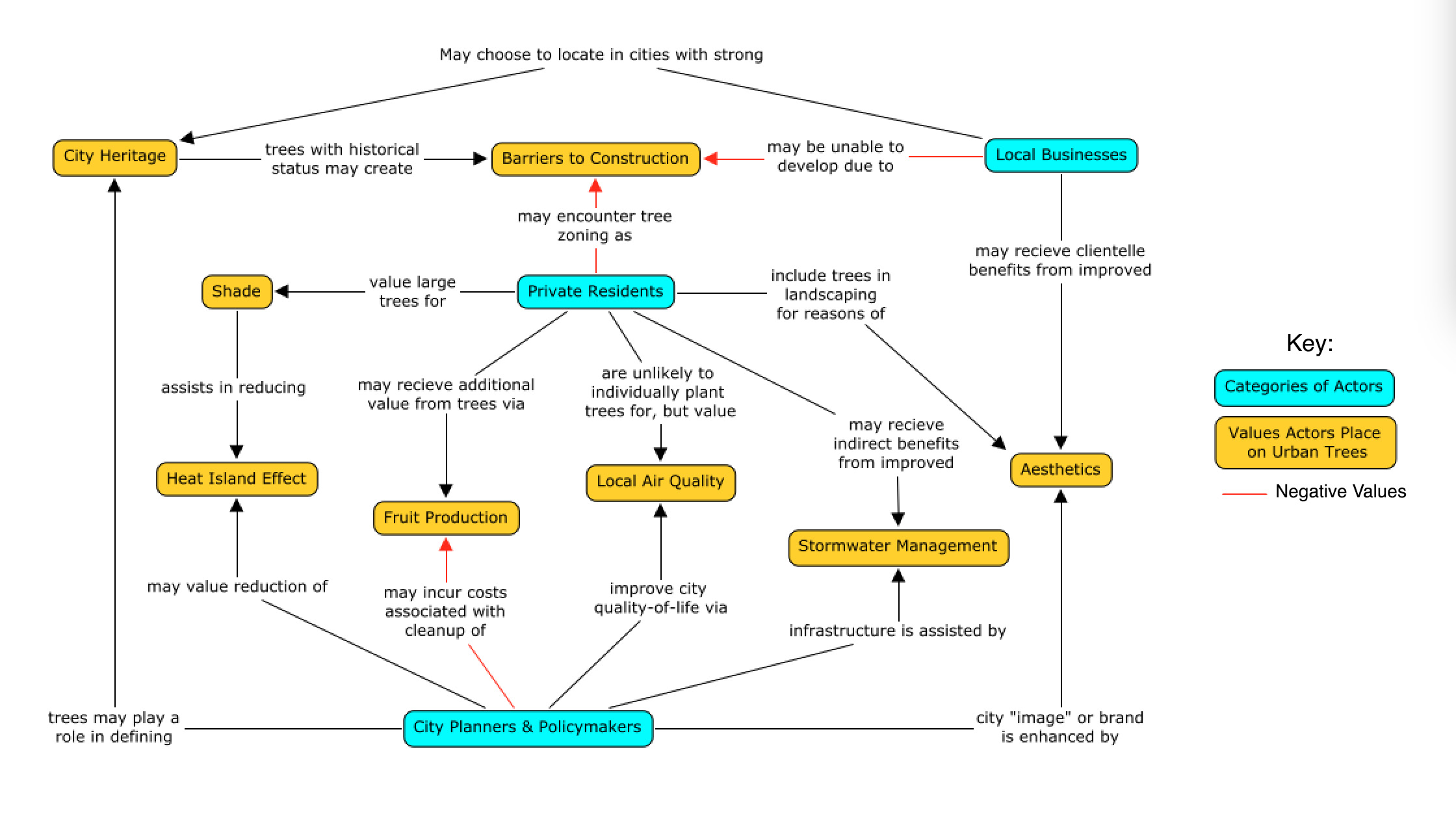
Concept Map: The Network of Values Surrounding Urban Trees

In trying to describe the complex web of interrelationships between different actors, their individual values towards urban trees, and those values’ influence on city shape, I realized the potential usefulness of one my favorite tools—the concept map. This form of concept map is an application of Actor-Network Theory, which approaches landscapes of issues through analysis of the relationships between its component parts. The concept map (or Cmap) below is only one element of a larger picture, but it does a better (or at least different) job of describing the way in which different actors value urban trees.

TreeValueCmap

Filed Under: Posts, Thesis

November 10, 2015 By Aaron Fellows

Hitting the Books: Grounding Data in Theory

Whereas a typical paper published in an economic journal might devote a few lines to the economic theory on which their research is based, an undergraduate economics thesis is intended to demonstrate mastery of certain models of theory. I started thinking about this as I was starting to feel that I had conquered the behemoth of my data analysis, and realized that I had done minimal reading concerning the theory in which I was grounding my experiment. So, I began to delve deeper into how I was connecting my econometric model to the theoretical model of Hedonic Analysis which is presented in literature.

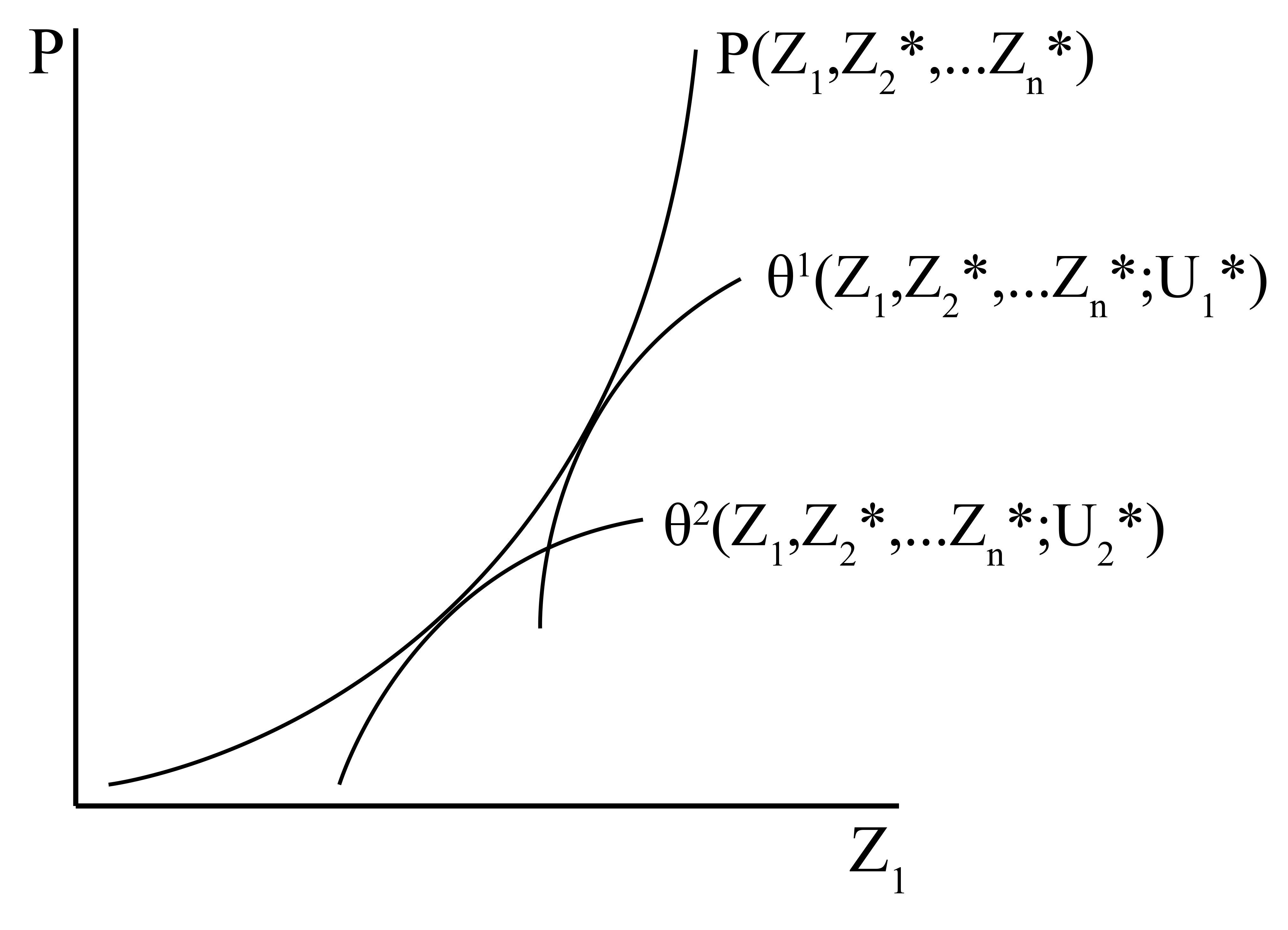
GraphIn the case of Hedonic Analysis, the best model is arguably the first, and I returned to the seminal paper on Hedonic Analysis published by Sherwin Rosen in 1974. Rosen connects the framework of hedonic regression to the utility maximization model, showing that the housing market can reveal the value of its constituent characteristics in a perfectly competitive market equilibrium (see the figure to the left). I go into more detail in my Theory section, but suffice to say that I have spent much of my recent energy on this project in connecting with grounding theory

Filed Under: Econ Thesis, Posts, Thesis

Earth has 3.04 Trillion Trees, New Study Reports

November 8, 2015 By Aaron Fellows

Earth has 3.04 Trillion Trees, New Study Reports

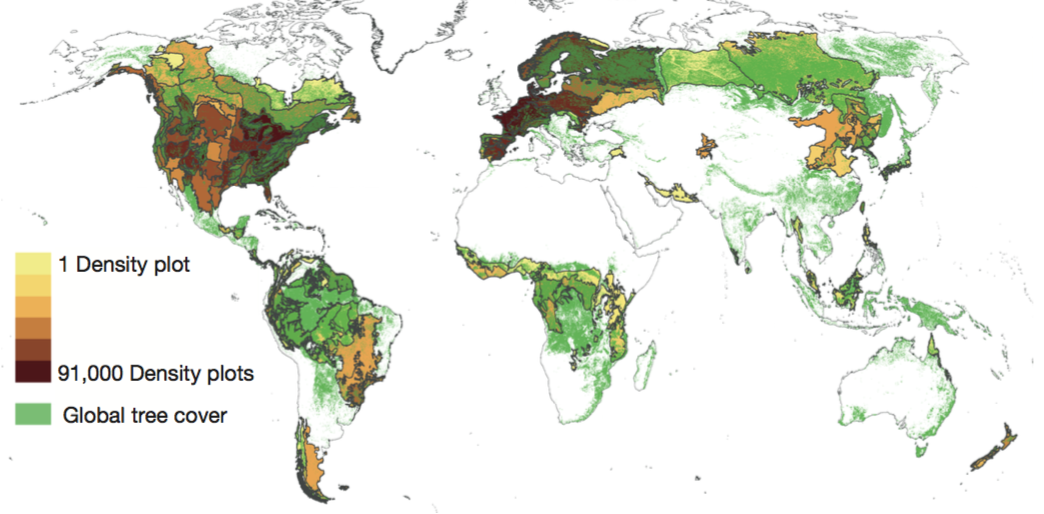
An article by Crowther et. al, just published in Nature, undertakes an ambitious project to (as implied by the title) map tree density on a global scale. The study relies on ground-sourced measurements of tree density, but relates them to GIS and remote sensing data to construct a model of tree density. Based on the maps produced, they estimate that earth has 3.04 Trillion (3.04 x10^12) forest trees.

The number of trees in a given area can also be a meaning- ful metric to guide forest management practices and inform decision-making in public and non-governmental sectors14,15. For example, international afforestation efforts such as the ‘Billion Trees Campaign’, and city-wide projects including the numerous ‘Million Tree’ initiatives around the world have motivated civil society and political leaders to promote environmental stewardship and sustainable land management by planting large numbers of trees.

Although the article does not specifically address trees in urban areas, it does put individual cities within the context of tree density in their local biome. It also represents a huge-scale methodological use of data measurement, remote sensing, and regression models to estimate forested area.

Screen Shot 2015-11-08 at 2.04.15 PM
Image Credit: Crowther et. al.

Filed Under: GIS, Posts, Thesis

November 1, 2015 By Aaron Fellows

Japanese Historical Attitudes Toward Wolves

The following is in response to the first several chapters of Brett L. Walker’s The Lost Wolves of Japan:

Walker points out that the “westernness” of the Linnean taxonomic system makes historical inquiry into Japanese wolves difficult. He says “the emergence of Nihon ōkami, or the Japanese wolf, became possible only with the emergence of many other distinctly ‘Japanese’ things at the turn of the century, such as Japan’s unique brand of ethnic nationalism and its imperial ideology.” The identification of a distinct species of Japanese wolf was therefore somewhat of a product of globalisation, whereby Japan began both to export elements of its culture and to import western science, among other things.

This helps to explain the strange polarization of historical Japanese attitudes toward wolves. Walker comments on the rapid shift from Japanese reverence of wolves (“grain farmers worshipped wolves at shrines, beseeching this elusive canine to protect their crops from the sharp hooves and voracious appetites of wild boars and deer”) to the persecution of the same. Prior to the introduction of western taxonomy, wolves and dogs were not so distinct from each other in Japanese reasoning—indeed, wolves have variously been referred to as “mountain dogs.” This is because Japan, a culture which prioritized grain-farming over animal husbandry, did not have the need to villain-ize wolves as distinct from dogs. This changed with the introduction of western taxonomic distinctions and the introduction of cattle ranching. This both made wolves into a species distinct enough from dogs to cast one as good and the other as bad, and provided a context for wolves to be cast as the villain (as they now could prey not on the defilers of the crop, but on the “crop” itself).

Finally, some linguistic speculation: Walker mentions that the people of Morioka “referred to the wolf as oinu, attaching the honorific o to inu, ‘dog’ in Japanese and thus rendering it ‘honorable dog.’” Walker uses this point to illustrate the honor attached to the wolf in this region, but it also appears that the modern Japanese name for the wolf, okami, attaches the honorific o to kami, or deity. This serves to highlight the venerated status of wolves. Furthermore, the word inu also appears as a constituent part of the name of the Ainu people, who featured wolves in their origin stories, had hunting patterns based on the native Hokkaido wolf, and, like much of Japan, revered wolves in their religious ceremonies.

(Edit: after some research, it appears that my linguistic speculation hits off the mark. Oh well, it was worth a shot!)

Filed Under: HIST 261, Posts

  • « Previous Page
  • Page 1
  • Page 2
  • Page 3
  • Page 4
  • Page 5
  • Next Page »

Digital Scholarship Multisite © 2018 · Lewis & Clark College · Log in

✖