Looking around, I had a strange feeling at the Sendagaya Fuji-zuka shrine in Tokyo. Utilitarian scaffolding and other metallic construction equipment were strewn about the grounds at the Fuji-zuka (“Fuji mound”)–a religious miniature replica of Mt. Fuji, of which there are many and which are often constructed from actual stones taken from Fuji herself. A typical Japanese shrine combines non-human, “natural” elements and cultural elements of architecture, statue, walkways, gates, fences, and of course the shrines themselves. However, shrines in modern Japan seem more complex than they may have appeared in paintings and woodblock prints from centuries ago. The incorporation of globalizing, commercializing, and pragmatic elements in many shrine locations, especially urbanized ones, leave one with the feeling that these shrines are presented just as much for tourists, scholars, and photographers as for “legitimate” religious practitioners. At the Sendagaya Fuji-zuka, there is an advertisement for the shrine’s Facebook page displayed prominently on the offertory. There are multiple and ubiquitous diagrams including pictures and written descriptions of exactly how to “use” the shrine’s different facilities – in praying, hand-washing, offering, and bowing. The presence of cars, modern constructions and renovations, and of course a plethora of tourists wearing a huge variety of clothing and visiting for different reasons, make the cultural implications of a place like a Fuji-zuka shrine incredibly complex. Not only is there a contrast between the bamboo trees, the foliage, the dirt, the insects, and the birds (the “natural”) and the gardening techniques and buildings of the shrine ( the “cultural”), but in my mind, there exists a third contrasting category – the presence of modern cultural additions on the foundations of the traditional shrine. Whereas the wooden traditional shrine buildings were obviously made in conscious sympathy with the aesthetics of the surrounding foliage, the cars, carpenters, and card diagrams seem incongruous, temporally and culturally separated. Yet despite their striking differences, these elements are not completely separated from one another. They all come together to form a single entity of place, which harkens back to Doreen Massey’s article “A Global Sense of Place,” in which she defines places not “as areas with boundaries,” but instead as “articulated moments in networks of social relations and understandings” (27).
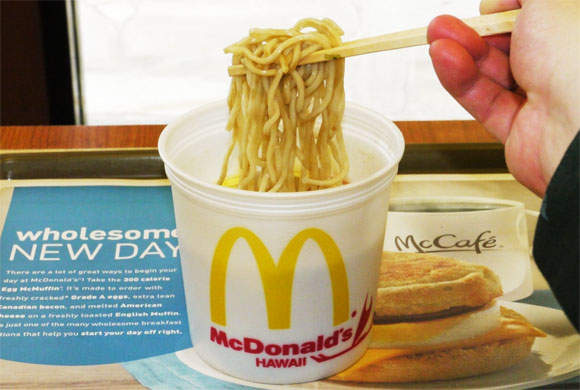
As Americans visiting Japan, I am sure that our entire study abroad group has been struck by the presence of such American institutions as fastfood restaurants (namely McDonalds, KFC, Subway) and convenience stores (namely 7/11). The presence of their familiar logos lining the streets of Tokyo may be something of a comfort, but they may also seem strange and disconcerting to an American who expected to come into a “foreign culture” and experience “brand new things.” However, upon entering these Tokyo establishments it becomes clear that these are not the same stores which are constructed in the States. McDonalds sells shrimp burgers and yakisoba, and soy sauce comes with every meal. Unlike the convenience stores in the States, where the cashiers are specifically instructed to not let underage people purchase alcohol or tobacco, in the Tokyo 7/11s the purchasing of alcohol or tobacco requires nothing more than the customer pressing a button, legally claiming that he or she is of age. The phenomenon of “glocalization,” in which globalizing forces are adapted to their different, idiosyncratic settings, is easy enough to understand in an introductory environmental studies class, but to experience the reality of a glocalized community, in this case urban Tokyo, has put the stamp of observable reality in my memory about the implications of globalizing consumerism- a force which has been inexorably gaining momentum and growing in intensity for the last few hundred years. Aviad Raz describes the process of glocalization in Japan in his book Riding the Black Ship by arguing that the Japanese are not “passively dominated [by American consumerism] but rather make an active and manipulative use of Western culture” (12). The desire for profit is a major incentive for global corporations to change their menus, aesthetics, and company values to match local tastes and international cultural differences. While the power of money may actually help to preserve the unique qualities of cultures overseas, it may simultaneously contribute to the spread of mass-produced and homogenizing consumer products. It is a great contradiction, with unseen implications for the far future.
In his lecture on the “Cult of Mt. Fuji,” Marco Gottardo described how the name Fuji (Fushi) can mean “no death,” which is a testament to the ideas of immortality which surround Fuji. Compared to our short human lives, Fuji is indeed an unchanging constant (granted that it doesn’t erupt in our lifetime). However, the concept of immortality or “foreverness” which surrounds Mt. Fuji is culturally driven, not a physical reality. In reality, stasis is almost non-existent. The only thing which is unchanging and eternal is change itself, entailed in the endless motion and activity of the universe. Scholars like Marco Gottardo study how elements of culture can actually be preserved, remaining unwavering forces in our human world. The religious ideals of Fuji as a personified figure, a god of sorts who retains honorable characteristics, value, and great beauty, have survived and proliferated in Japanese and even global society today. Another speaker who presented to our group, Seiichi Kondo, spoke about how his childhood was influenced by Fuji, and how his parents encouraged him to cultivate strength and stringency, using Fujisan as a great and heroic example. Although Fujisan has remained a hugely important iconic figure in Japanese culture today, representing something of a “static,” figure, the depictions and usage of Fujisan as a symbol has changed drastically with the advent of modern institutions. I myself have seen Fuji used multiple times, in cartoon or photographic depictions, in advertisements in the Tokyo subway stations. Thousands, if not millions, of people must see these depictions every day, and although many will simply gaze over that picturesque snowy face without a second thought, many will also look at Fuji and be reminded of something they have learned, something they have felt, or something they have seen.
Works Cited
Massey, Doreen. “A Global Sense of Place.” Marxism Today 35.6 (1991): 24–29. Print.
Raz, Aviad E. Riding the Black Ship : Japan and Tokyo Disneyland. Cambridge, Mass: Harvard University Asia Center, 1999. Print.