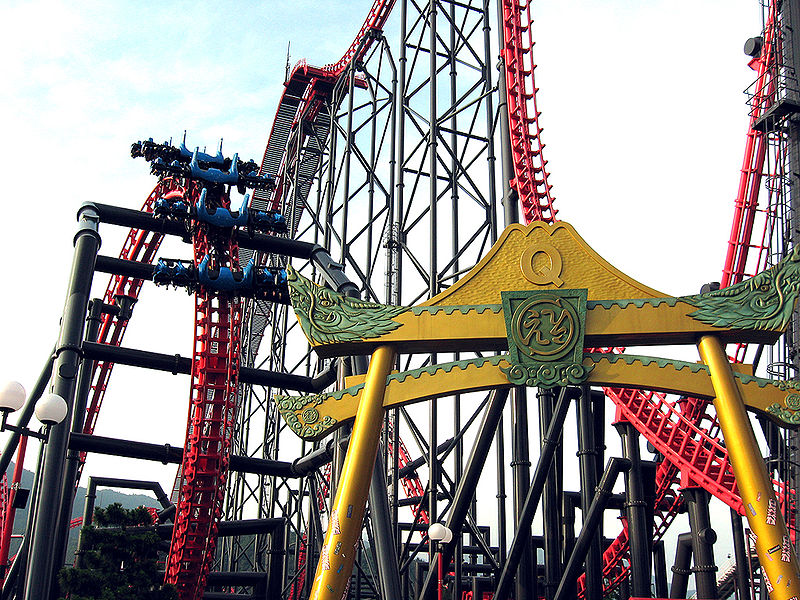
While being strapped into a roller coaster called Eejanaika at the Fuji-Q Highland amusement park, I could almost swear that I was at Six Flags or the Santa Cruz Boardwalk back in California, given the lines of smiling tourists in shorts and flip flops, smells of churros and soda pop, and muffled, indiscernible words blasting over loudspeakers. But hints here and there reminded me that this definitely wasn’t an American roller coaster. Painted on the ceiling of the landing zone was an intricate tangle of dragons surrounding the characters for “ee,” short for the phrase “eejanaika” which is commonly chanted at matsuri (Japanese festivals). Ride attendants bowed and applauded as we began rolling down the tracks, with cherry blossoms decorating the bandanas of their uniforms.
It seems easy to characterize amusement parks like this as an American development which spread around the world, but there’s obviously a local spin on it. An excerpt from Aviad E. Raz’s book, Riding the Black Ship, part of which we read for homework a few weeks ago, mentions that, “according to the famous Japanese ethnographer Yanagita Kunio. . . the matsuri is a utopian form of culture in which all social divisions dissolve in the ecstasy of communal celebration” (Raz, page 13). These matsuri traditionally blurred the lines between generations. In a similar fashion, modern theme parks blur the lines between local and global cultures. Fuji-Q Highland Park seemed to be a perfect place to explore the local-global dyad we’ve been discussing throughout this trip. Though the park may be operated and decorated in a uniquely Japanese style, the main goal is to entertain (and profit from) anyone who walks in the gate, regardless of their cultural identity. So, although the park already has universal appeal in its Japanese-engineered fast rides, shops with Hello Kitty and Hamtaro knickknacks, and a yummy ramen shop, it’s made even more accessible by adopting practices that cater to a global community: signs and directions with diagrams, pictures, and multiple languages; food and drinks that one could find almost anywhere in the world (like burgers and Coke); and wordless videos with actors in Power Ranger-like attire demonstrating the rules of the park on screens beside ride lines, to name a few. Even more, there was a whole section of the park with a Parisian theme! Edith Piaf melodies played on accordions over the speakers, and a two-story Eiffel Tower model came into view after a walk over cobblestones past a crêpe shop. The park seemed to use the specific appeal of French culture to stir the generally positive, romantic admiration of Paris that people around the world have.
Of course, this combination of local and global cultures and ideas spreads far beyond the amusement park. The French section of the park wasn’t the only place I could go to satisfy a crêpe craving. For example, in Japan I walk into a grocery store excited to get some edamame, udon, and tofu for a Japanese-style meal. Nonetheless, I’m also surrounded by plenty of items to help me make a chocolatey, fruit-stuffed crêpe; a PB&J sandwich with American brands; a Greek salad; or some south Asian vegetable curry. Locals doing their regular shopping have a mix of these products in their carts; I don’t notice anyone buying only foods that make up traditional Japanese cooking, nor does anyone go for solely ‘international’ cuisine. Local and global foods can be especially tough to distinguish in any case, since cultures use foods from other geographic regions in unique ways (such as Italians using New World tomatoes for pasta and pizza sauces), and a Japanese company may source foods from all over the world in order to get bananas and avocados into the nation’s grocery stores.
On less organized levels, I can see evidence of a globalized world in the most unexpected places. I’ve played with dogs named Pero (Spanish for “dog”), Weiss (German for “white”), and Hope, while walking around Mihonomatsubara beach, a mulberry plantation in the Oishi region, and Lake Sai, respectively. Each of the dog owners spoke at least a little English, and mentioned why they had named their dogs as they did. A common explanation was that they’d studied another language, and certain words had stuck out as especially beautiful or fitting for their dogs. It was so intriguing to see people adopt foreign languages in such a personal way, in naming their companions. There was a really pleasant exchange in these brief conversations – we had come across the ocean to experience a different culture, and in petting one cute shiba inu with a German name, we can experience multiple cultures that mix together to become an even more unique one that makes Japan “Japan,” as viewed by everyone from local Fujikawaguchiko townspeople to international American visitors.
References :
Raz, Aviad E. Riding the Black Ship: Japan and Tokyo Disneyland. Harvard University Asia Center, Cambridge 1999.