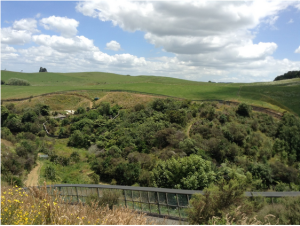
Welcome to Jurassic Park. Our bus screeched to a halt at the base of a looming mountain entrenched in green trees, and encircled by a foreboding fence. We hadn’t been given much information during our long saga towards the center of the North Island, but as we hastily applied sunscreen the guides filled us in. Sanctuary Mountain, Maungatautari, is an ‘ecological island’ located in the north island of New Zealand. They are trying to restore the surrounding habitat to its native, pest free condition. Maungatautari is the largest sanctuary of its kind, measuring in at 3400 hectares, and features many smaller sanctuaries within its boundaries (sanception). It has the longest ‘pest proof’ fence in the world, ensuring that endemic species are safe from predatory reach. The fence is monitored by staff to prevent any breakthroughs from the more wily pests. The parallels to the beloved early nineties film were hard to miss with it’s vast swathes of tropical vegetation and giant electrified fence. And little did we know, we would indeed be seeing dinosaurs.
The absence of native predatory mammals has been key in the evolutionary development of many endemic species of New Zealand. The only native mammals to New Zealand are two species of bats, the long tailed bat and the lesser short tailed bat. This environment made it possible for many species of flightless bird to thrive in New Zealand and develop defense mechanisms which made sense in the mammalian predator free environment. This has changed since humans have introduced domesticated mammals and other predators to New Zealand. These include animals such as cats, dogs, goats, possums, and others, considered ‘pests’ to New Zealand. The native wildlife were not used to dealing with the threats posed by introduced pets and pests, which took such a toll on endemic flora and fauna that many were pushed to the brink of extinction.
Maungatautari is home to many of New Zealand’s iconic but threatened species such as the Tuatara, Stitchbird, Northern Brown Kiwi and Takahe. The Takahe, a flightless bird, was once so endangered that is was thought to be extinct. Many of these species have been reintroduced while others have been allowed to grow and spread in their natural habitat, thanks to the fence. In the future, the sanctuary hopes to reintroduce even more species, such as the kakapo, a ground dwelling parrot..
We visited the sanctuary on January 10th and we were given a tour by our very knowledgeable guide, Nigel. He warned us about how easily predators could sneak their way past the fence, even asking us to check our bags. Apparently,on one occasion, a mouse had taken a ride in inside a volunteer’s backpack. Nigel used his keys to get us past the gate and into the sanctuary, pest free.
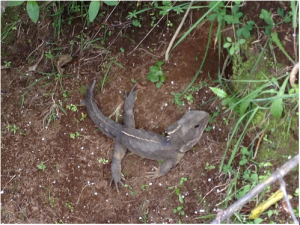
Once inside, we did indeed see some dinosaurs, or at least the closest you can get. The two species of Tuatara are the only known organisms that belong to an ancient order of organism known as Rhynchocephaliia. A last vestige from the mesozoic era, Tuatara may look like lizards but actually possess some insane functional and morphological differences. These include two rows of teeth on their upper jaw, rib-like bones similar to birds, spines similar to a crocodile, a preference for cooler climates, and a developed third eye on their foreheads! (Author’s note: many lizards actually possess a third eye, but it is much more developed in Tuatara.) [Author’s edit: Lizards have a third eye?!] According to our guide, they take a breath once every hour, are the fastest evolving creatures, and “They’ll scrap”. But all of that should probably be fact-checked. Though most importantly, they are also the namesake of a tasty New Zealand beverage.
Following our Tuatara visit, we explored the forest nearby and hiked our way up the stairs to a tree viewing platform. This gave us a chance to see some of New Zealand’s unique fauna, such as the rata which begins as a small plant and grows down a larger tree. Afterwards, we headed back to the nature center and thanked our guide. Overall, the visit gave us a taste of New Zealand’s can-do attitude toward conservation. Pest-proofing is a big theme in New Zealand conservation, so Maungatautari serves as an example to future projects. The unique natural habitat of New Zealand is source of pride to many Kiwis, a legacy to be passed down to younger generations, as we saw in the children’s drawings in the nature center, taped to the walls of the center, depicting the tuatara, the world’s last dinosaur.
From the nature center there is a stark dichotomy present between the landscape on either side of the fence. Farmland and sheep from colonized New Zealand on one side and the wild untamed expanses on the other, Old Zealand if you will. Nature reserves like Maungatautari provide a glimpse into what the world could have looked like if mammals never took over. A lost world ruled by the descendants of the dinosaurs: birds and tuatara.