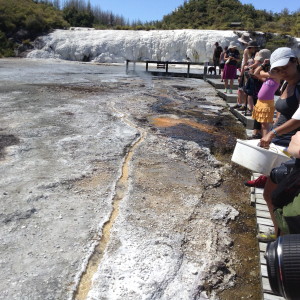
A hot water stream at Orakei Korako hot springs.
Sophia Horigan & Eli Baginski
One of the classes we are taking is Life in the Extremes, and our first situated study of this topic was learning about geothermal hot springs and their micro-biomes. New Zealand is a very thermally active landscape due to it being situated on a plate boundary. Trapped heat below escapes not only through volcanos but also through cracks in the crust that lead to vents of steam, which heat pools and create bubbling mud. The water is heated in reservoirs underground, and emerges from the ground at these so called ‘hot spots’ at temperatures very close to boiling. Also brought up are a variety of molten minerals that are deposited at the surface and harden to form incredible structures and patterns.
So what kind of life can tolerate or even thrive at these incredible temperatures? Well.. microorganisms!! Bacteria are EVERYWHERE and involved in EVERYTHING– in fact, roughly half of the world’s biomass is bacteria. That’s awesome to think about, considering the fact that it’s all beyond our capable sight. (Note that archaea are also microorganisms, but are not focused on in this discussion). Another great fact: only 1 in 10 cells on our physical body are actually human cells, the other 1,500 trillion are bacteria. Kind of redefines what the individual is, huh. Each of us has our own unique bacterial fauna that have been found to have a profound affect on all from obesity to mosquito attraction, and even controversially, autism. Microbiology is a great up and coming field as we are beginning to understand the extent of which the role of microorganisms shapes functions of life.
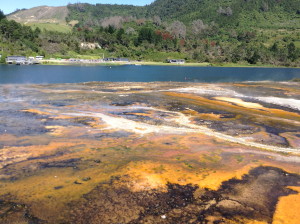
Many different organisms live in close proximity, creating a colorful ecosystem.
The bacteria that inhabit hot springs are known as Extremeophiles- organisms capable of all of the functions characteristic of life but in an environment where most others would perish. Amazingly enough, extreme environments are a place for much diversity: temperature and pH determine most species boundaries, and the great variety of combinations of the two provide many niches that are inhabited by different bacteria. These species of bacteria utilize the different minerals that are being deposited from below, in a sense mediating the geology at the surface. These interactions lead to a great variety of colors of biofilm and rock types unique to geothermally active locations.
To see life in geothermal hot springs in action we visited Orakei Korako. The landscape surrounding Orakei Korako is covered in lush forests ending in a brilliant blue lake. Just uphill of the lake, the landscape changes dramatically. Boiling waters bubble out of the ground creating an entirely different ecosystem, where bacteria, algae and insects proliferate. At first glance, the streams appear to be a random collage of colors and textures. On further examination, however, the life forms cover the land in predictable patterns. Using temperature probes, we measured the temperature of waters throughout the area. Water temperature could change by 30 °C or more within only a couple centimeters! Temperature also changed with depth, deeper waters being cooler, and turbulence, more turbulent the water the cooler it is. As organisms have optimal ranges that they inhabit, these temperature differences, along with pH and dissolved oxygen levels, largely control where organisms are found in the hot springs. In areas where the water temperature is above 60 °C only certain species of bacteria thrive, while cooler sections of the streams are completely covered by algae. Interestingly, in zones of high water temperatures, algae can actually be found growing underneath a bacterial film. The bacteria act as an insulating layer that protects the algae from the high water temperatures.
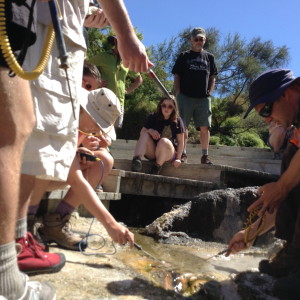
Measuring water temperature at different locations along a hot water stream.
Besides being a fascinating ecosystem that has useful applications in our daily lives, such as providing us with the enzyme used in polymerase chain reaction, geothermal activity plays a large role in New Zealand’s renewable energy. In the Wairakei area, the first geothermal energy system in the world was created. It brings up steam from over 2km down in a pipe system which is utilized to create electricity, and the steam in this network is of temperatures between 250 and 300 degrees Celsius. The steam is subsequently cooled and the heat is extracted for energy use. As far less energy has been put into the study of bacteria and other micro-organism than to the study of mammals and other macro-organisms, we will undoubtably gain much in the upcoming years from further investigation into these unique ecosystems.