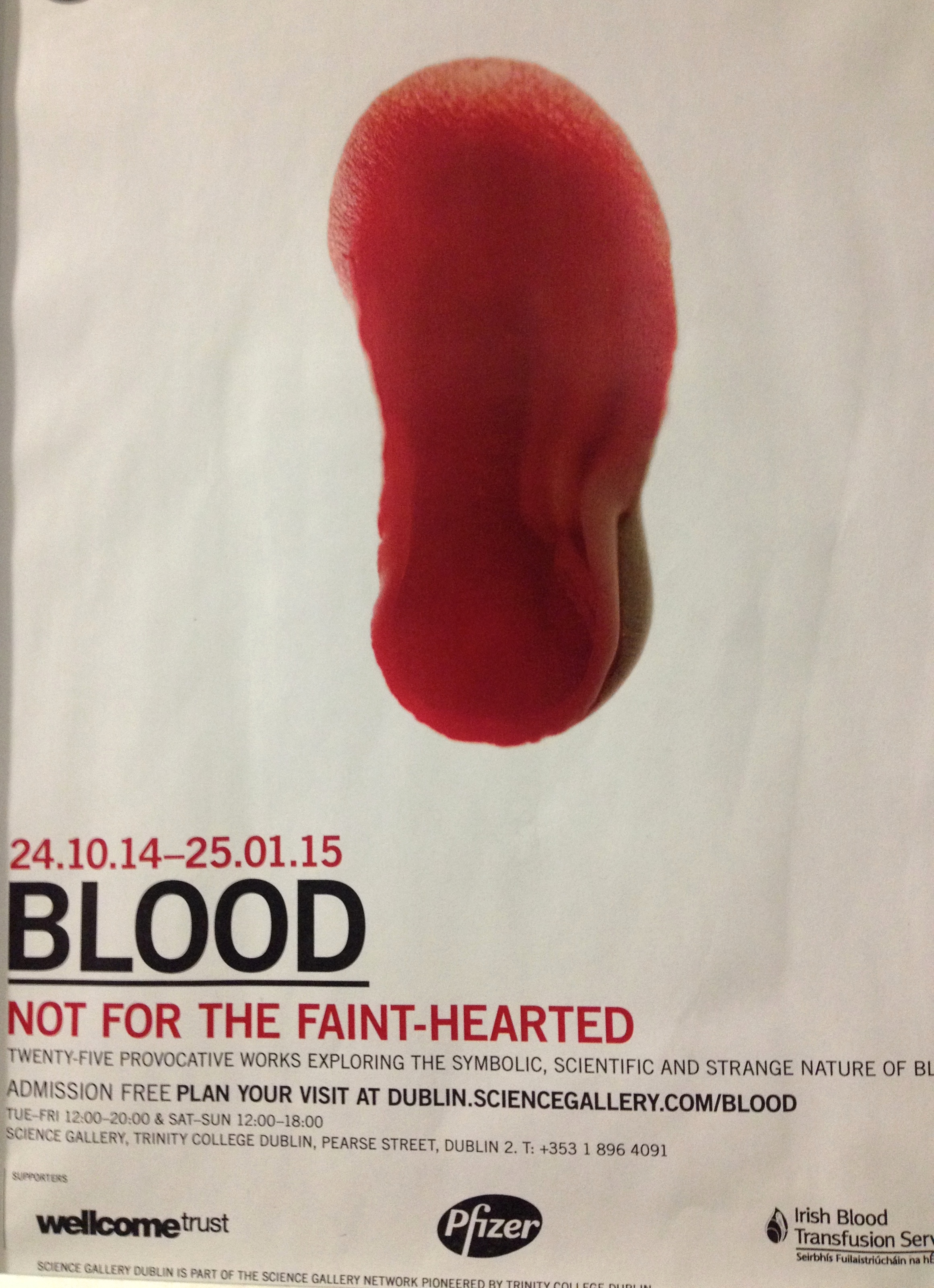
For the first week as I walked around the streets of Dublin, I continuously noticed a poster simply titled, “Blood—not for the faint hearted.” The primarily black and white poster showcases a single red drop of blood that appears 3-D like.
A group of us decided to explore the Blood exhibit which was located in the science gallery at Trinity College. I had no idea what to expect. I only knew that there were going to be art pieces related to the topic of blood.
One of the first pieces I observed as I entered the exhibit was titled, The Swarm. At first glance there appeared to be many individual wax squares each with a single black dot, forming one large square shape. The black dots were actually mosquito bodies. The artist used the encaustic mixed media method to create this piece. This is a method in which the artist heats the wax until it is liquid and adds a pigment of color. On the wall there are 1,500 squares each holding a mosquito. The artist commented that the longer an observer stares at this piece, they can begin to feel the presence of the mosquito landing on their skin, and begin to actually feel the “swarm.”
Another interesting piece explored the relationship between humans and animals through performance art. The artists call it bio art, where a human body is hybridized with a foreign animal body. In this case it was through the injection of horse blood. The performance included a behavioral researcher, two artists, and one horse in Slovenia. The main focus of the artwork is to investigate therapeutic research to test the positive effects of compatibility with horse blood. The artists’ goal was also to explore barriers between species.
Some other intriguing highlights of the museum included a station in which you could test your own blood type, learn about the Nazi ideology of blood, watch a 3-hour video that explored sadomasochist excess, dismemberment, celebration of ressurection, and transcendence.
The artist who created the 3-hour video performance is known for his fascination with religious art and exploring excessive beauty and our overall human existence. When we viewed this piece we were warned that it was explicit and disturbing. While a group of ten or so were on a guided tour, the guide mentioned that the performers paid to be in this performance. Which I found extremely interesting. Before we saw the video we only saw the faces of the observers as they witnessed what was on the screen. Their faces were in disgust. Many looked away, while others left the enclosed room quickly. No matter how many times I read the summation of what this video piece was about, I was left feeling simultaneously confused, disgusted, and curious. Even the tour guide mentioned how she still felt clueless to the meaning of this artwork. The scenes in which we witnessed showed a ritual-like occurrence taking place with a man and a woman both tied up, naked and blind-folded. I would go into further detail, but it is was quite graphic and revolting. Within the description of the piece it states, “Every descent into the perverse and the unappetizing takes place for the purpose of bringing about healing awareness. Increasing disgust and horror, and crossing all boundaries and taboos should ultimately lead to an affirmation of life transcending life and death.”
All in all, the exhibit included 25 artworks that “explored the scientific, symbolic and strange nature of blood.” I found this exhibit to be fascinating, considering the artistic representations that developed from pondering the theme of blood.