Sorry this took so long to post, there have been a few technical difficulties, but here is some summary of our time back in Sydney during the week of Australia Day!
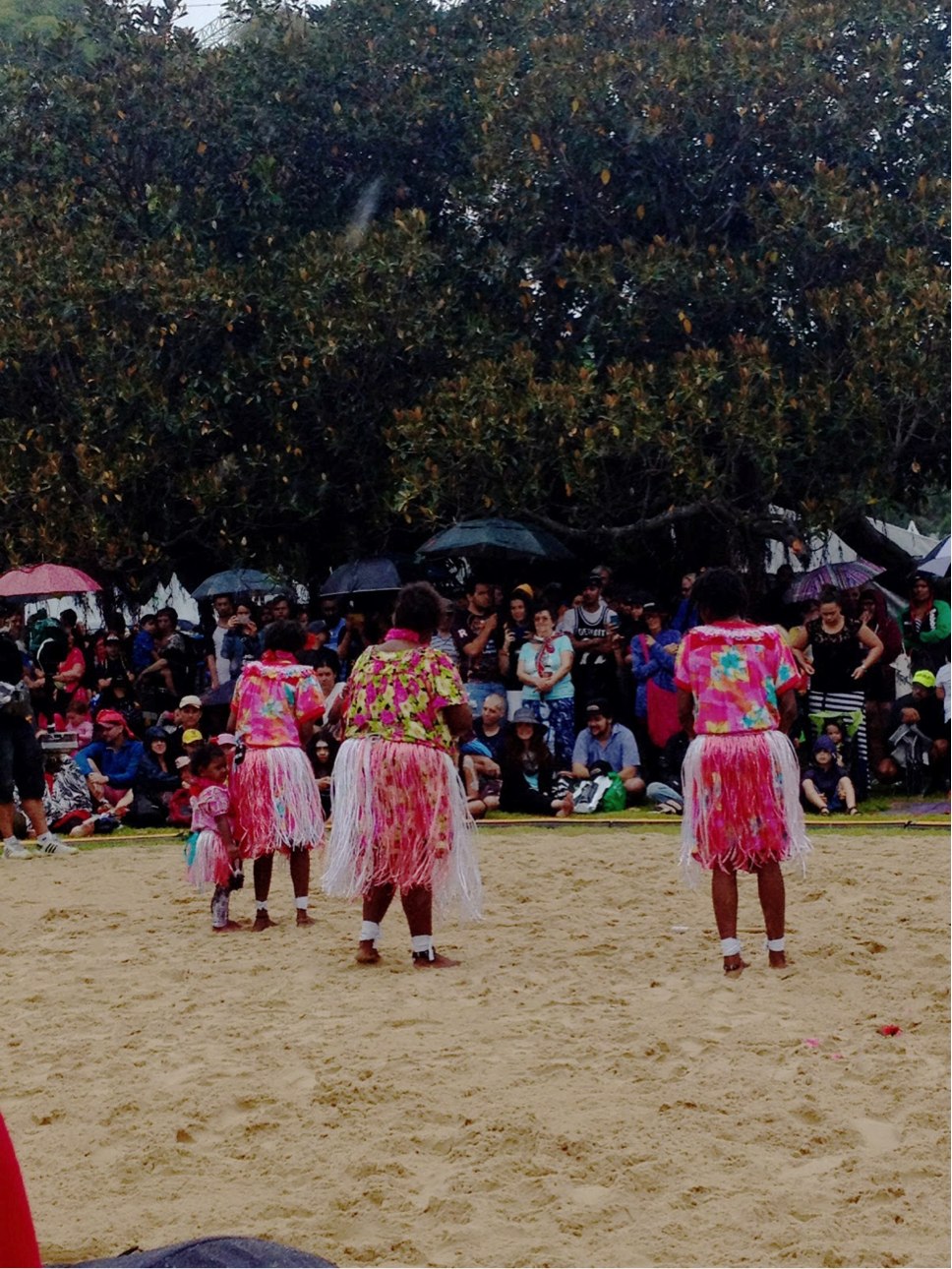
We’ve been busy travelling around and learning about the vast diversity of culture here in Australia. I guess the place we last left off was around Australia day, or Invasion day as the Aboriginal community calls it, back on January 26. What an event that was! Most of our group started off the morning at the Yabun festival in Victoria Park which was the Aboriginal community’s protest of Australia day.
The goal of the Yabun festival was to raise awareness for struggles within their community and the horrendous racism and discrimination Aboriginal people faced since the European invasion in 1788 when the first fleet of convicts landed in Sydney harbor.
Despite the struggles that the community still deals with, the festival was rich in cultural heritage where community members performed dances and music while vendors displayed traditional art pieces and clothing that promoted their communities. Other vendors were there promoting support and awareness for issues within their communities and potential services people could refer to for help. It was very powerful to hear the voices of the Aboriginal communities calling out for more respect within the greater Australian population.
From there the group diverged to explore the other celebrations of Australia day put on by those of more European descent. a few of us found our way downtown, around Circular Quay (pronounced “key”), where artists performed on several stages all afternoon, and countless food vendors and artisans sold a huge variety of trinkets and souvenirs.
Every direction you turned, there were people with Australian flags, tshirts, sports jerseys, tattoos, and most of the stores had some kind of decoration in the window. It was an exciting celebration of Australian culture, despite the fact that many people actually see the holiday as more of an excuse to go out to bars or host a barbecue than to actually celebrate being Australian. To many people, it’s a just long weekend at the end of the holiday season.
Throughout the rest of the week, we learned about the dichotomy between Aboriginal cultural heritage and the European cultural heritage, and how some of the discrepancies are manifested through historical context and contemporary media.
We started off the week looking at cultural perspectives through art with a visit to the art museum and looked at the European styles of portraying Australia through a Eurocentric lens. Paintings were designed to entice people in to move to Australia, even though the depictions were somewhat fictitious.
In stark contrast, the Aboriginal art gallery focused on depicting Australia in a more tangible way. Artists depicted where foods could be found and cultural stories of their people. These two incredibly contrasting styles of artwork are highly indicative of the discrepancies between European settlers views of Australia and the traditional Aboriginal understanding of the land.
Another interesting dichotomy we explored was women’s role in the particularly patriarchal development of Australia. Australia was one of the first countries in the entire world to give women the right to vote, but women were still expected to be homemakers and caregivers for their families.
Originally, since the population of Australia was predominantly male, women were sometimes viewed as a civilizing factor in Australian society due largely to the fact that men were encouraged to settle down and start families, where otherwise the men were often more prone to gambling, drinking and generally more stereotypical male behaviors.
Finally, we finished up the week by looking at some more contemporary views of Australia through the media. I was surprised to learn that Australia plays an important role in the worldwide film industry, and has long exerted a significant influence on film, despite the emergence of Hollywood in the USA.
Australia actually is still deeply ingrained in Hollywood production, providing shooting locations, production crews, directors, and big time actors. While Australian involvement in film isn’t necessarily reflected in its national box offices, they consistently have a hand in big productions.
Another interesting note is that the Australian cinema industry as well as their television media is publicly funded through the government. Their news media is often fairly balanced, with the main perspectives coming from the two major political parties, but with more attention paid to minor parties than the US often shows.
Overall, there is a lot more the Australian culture than the general worldwide stereotype of Australia, though there is some truth. Australia offers a richly diverse and complex socio-cultural diversity with a fascinating history with competing stories and versions of events as well as continued struggles to form a coherent national identity around which all the citizens can agree represents them accurately and fairly.