 The Space of the Revolution
By Elliott Young
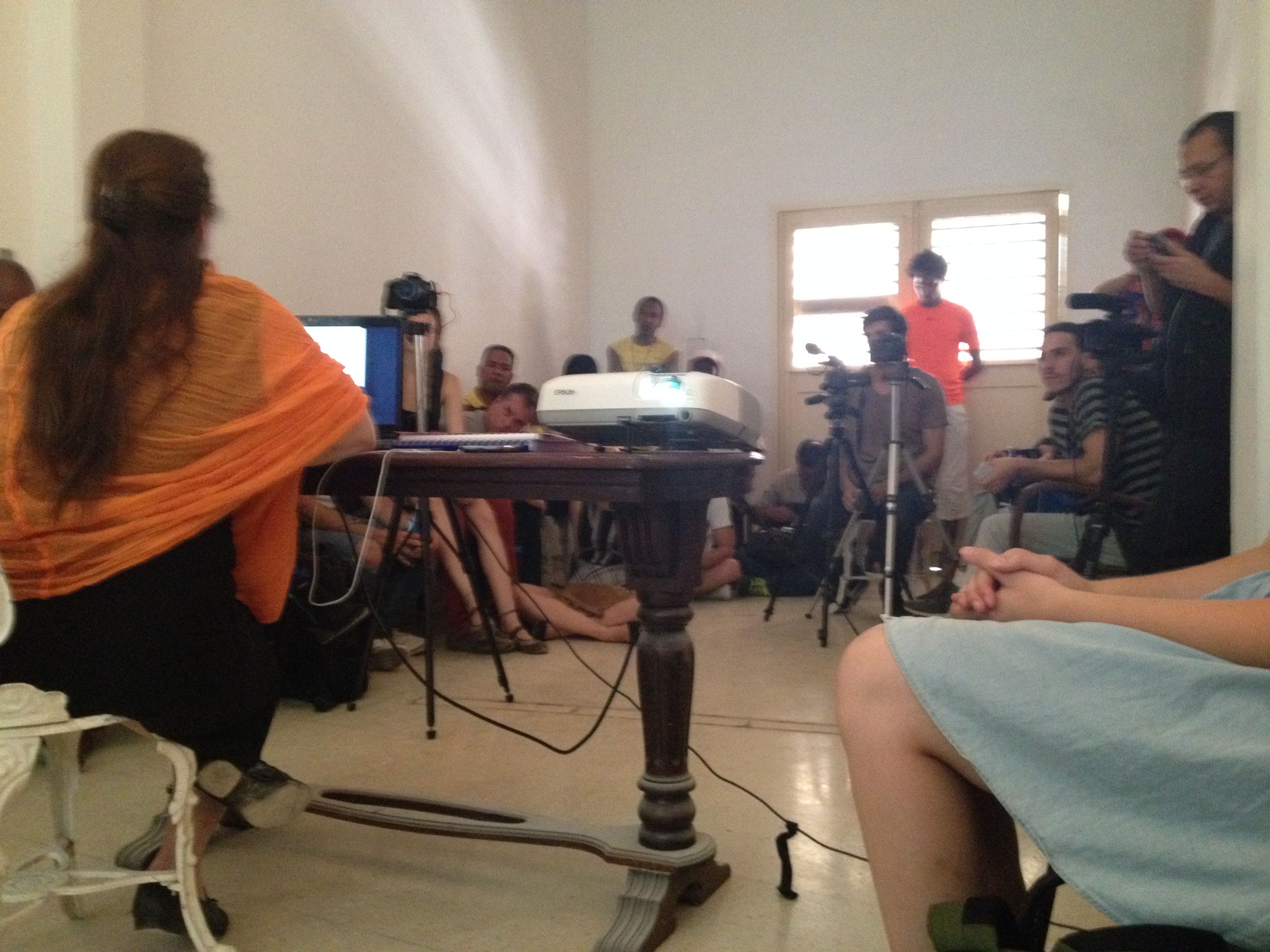
On Friday March 13th, a group of thirty artists, journalists, students and activists crowded into the Cuban performance artist Tania Bruguera’s house in Old Havana to hear her side of the story. Bruguera has been artist non grata ever since she attempted to do a free speech performance in the Plaza of the Revolution on December 30th. She was arrested three times, dressed in prison garb, her telephone has been cut and she faces numerous charges including disturbing the public peace and inciting to riot.
Over the past several weeks state controlled cultural institutions including the prestigious art university Instituto Superior de Arte (ISA), have held meetings with faculty, students and staff to discredit Bruguera.
The performance Tatlin’s Whisper #6 in which the artist set up a podium and invited people in the audience to say whatever they wanted for one minute was presented at the 2009 Havana Biennial. Although Tatlin’s Whisper was critiqued in 2009, it was not censored.
This time Bruguera proposed doing the performance in the very public and historically charged Plaza of the Revolution. This massive open-air plaza is anchored by an enormous monument to Cuban independence hero José Martí and flanked by huge profiles of two of the three most revered comandantes of the Revolution: Che Guevara and Camilo Cienfuegos. The third is Fidel. The performance was not the problem. The issue was the very public space in which it would unfold.
Before the performance, Bruguera met with Ruben del Valle, the president of the Cuban Fine Arts Council and the Havana Biennial, who tried to convince her to conduct the performance inside the Fine Arts Museum. According to Bruguera, del Valle argued that art belonged in an art space.
Bruguera insisted that the performance happen in a public space, proposing the street located between the Fine Arts Museum and the Museum of the Revolution. After failing to reach an agreement, del Valle sent her a letter in which he ominously warned her that given her intransigence he would take no responsibility for what happened to her legally or otherwise. Since then, del Valle has described Bruguera as a mouthpiece for the “restoration of capitalism.”
An ISA student at Bruguera’s house described a meeting she attended in which they were shown photographs of the artist with the dissident group Damas en Blanco as evidence that she was consorting with the enemy. Bruguera does not deny meeting with the Damas en Blanco who she describes as “courageous.” One of the Damas was even in attendance at the gathering at her home, but she insists that meeting with someone does not mean she herself is a dissident. The government sponsored meetings have been designed to isolate Bruguera, depict her as an egomaniacal opportunist and counter-revolutionary. From the many conversations I have had with ISA students and faculty, the campaign appears to be working.
Bruguera has found herself embroiled in a Kafkaesque drama, a performance that she started but which seems to have no end. Given the leading role the Cuba government has played in this performance, one wonders if they should have some of the authorial rights when the piece is eventually sold to a museum.
Since Cuban authorities hold her passport, she may be unable to attend the upcoming Venice Biennial in spite of being the only Cuban invited to participate.
The government has already delayed her case for 60 days and it can continue to do so for another six months, leaving the artist in legal purgatory. Meanwhile she has been unable to find a lawyer because all lawyers on the island work for the state. Bruguera has been using her time to study the Cuban constitution and criminal law, which sat on the desk in two thick binders with brightly colored tape flags sitting in front of her as she spoke.
The question of who has the right to public space has been the central issue from Tiananmen Square to Occupy Wall St. to the Umbrella Movement in Hong Kong to Bruguera’s aborted performance. Although liberal democracies in France and the United States like to claim that they hold free speech sacrosanct, if you cross some line in a comedy club in Paris or on an American university campus, the guardians of propriety and civility come down hard.
Cuba is no exception, except in Cuba the state controls almost everything. As Bruguera put it, “artists are confined to art spaces, and the Revolution controls the rest.”