Lewis & Clark Around the World

Programs associated with Lewis & Clark College, Portland OR

  • About
    • About Lewis & Clark Around the World
    • Contact Information
  • Programs
    • Featured Overseas Programs
    • View All Overseas Programs
    • View All Program Sites
  • Participants
    • Posts
      • Featured Student Posts
      • View All Posts
    • Projects
      • Featured Student Projects
      • View All Student Projects
      • Map of All Projects
  • Help
    • Participant Orientation
    • Post Reminders
    • Your Dashboard
    • Your Overseas Project
    • Setting Up a New Program

Public art

May 29, 2015 By Tyler Wayne Patterson

We were lucky enough to be in La Habana for the 12th annual Biennial, a multi-week, bi-annual celebration of art in Havana. My last full day in Cuba, I took a stroll by myself down the Malecon, from Vedado to Habana Vieja. As part of the Biennial, there was a series of temporarily installed “public art” pieces.

They start just after the United States Interests Section, since one is not allowed to congregate along this part of the Malecon—You must keep moving and, by the way, you may not walk on the interests section’s side of the block.

I was rather underwhelmed by many of the pieces. Many were not accompanied by titles, and nearly all did not have any sort of description. This lead me to think about the purpose of public art, and how accessible it should be. These are not permanent pieces, and they are part of a public arts festival, but for those without any experience in the arts, a description should be included.

Though I have some experience in the arts, I couldn’t understand many pieces without a description. I found many of the pieces underwhelming. A few served only as just aesthetically pleasing additions to the usually bleak concrete. I couldn’t understand what the artists intentions were because there was no context. 


I began to consider some general questions about public art. Should public art just be a space for artists to present work, or should it serve the public? Should it represent universal, or shared values held by a community or majority, or provoke conversation?

I was interested in the most experiential pieces of Art. The first I encountered forced the pedestrian to experience it. One could either step over crates that continued from the sea to the street, or walk through the maze-like structure.
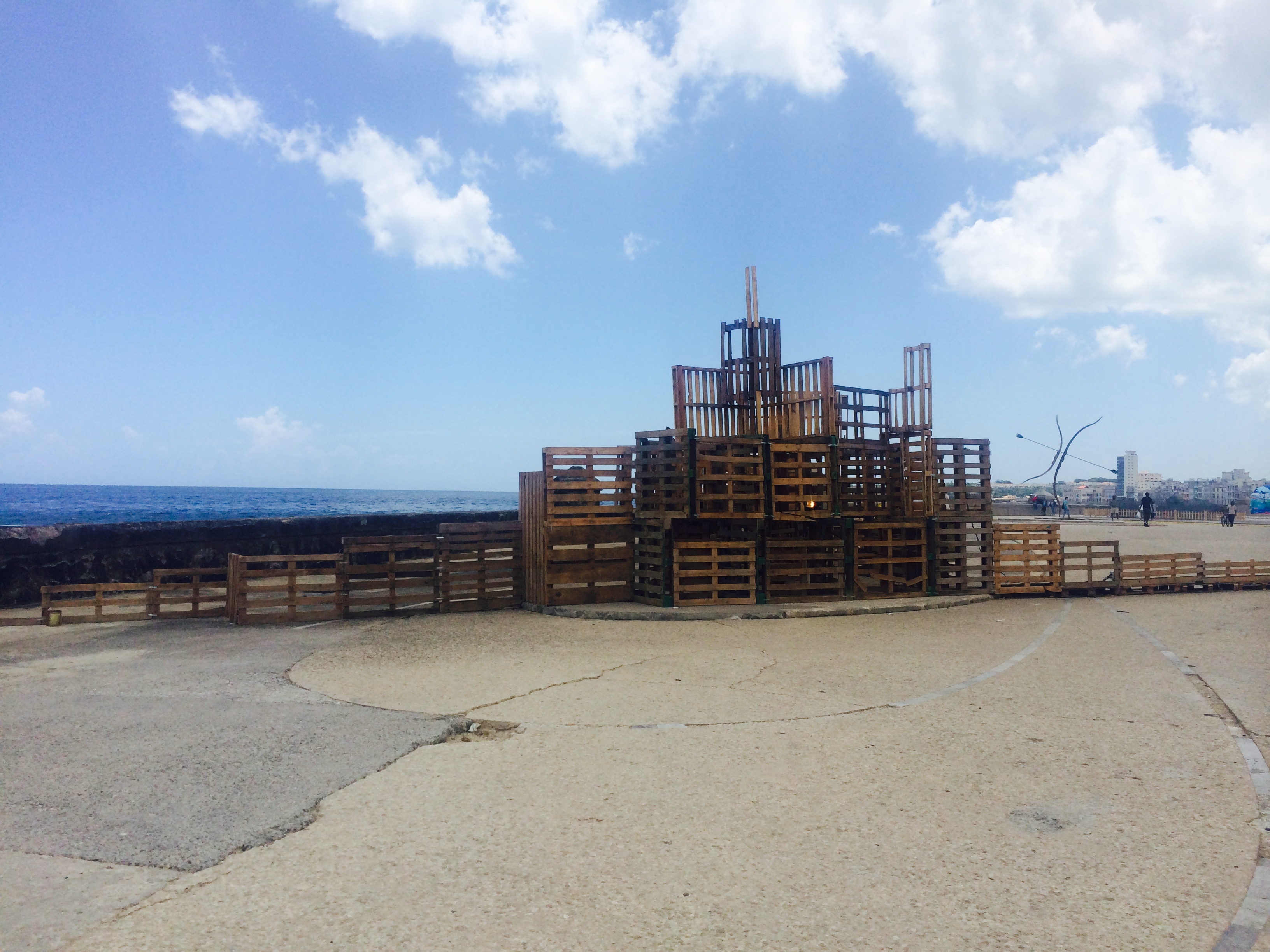
IMG_6702

Perhaps my favorite piece was a fake-beach front designed by “”. La Habana doesn’t have any sandy beaches; one must travel slightly out of the city to find one. Though all beaches in Cuba are public, hotels cannot reserve spaces on beaches for guests, the chairs usually cost 3 dollars. Here, any spectator can rest in the sun or shade on plastic white chairs. Perhaps it was a statement on tourism and its moral implications, or on public space versus private space in the city.
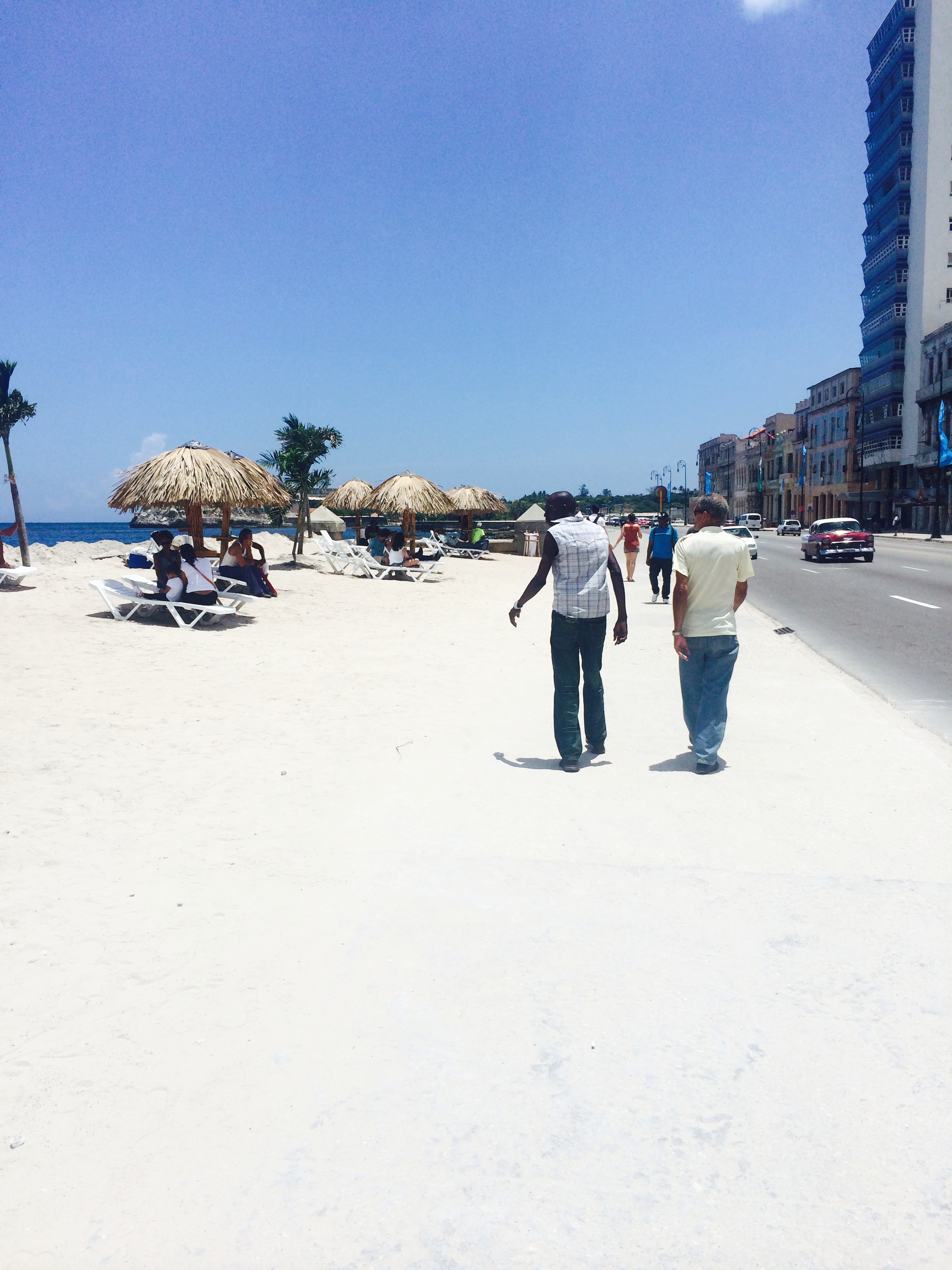
IMG_6714

Should public art be designed to remain for decades, like the monuments to Latin American Presidents on Calle G, representing long-term social values of society? Or should it be like the sandy beach, a temporary statement about contemporary conditions?

Art has been a central component of my experience in Havana. Concerts cost just one or two US dollars, museums and film just a couple of United States cents. And, since the program is synced to end after the first week of the Biennial, I was able to see the work of artists around the world.

Filed Under: Cuba Spring 2015

For more information on Lewis & Clark Overseas & Off-Campus Programs, visit our website.

Featured Programs

  • Fuji Summer 2017
  • Morocco Spring 2017
  • Cuba Spring 2017
  • Germany: Berlin Fall 2015
  • India Fall 2015
  • Fuji Summer 2014

Recent Posts

Diving Deeper into Coral Reef Ecology at Lady Elliot Island

Diving Deeper into Coral Reef Ecology at Lady Elliot Island

Another day in paradise. Today marked our third day on Lady Elliot Island, and it’s easy to see that we’re all getting used to this. Waking up early isn’t a challenge with the bright sun and the cacophony of seabirds, but for once no one is upset, as our first activity is a quick snorkel […]

Journey to the top of Queensland – 5/4/18

Journey to the top of Queensland – 5/4/18

Today marked our last day at Carnarvon, with our next stop to be the Great Barrier Reef. Although we’ve stayed at Carnarvon Gorge longer than expected due to the cyclone off the eastern coast, it allowed us to explore even more of the beautiful park. We were woken again by the sounds of Laughing Kookaburras, […]

Great Times at Great Kepple

Great Times at Great Kepple

April 7, 2018 Our first full day on Great Kepple Island! We spent the morning in lecture learning about coral, coral reefs (there’s a difference!), conservation and the general weather trends that can dictate the biogeography of the ocean. While some had come into this program with invertebrate knowledge from classes at Lewis and Clark, […]

Planes, trains, automobiles and the amazing reef!

Planes, trains, automobiles and the amazing reef!

On April 10th I woke up to the sound of the train wheels clacking. It was 5:30 in the morning. I was so tired but also so thrilled to be traveling to a new destination. Soon after we woke from the comfy and unique accommodation of the train, we all gathered our belongings and hopped […]

Under the Milky Way Tonight

Under the Milky Way Tonight

  On April 3, 2018 we stayed at the Takarakka bush resort in Carnarvon Gorge. One of the many highlights of Carnarvon George is the sky. Specifically, the entire Milky Way. Which, as our tutor brought up, used to be a sight that everyone could see. It is because of our cities light pollution that […]

Digital Scholarship Multisite © 2018 · Lewis & Clark College · Log in