For our first paper here in New Delhi, our teacher, Dr. Sunil Kumar, asked us to write about a place we had visited since being here in the city. The guidelines were very open and basically he encouraged some research into the place, but wanted a paper that showed our engagement and reflection with and on the space. For my place, I chose the National Gallery of Modern Art, which is convienetly located only about 5 minutes (by auto rickshaw) away from our residency. I was extrememly moved when I visited the museum, both by the museum itself, as well as the art. The museum was much larger than I realized, and I ran out of time before I ran out of rooms, though I intend to go back before we leave to check it out again! Unfortunately, photography was not allowed, but if you are interested, be sure to check out the gallery’s website here. Below is the paper I wrote on this place, including images of 3 paintings from the collection–if you are ever in Delhi, please don’t miss the National Gallery of Modern Art!
The National Gallery of Modern Art (NGMA) is located at the end of Rajpath, in the Jaipur House, a building constructed by architect Sir Arthur Bloomfield in 1936 as a residential palace for the Maharaja of Jaipur. Right away, we understand that this construction was meant to emulate a certain type of grandeur; fit for an Indian prince in the 20th century. Rajpath, (where the Jaipur house is located) means “Kings Way” and is flanked with lawns, canals and trees ending at the India Gate. Interestingly, the Rajpath is intersected by Janpath, “People’s Way”, seemingly furthering an elitist attitude in the area. Overall, this splendor reminds me of something I might have seen in France or England, not amidst the crowded and diverse streets of Delhi. This of course, is due to influence from British rule during the 20th century when this construction took place– which gives a feel similar to that of Connaught Place, without the mass of contemporary shops and bustling indian culture, today.
All of this paints a picture of the type of neighborhood in which the NGMA is located–stark in contrast to even wealthy, surrounding neighborhoods. The Jaipur House was used residentially for less than 18 years before its inauguration as the NGMA in 1954. This inauguration was significant as it marked India’s first institution of its kind, and was supported by Prime Minister Nehru, who attended the opening ceremony. A significant amount of effort in development can be attributed to the popular first curator of the gallery, Herman Goetz, well respected for his contributions and in his line of work. Notably, Goetz was German and having studied and worked throughout Europe left him versed in techniques and styles from prestigious, European art museums. However, Goetz had also extensively studied Indian art and art history both during and prior to his time in India, thus contributing to the creation of a museum collection which emulated traditional western style, while emphasizing Indian artists and culture. It is hard to tell if this western influence makes the gallery inauthentic in anyway, but most records paint Goetz and his work in a good light, he stayed on with the Gallery until in old age he moved back to Europe.
After visiting the museum, I would also like to draw a comparison among the above, a traditional, western-style museum with sophisticated work which emphasizes Indian art and culture, and the feelings from the exhibits inside. In order to do this, it is important to describe the structure of the building itself. After 55 years, in 2009, a new, second wing was built behind the Jaipur House (yet still very much incorporated into the estate) creating about 6x more gallery space for exhibits. This wing is structured in levels, each open in the center to the main lobby, and which, as you ascend, take you through paintings, drawing and sculpture, along a timeline of history and style. The beginnings of both exhibits showed similarities to underlying British or European influence, sometimes not so subtly.
In the first exhibit, a large portion of the work from the life of Indian artist Amrita Sher-Gil is displayed in semi-chronological order, starting with her studies at Ecolé Des Beaux Arts in Paris. Most of these works featured nude, white models, and Amrita was said to have painted some of her self portraits in response to a feeling of otherness and as a critique of the fetishization and idolization of western physicality. In contrast, her self portraits are more colorful, full of expression and personality. As the exhibit progresses, Amrita’s work shifts in style–no longer trying to imitate impressionism or realism–as well as in subject towards Indian lifestyle and culture as she finds her voice and place in the 20th century art scene. During this time, very few Indian artists were working in this way–paralleling European artistic movements, yet without losing sight of where one’s own experience and creativity fit in.
The second exhibit features a variety of artists, but continues in a timeline theme through India’s fine art of the 19th and 20th centuries. This starts out with realism from British artists who were largely painting and drawing specific monuments, plants or people, often commissioned by the Company for documentation purposes, though also too for art’s sake. These impressive paintings feel almost awkward or imposing in this gallery. Greater in size, yet with much duller color palates, for most part the paintings, though beautiful, feel like the gaze of a foreigner, rather than as engaging with Indian culture. As the exhibit continues on however, and as the British left the scene, Indian culture emerges– these paintings are full of bright colors, detailed patterns, gold detailing, and Hindu deities, to name a few. Even as the exhibit moves into cubism, modernism and abstraction, many of these themes seem somehow to prevail.
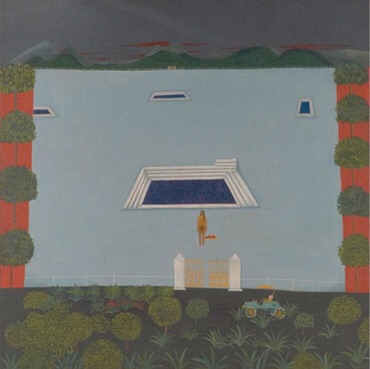
Bhupen Khakar
Hamam-khana
Oil on board
49 x 49 inches
1968
Many pieces might be unidentifiable as Indian, true, yet in many by working in pieces of their culture, be it goats, bicycles with water jugs, bright mandala inspired patterns or a bony nude titled “Starvation”, artists allow viewers to understand underlying influences of culture. But at the same time, here these pieces are, in an elite gallery modeled after european counterparts; moving out of the streets and homes that the work emulates, into a worldwide dialog of modern fine art.
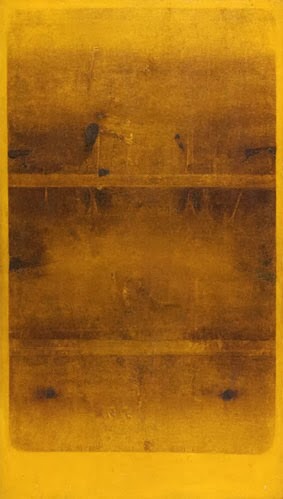
V S Gaitonde
Painting,
Oil on canvas
101.3X178 cm
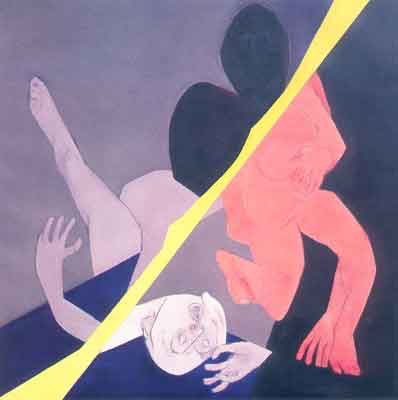
Tyeb Mehta
Diagonal Series
Oil on canvas
68.9″ x 68.9″
1973
There is a lot that could be said or asked about the art itself, but to stick to understanding the place, the NGMA, it is important to ask other questions, such as who is a part of the experience. For the most part, I observed only other foreigners, and well-dressed Indians, many speaking only in English, including one couple who seemed to be engaging in some interior redecorating of their home, deciding which pieces to purchase reproductions of (these two were also wearing highly westernized clothing). In addition, there was a group of students, with whom I talked to find out that they were graduate students from a university in Delhi, studying journalism and mass communications. The NGMA seems to be slightly isolated from its larger surroundings, in the sense that it is attracts people to travel to it, rather than a purpose to appeal to residents of the neighborhood. This could be due to entry fees (though relatively low for Indian residents) and as such a specific subject and purpose the building holds, catering to a rather specific crowd. Guards at the entrances and along the high fences that surround the grounds keep the atmosphere inside the estate both professional and calm, there are no vendors or beggars. I would guess that the NGMA is used to tourists, as I did not get as many looks, and no one made any comments towards me, as has often happened when I go out; I apparently seemed to be in the right place, I was expected, and I felt very comfortable.
Despite feelings of elitism that may surround this place, I hope that it is considered with high regard among Delhites, as to me, I felt that it was an incredible collection and celebration of Indian culture as well as a way for India to engage itself in a modern, worldwide tradition of art. I am so glad that I visited and will probably visit at least once more before I leave Delhi.