
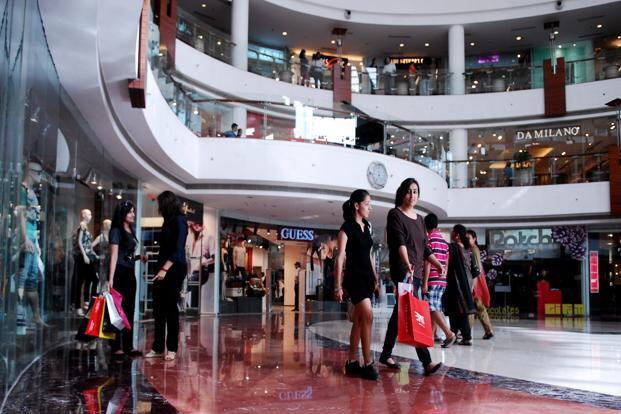
 After winding through the colorful and cluttered streets of India, entering the shiny, white, and supersized environment of the Select City Walk mall complex transforms the world around you. Instead of hustling street shops and local venders calling out prices, the mall contains almost exclusively western stores catered to tourists and upper-class locals. Any major metropolitan city in a developed nation would be proud to advertise this mega world of economic exorbitance. Store after store advertises western styles and beauty standards, with short skirts and tight dresses modeled on thin Caucasians positioned in sexual poses. Although I have observed the integration of western fashion in Delhi culture, most of the revealing clothing sold at this mall is rarely seen at the other places in Delhi we have visited. While Delhi is a huge metropolitan city with many up-and-coming technologies, the creation of the Select City Walk mall complex reflects a greater trend of the suppression of Indian culture by western ideals that reinforces the dichotomy of the east verses the west and the divide of the Indian identity.
As the world continues to expand its technological innovations and exchange ideologies, India faces increasing globalization that is transforming Indian culture and identity. The Select City Walk mall reflects the global reaches of the capitalist ideology and its homogenizing consequences. Through observing the whole operation of the mall and its location, it seems as though its construction correlates with an agenda of demonstrating Delhi’s industrial advancements and global reach. Opened in 2007, the internal system of the mall emphasizes modernity, luxury, and wealth. The mall radiates purity and cleanliness with bright lights illuminating the clean whiteness of the floors and stores. This juxtaposes the muggy and dirty streets that surround it. The stores advertise excess wealth that can be spent on pricy goods which adhere to popular western styles, such as things from Forever21 and Victoria’s Secret. These revealing styles contrast with the modesty of the clothes I observe on people in the streets and that are sold in local markets, such as the one right outside its doors. While there is never a simple or linear answer to the processes behind city development, it seems as though this mall is a reaction to the ways in which developed nations judge less developed countries, a way for Delhi to prove its functionality, innovation, and retreat from “traditional”. Through this insertion of a western styled mall and other western ideologies of culture and beauty, Delhi faces a process of dividing identity. Cultural practices, such as women wearing locally sourced saris, are being replaced with outside practices, with stereotypical western clothing and stores. Obviously, I am making blatant assumptions based off of ten days of experiences in Delhi, of which I interpret through my American lens and liberal arts education. Nonetheless, I have observed a separation in the making of an Indian identity that correlates with globalization.
The relationship between the Select City Mall and the surrounding Saket area reinforces the idea of the dichotomy between the west and the east, between developed and developing, and between modern Delhi and traditional Delhi . The stark contradiction between the clean and shiny mall and the hectic street market overly emphasizes the differences between the two operations and the cultures they represent. The mall is ordered, bright, mechanical, and gaudy, while the street market swims with foot and bike traffic, heckling venders, and pungent smells. Stepping into one after observing the other, I noticed their contrasting differences even though they live across the street from each other and both their basic purpose surrounds selling goods. Their contradictions seem to reinforce the Orientalist dichotomy between modernity and tradition. Another stark dichotomy fueled by the existence of the luxury mall lies in its relationship to the mosque right outside its doors. The mall, representing capitalism and modernity, stands in opposition to the mosque, which reflects old religious authority. This dichotomy, which has historically been used as an imperialistic strategy to colonize and control communities in the eastern world, homogenizes both the historical cultural practices of Delhi and its culture of advancing industrialization. While the dichotomy between the old and the new in Delhi is far too stereotypical and incomplete, the placement of the mall next to the street market and the mosque exaggerates the opposition between tradition and modernity. As a postcolonial society, Delhi demonstrates consequences of the imperialist ideology, such as a renunciation of the past, a political system based on liberal theory, and a culture of divided identities.
Finally, the creation of the Select City Walk mall implicates the social dynamics of Saket and represents greater social trends in Delhi surrounding its divided identities. The people that I observed shopping in the mall seemed to be of wealthier backgrounds. Wearing expensive looking, western clothing that was well-kept, these shoppers were clean, spoke English, and seemed to immensely enjoy the space they were in. The workers in the stores also spoke English and acted very orderly and quietly. In opposition, the shoppers in the street market moved fast, spoke a mixture of Hindi and English, and dressed in more draping, tattered clothing. The venders dressed in less formal clothing and periodically shouted out to get the attention of passers by. While these are blatant assumptions, a loose observation can be concluded that the mall houses stores of foreign companies and caters to a more elite class, while the street market attracts less wealthy classes and employs local venders. As the rich and the poor segregate and occupy different spaces, the gap between them grows more and more. Likewise, the creation of malls like this one contributes to the displacement of local wealth circulations and craftsmanship. As more and more foreign stores enter the local economy, Indian crafters are being displaced and their products replaced with mass produced goods from China, as explained by Jaya Jaitly. Instead of using their skills to make a living, craftsmen must find other employment, such as performing the invisible jobs at the mall. Mall shoppers do not notice who washes the floors, who keeps the space immaculately clean, or who opens the doors. While the creation of the mall reflects a divide in the Indian identity between the old and the new, the poor have less of an opportunity to negotiate an identity for themselves and are more likely to be placed in the stereotype of backwards and traditional.
While the creation and location of the Select City Walk mall complex represents larger trends of globalization, identity distinctions, and dichotomizations of cultures in Delhi, this interpretation is too simplistic and filled with assumptions. I am extremely interested in the socioeconomic and historical situation in Delhi, however, my cultural and social background influences my interpretation of this city. Just as the dichotomy between traditional Delhi and modern Delhi, represented by the street market and mosque in relation to the mall, homogenizes Delhi’s complex and transforming urban system, any interpretation of Delhi that I come up with will be far too simplistic. Delhi’s colonial past, it’s traditions that stem from ancient civilizations, and its introduction into the globalized world ensure that no dichotomy or simple contradiction will ever capture its complexities. Through careful observation, reflexivity, and human interactions, I intend to continue to open my mind to the diversity and entanglement of Delhi.