
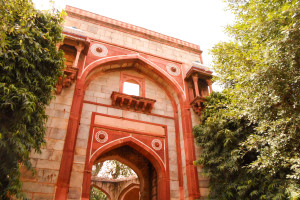
The heart of Delhi is, through my eyes, defined by the sum of its ‘pockets’ of character. Though there are not always clear divisive lines, each hub of the city is separate not just by obvious divisions of language or religious affiliations, but also in more nuanced ways- dietary practices, the symbolic use of color, the presence or lack-thereof of sidewalks, categories of plant and/or animal life, recurring architectural patterns, and for the focus of my study: each region’s distinctive relationship with memory. In visiting key historical markers around the city of Delhi, I took interest in the ways in which each history was being conveyed- how is history remembered today, through these monuments? Via placard, oral recounting, or immediate reflections of the students around me, each story took on a subjective form and was almost always tied-off with some kind of convenient motive. The distinctive memory of each historical site was carefully arranged for our experience, scripted and polished to meet the standards of an, ultimately, nationalistic narrative that we were to discover first-hand. In this essay, I explore the ways in which a particular approach to remembrance is depicted upon a visit to Humayun’s Tomb, and how it may be anecdotal to a broader understanding of the Indian relationship with remembering history.
“It’s my favorite place in the city of Delhi,” said one Delhi University student when she got news of our scheduled visit. Before arriving at the tomb, we were lead to an understanding of a place that was to be relatively tranquil, full of open space and greenery, mesmerizing architectural detail, and plenty of room for solitude. At the entrance gate, these ideas were confirmed. The landscape was sterile; it was a breath of fresh air compared to what we had seen of city life. A well-manicured lawn spread for what seemed like miles to our left and to our right, which was for the most part, void of visitors. There was a woman washing even the signs in front of each ‘site of interest.’ It was clear there was an order to things; this place existed at the core of Indian (nationalistic) society and it was to be kept a spectacle in its purest form.
Our tour guide repeatedly stressed the amount of pride associated with maintaining the grounds in such a way- using the same technologies and methodologies as were used in its original construction in the 1500s. A mighty feat at the time, this process, nowadays, is extensive and inefficient compared to modern means; yet, the private caretakers of the grounds insist on upholding the merit of the structure by looking after it in a way that would suit its original state. It was at the mention of the calculus and meticulous handiwork involved in restoring each inch of the waterways throughout the grounds that I was struck with curiosity about the purpose of doing all this work in such a way. Rather than renovate, the site gained a degree of historical legacy by crystallizing a memory of how magnanimous the nation once was. Preserving more than just the methods and materials of constructing the tomb itself, but more importantly the ideology of a society at the height of its glory.
We saw this notion arise time and time again throughout the duration of our tour: a constant tension between the ethics of restoration versus reconstruction. If memory is a mobilization of the past to suit our present needs, an idea so eloquently posed by Erna Paris, then why were the keepers of the tomb so fixated on memorializing the needs/standards of the past?
The history of the tomb, as told by our tour guide, was contradictory to these ethics even within its own narrative. During a time of civil disruption, refugees flocked to the grounds to find salvation; and in their time of crisis, they made themselves at home. Dislodging the wooden doors from the periphery of the tomb, the material was repurposed to suit their needs- they used it as firewood to keep warm. In doing so, the formal memory of Humayun’s Tomb was disregarded; its structure was compromised for the sake of conveniencing those who occupied the space. Though, to my understanding, these actions were not done in vain. There was no blight to the legacy of the tomb or the might of the nation, rather- the repurposing of the wooden doors became a productive means of engaging with the history of the tomb itself.
This discrepancy was blatant across the various monuments, tombs, and shrines we have visited across the city of Delhi. Are sites of memory honorable as pristine postcard subjects or rather, as repurposed, modern sites of cultural engagement? Depending on our location, the relationship with these sites of memory varied dramatically. While Humayun’s Tomb represented one end of the spectrum- with complete authority placed in the preservation of historical memory in its purest form, this was not the case at, for example, Nizamuddin’s Shrine- where people continued to enter each holy space, decorate the structure with beads, fill the air with songs and prayer, and engage with the memory of the space through their daily personal practices. Through the active participation of its visitors, the shrine was undergoing constant transformation- the key to remaining a spiritually, historically, and regionally relevant space.
I speculate that this diversity in rituals surrounding sites of memory is common not just throughout Delhi, but likely across the nation. While a nationalist perspective promotes monumental ‘sites’ as sanctioned with stature, hands-off, incomprehensible spectacles to the common visitor, I would even go so far as to argue that it is this very “censorship” of engagement and resistance to renovation that is responsible for the vacant grounds of, for example, Humayun’s Tomb. On the other end of the spectrum, holy sites and cities, ancient yet thriving bazaars, river rituals- these activities show a very different relationship with historical memory, one that remains inclusive, alive, and most importantly: practical. What purpose historical memory serves, and to whom it is accessible- these are the dissimilarities that characterize each ‘pocket’ of community and lend us a hand in understanding the heterogeneity of the Indian national identity.