Lewis & Clark Around the World

Programs associated with Lewis & Clark College, Portland OR

  • About
    • About Lewis & Clark Around the World
    • Contact Information
  • Programs
    • Featured Overseas Programs
    • View All Overseas Programs
    • View All Program Sites
  • Participants
    • Posts
      • Featured Student Posts
      • View All Posts
    • Projects
      • Featured Student Projects
      • View All Student Projects
      • Map of All Projects
  • Help
    • Participant Orientation
    • Post Reminders
    • Your Dashboard
    • Your Overseas Project
    • Setting Up a New Program
The Odeon of Herodes Atticus

The Odeon of Herodes Atticus

September 24, 2015 By Victoria Baskett

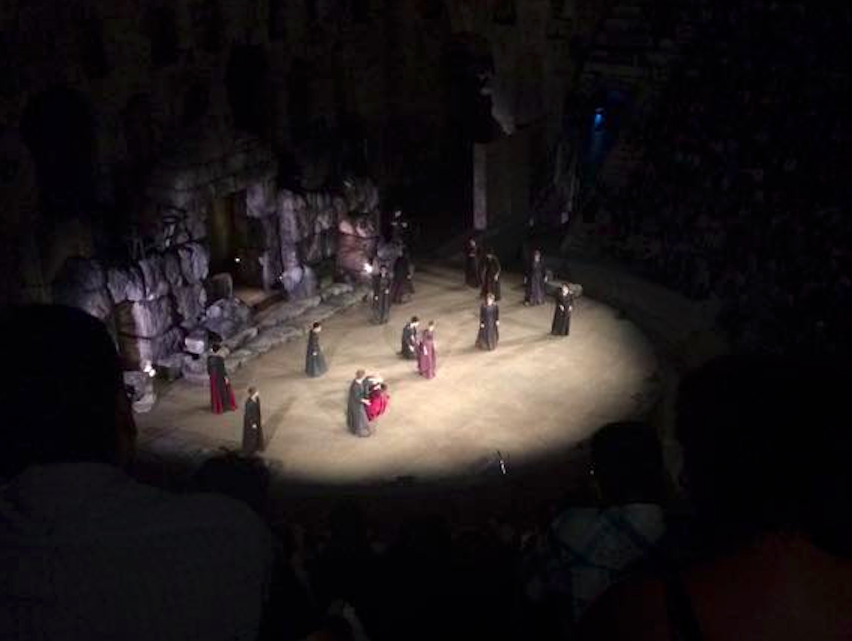
Last night we all went to see a performance of The Trojan Women performed at an old Roman style theatre, the Odeon of Herodes Atticus. This theatre sits beneath the Acropolis in Athens, with a view of both the entry gate and the back of the infamous Parthenon.

The Trojan Women is a highly tragic play, it was written by Euripides and performed in 415 BCE. This play focuses on the aftermath of the Trojan War – more specifically the fate of the women after Troy is taken. Although the play does not seem to follow the character development of one main character, it does follow mini plots in a sort of vignette – style. Hecuba, Queen of Troy and wife of Priam, remains onstage the entire performance and encounters a series of three women.

First to come and lament her fate is the profit Cassandra. Doomed to be a seer yet to never be believed, Cassandra gives a chilling performance in which she performs her own wedding march while she revels in the tragic fate that will become her new master/husband, Agamemnon (if you don’t know the story of Agamemnon I highly recommend looking it up). After Cassandra is dragged away, Andromache, wife of Hector, comes to comfort Hecuba for the horrors that have befallen her children, only to learn that her own son is condemned to die. Wailing in utter sorrow, Andromache watches as her young boy is lead away only moments before she herself is given as a concubine to the son of Achilles. Last to come forward is Helen. While Helen laments her own fate of assured death at the hand of her husband, Menelaus, Hecuba curses the woman that brought upon the destruction of Troy. The play ends with the return of the body of Andromache’s son, Hecuba’s grandson. As Hecuba mourns the loss of her family and country she is lead off, along with a chorus of Trojan women, to her life in slavery.

Although this play is set in the heroic age, many believe this was a Euripidean anti-war play. In 415 BCE when this play was first performed, the Athenians were engaged in the Peloponnesian War and had just put down a rebellion on the island of Melos. In response to the Melian Revolt, the Athenians killed all the men and children of the island and enslaved the women – an action similar to the one taken by the Greeks, against the Trojans, in The Trojan Women. Many feel that the timing of this play indicates that Euripides was attempting to illustrate the horrors of Athenian policy through a very public protest.

It is clear that Euripides won second prize for his trilogy (including this play) at the City Dionysia, a city-wide festival celebrating the god of wine and revelry, in 415. Having seen this play last night, I can now honestly say that through his mastery of words, it is completely clear why Euripides is considered a seminal part of the tragedic world.

Filed Under: Greece Fall 2015

For more information on Lewis & Clark Overseas & Off-Campus Programs, visit our website.

Featured Programs

  • Fuji Summer 2017
  • Morocco Spring 2017
  • Cuba Spring 2017
  • Germany: Berlin Fall 2015
  • India Fall 2015
  • Fuji Summer 2014

Recent Posts

Diving Deeper into Coral Reef Ecology at Lady Elliot Island

Diving Deeper into Coral Reef Ecology at Lady Elliot Island

Another day in paradise. Today marked our third day on Lady Elliot Island, and it’s easy to see that we’re all getting used to this. Waking up early isn’t a challenge with the bright sun and the cacophony of seabirds, but for once no one is upset, as our first activity is a quick snorkel […]

Journey to the top of Queensland – 5/4/18

Journey to the top of Queensland – 5/4/18

Today marked our last day at Carnarvon, with our next stop to be the Great Barrier Reef. Although we’ve stayed at Carnarvon Gorge longer than expected due to the cyclone off the eastern coast, it allowed us to explore even more of the beautiful park. We were woken again by the sounds of Laughing Kookaburras, […]

Great Times at Great Kepple

Great Times at Great Kepple

April 7, 2018 Our first full day on Great Kepple Island! We spent the morning in lecture learning about coral, coral reefs (there’s a difference!), conservation and the general weather trends that can dictate the biogeography of the ocean. While some had come into this program with invertebrate knowledge from classes at Lewis and Clark, […]

Planes, trains, automobiles and the amazing reef!

Planes, trains, automobiles and the amazing reef!

On April 10th I woke up to the sound of the train wheels clacking. It was 5:30 in the morning. I was so tired but also so thrilled to be traveling to a new destination. Soon after we woke from the comfy and unique accommodation of the train, we all gathered our belongings and hopped […]

Under the Milky Way Tonight

Under the Milky Way Tonight

  On April 3, 2018 we stayed at the Takarakka bush resort in Carnarvon Gorge. One of the many highlights of Carnarvon George is the sky. Specifically, the entire Milky Way. Which, as our tutor brought up, used to be a sight that everyone could see. It is because of our cities light pollution that […]

Digital Scholarship Multisite © 2018 · Lewis & Clark College · Log in