My entire life I have wanted to travel to India, but now that I am here, I don’t believe it. Despite being thrown into the sights, sounds and intensity of New Delhi, I feel that my body is an empty vessel and my mind isn’t awake. While attempting to immerse myself, I find it strange to be physically present in this new space– not just seeing, reading, thinking of India in some abstract form. This dream-state was epitomized for me on one of our first days in Delhi, visiting the shrine of Sufi saint Nizamuddin Auliya.
The site of Nizamuddin’s story stems back to the 13th century, when the renowned saint inhabited the South Delhi neighborhood with his many followers. His disciples were vastly talented and included the famous poet and sitar-inventor Amir Khusrau, who was buried nearby as the “gatekeeper” to Nizamuddin’s shrine. In Sufi tradition, and like other shrines we later saw in Delhi, people wanted to be buried close to the saint, who is considered to be a friend of God (wali). The Sufi concept of “union” with God could be more easily sought after death if buried near God’s friend. Today, the shrine continues a tradition of closeness: whether it is to God, the saint, or whatever unique brand of religious and social life, it is an intensely personalized and hands-on place for residents, Delhiites and outsiders alike.
The site and adjacent neighborhoods have developed around Nizamuddin Dargah as the devotional center. The social activities, residents, buildings and many dichotomies that could be observed from an outsider’s standpoint seemed to concentrate at the shrine as the axial node of the immediate community. This site stands with Delhi’s long history of diverse forms of Islam that diverge from a single narrative of Muslim religious life. In “The Mystery of Nizamuddin Dargah: The Accounts of Pilgrims,” Pinto states that orthodox groups renounce the dargah as “unIslamic” and a “falsification of the teachings” while still all classes of Muslims visit the site today. The study finds that this phenomena is not an unusual paradox, and is in fact one with a long tradition, tracing back to Muhammad.
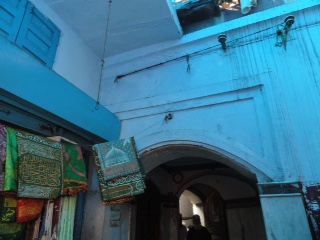
A clear inside boundary is marked for the site. Upon removing shoes and walking through the archway, there is a smooth, white marble flooring for the entirety of the square that surrounds the inner sanctum of the shrine. The noises and packed crowds of the neighborhood dissolve in this space. The environment is cleaner, quieter, and tangibly separate from the outside world, while still being accessible and porous to all who choose to enter. The most exclusive part of the shrine is for men; women are not allowed to enter the shrine and must cover their heads.
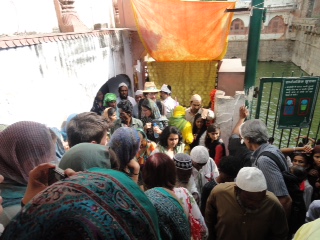
The comfort and mobility of the people at the site seemed to give some indication of the social profiles of the residents. Our group was clearly out of place as the only white people or at least starkly foreign tourists at the site. The people sitting or laying by the shrine were more likely residents that spent their days there. Because it was so crowded it was hard to tell who was visiting and what the site typically looked like, as it was also the afternoon before the Muslim holy day of prayer. There were other Indians who were taking pictures (presumably Delhiites from outside neighborhoods or other cities even), who seemed quite comfortable walking around. The girls in our group formed a chain of hands while walking through and I noticed other Indian girls who were holding hands to stick together as well. My impression was that they were probably Delhi residents also taking a day trip to the shrine, but were clearly not as physically comfortable in the space as the residents were.
There seemed to be people of many classes walking around the shrine. Based on clues of dress and manner, I could see a variety of people who looked Indian, some of whom had iPhones. However, most evident were the extremely poor, who were partaking in the most activity at the site. Residents seemed to be of lower class and were praying, sitting, begging, fanning themselves and arguing. Very small children and babies lay unattended on the marble floor, many crying, running around or sleeping. What it would be like to grow up there? Was this the center of their world? I saw a little boy just outside the shrine, running up a high, narrow stairwell that I hadn’t even noticed. Is he going to where he sleeps at night? There are secrets to this place I wouldn’t even begin to have access to.
The poverty and tragic beauty of Nizamuddin made me feel as if I was seeing still images and not experiencing real life. I was already confirming ideas and images of “India” in my head. What did it do to my brain and larger concepts about India when I encountered this site? In some ways, my dream state was deepened, and it began a process of separation. I felt as if I saw an image of a far away reality, but it was so beyond my measures that I didn’t have to deal with what it meant or how it made me feel.
Furthermore, what did the residents think when they saw me? Are they exposed to foreign media? How are our ideas of each other different, as my media is framed by poverty, religion and exoticism in pictures of them?
The intense nature and happenings felt microcosmic of a certain exotic ethos I expected. However, an awareness of the uniquely textured history and distinctions of the geographical, cultural and historical circumstances help me now to process my brief time at Nizamuddin Dargah.
In my first week and a half here in India, the challenge of feeling so out of place, while also struggling to grapple with the realities and histories of my new world is like nothing I have experienced before. While energizing and exciting, it is sometimes exhausting, even disembodying to simply walk the streets with so much to be aware of at all times. At one moment, I am wrapped up in my safety and health, then religious and cultural norms, then the immense historical lineage of sites I can’t even conceptualize the scale and time of creating.
In the introduction to Pinto’s essay “The Mystery of the Nizamuddin Dargah,” he states: “The word ‘mystery’ in the title of this essay is used in the sense of something which is present or confronts one and yet is ever distant. It is not something persons can master, but that which persons let themselves be grasped by.” Pinto’s discussion about the importance of subjective experience and empathy as the center of his study on the accounts of pilgrims is something I take to heart while experiencing Delhi. While still feeling distant, I seek to be confronted and grasped by this world that is so far from my own.