Lewis & Clark Around the World

Programs associated with Lewis & Clark College, Portland OR

  • About
    • About Lewis & Clark Around the World
    • Contact Information
  • Programs
    • Featured Overseas Programs
    • View All Overseas Programs
    • View All Program Sites
  • Participants
    • Posts
      • Featured Student Posts
      • View All Posts
    • Projects
      • Featured Student Projects
      • View All Student Projects
      • Map of All Projects
  • Help
    • Participant Orientation
    • Post Reminders
    • Your Dashboard
    • Your Overseas Project
    • Setting Up a New Program

What Will You Gain?

September 25, 2015 By Lauren White

Since my time in India, I’ve realized that experiencing a new country automatically shifts my perception, making everything, even the typical, seem different. I remember walking around Lodhi Gardens in the beginning of our stay in Delhi, mesmerized by the Bara Gumbad mosque and tomb and the Sheesh Gumbad. They sky above the structures seemed absolutely still, disturbed (or enhanced?) only by the floating hawks against the muddy blue. I felt as if I had travelled into a photograph; the sights and experience something I had never encountered before. Even the grass under my feet looked different. Although I am seeing things in new ways, as we all are on this fantastic journey, a quote from our history professor, Sunil Kumar, sticks out to me: “Delhi should not remain an unfamiliar world.” As I ponder this statement in my blog post, I would like its readers to ponder it as well to find ways to constantly question things in order to make the unfamiliar familiar.

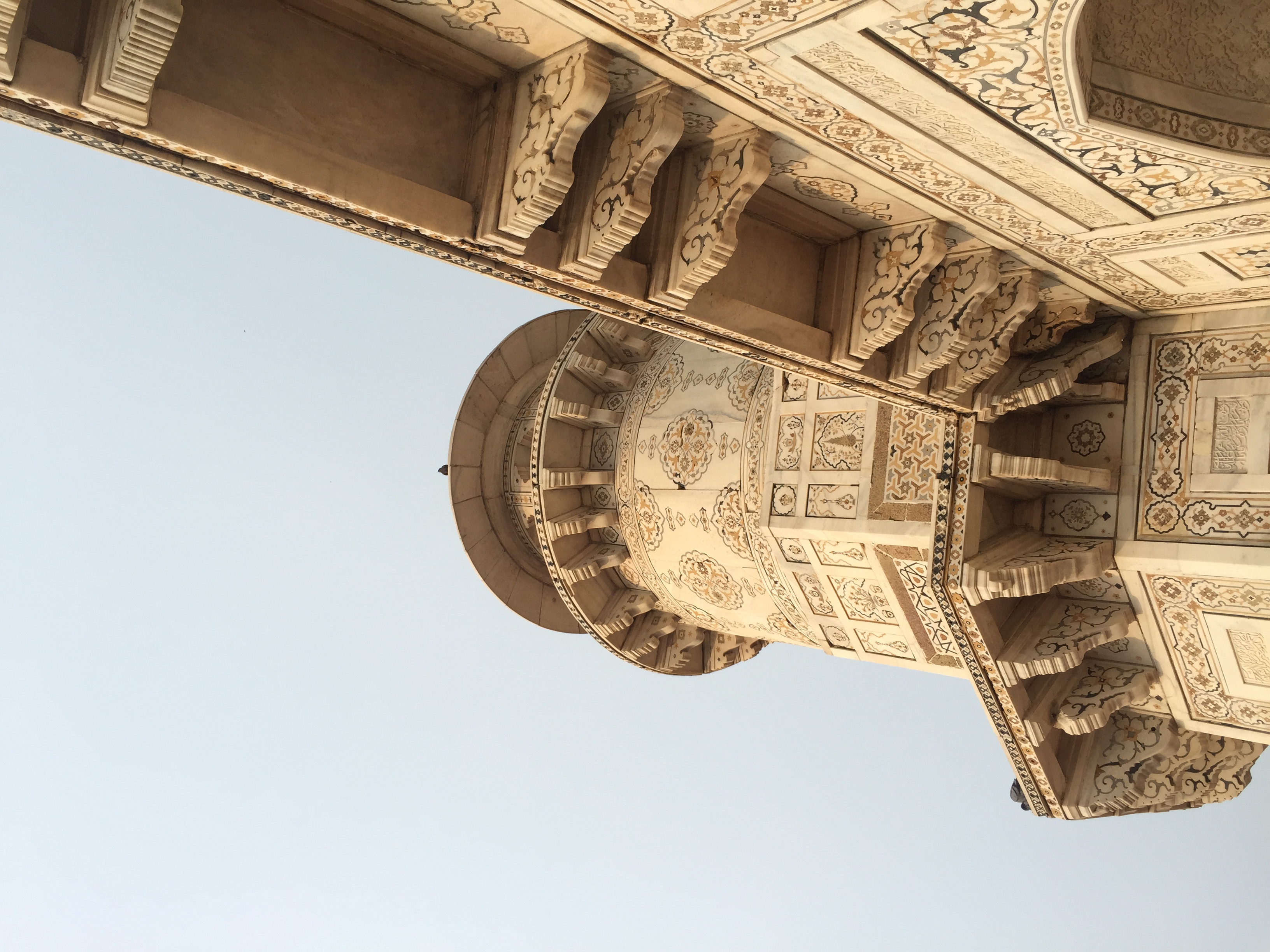
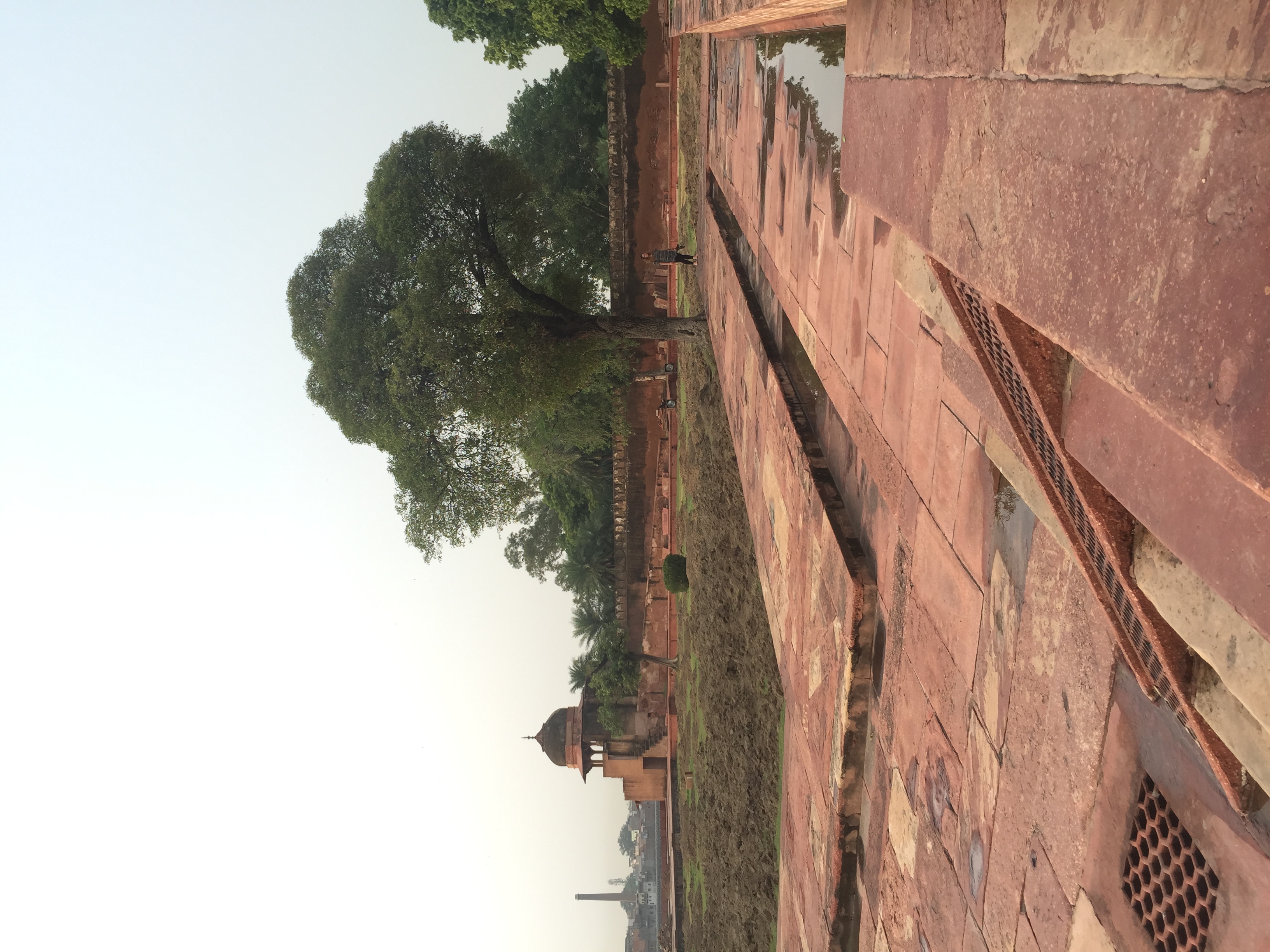
We are standing at the site of I’timād-ud-Daulah’s tomb in Agra. Beautiful pietra dura marble buildings reside in the center of the site on raised platforms, surrounded by large walls of red sandstone. Water trenches extend around the tombs, and tall trees offer umbrellas of shade. I’m aware that the Yamuna River is just yards away below the site, but I don’t scrutinize the larger space of the tomb’s surroundings. I step over some running water and meet a group of students standing by Sunil. I’m not sure how the conversation started, but at some point Sunil posed the question, “At what point did this Agra stop?” He pointed to the ornate structure just inches away from his fingertips and continued, “And turn into that?” His outstretched arm glided over and hovered just above the Yamuna, and I saw he was gesturing to the smoggy, congested city along the horizon. Someone mentioned modernization, but Sunil pressed for more thoughtfulness than that by suggesting (somewhat humorously, or maybe to start turning our brain gears) that perhaps there were just not enough important people to create embellished tombs for. Or, he posed again, had individuals forgotten their history and settled with the concept that India’s history is the present?

As I climbed back on our bus, I realized that even though we had exited the physical site, the words shared made an impression on me that I hadn’t experienced before. Sunil’s statements left me feeling uncertain about how I had been thinking about Delhi. Ever since that first meta-snapshot experience at Lodhi Gardens, I had been viewing all the monuments as singular entities with singular histories without questioning the larger context. I was living so much in the present of the architecture that I had forgotten to look over the river of my perception and see that, just like the smoke blanketed city, there is more to these locations that meets the eye, and always more questions to be asked.
IMG_0839IMG_0842


Filed Under: India Fall 2015

For more information on Lewis & Clark Overseas & Off-Campus Programs, visit our website.

Featured Programs

  • Fuji Summer 2017
  • Morocco Spring 2017
  • Cuba Spring 2017
  • Germany: Berlin Fall 2015
  • India Fall 2015
  • Fuji Summer 2014

Recent Posts

Diving Deeper into Coral Reef Ecology at Lady Elliot Island

Diving Deeper into Coral Reef Ecology at Lady Elliot Island

Another day in paradise. Today marked our third day on Lady Elliot Island, and it’s easy to see that we’re all getting used to this. Waking up early isn’t a challenge with the bright sun and the cacophony of seabirds, but for once no one is upset, as our first activity is a quick snorkel […]

Journey to the top of Queensland – 5/4/18

Journey to the top of Queensland – 5/4/18

Today marked our last day at Carnarvon, with our next stop to be the Great Barrier Reef. Although we’ve stayed at Carnarvon Gorge longer than expected due to the cyclone off the eastern coast, it allowed us to explore even more of the beautiful park. We were woken again by the sounds of Laughing Kookaburras, […]

Great Times at Great Kepple

Great Times at Great Kepple

April 7, 2018 Our first full day on Great Kepple Island! We spent the morning in lecture learning about coral, coral reefs (there’s a difference!), conservation and the general weather trends that can dictate the biogeography of the ocean. While some had come into this program with invertebrate knowledge from classes at Lewis and Clark, […]

Planes, trains, automobiles and the amazing reef!

Planes, trains, automobiles and the amazing reef!

On April 10th I woke up to the sound of the train wheels clacking. It was 5:30 in the morning. I was so tired but also so thrilled to be traveling to a new destination. Soon after we woke from the comfy and unique accommodation of the train, we all gathered our belongings and hopped […]

Under the Milky Way Tonight

Under the Milky Way Tonight

  On April 3, 2018 we stayed at the Takarakka bush resort in Carnarvon Gorge. One of the many highlights of Carnarvon George is the sky. Specifically, the entire Milky Way. Which, as our tutor brought up, used to be a sight that everyone could see. It is because of our cities light pollution that […]

Digital Scholarship Multisite © 2018 · Lewis & Clark College · Log in