Yesterday -October 3rd- marked the 25th anniversary of German Reunification. It’s the only official national holiday here in Germany, so most restaurants, shops, and cafes were closed. The city threw a large festival around the Brandenburg Gate, complete with live music, Currywurst (Bratwurst covered in ketchup and curry powder), a ferris wheel, and plenty of Berliner Pilsner. It was a beautiful day, so some friends and I decided to go check out the festivities. It felt as though everyone in Berlin had decided to show up, and I’m sure that there were many, many more people that night. Everyone was dancing, drinking, eating German food, relaxing in the neighboring Tiergarten and generally having a pleasant time. It was kind of like a very tame, less show-y, and less drunk Fourth of July celebration. German pride is a relatively new concept, so it was very cool to see the people being proud of their country.
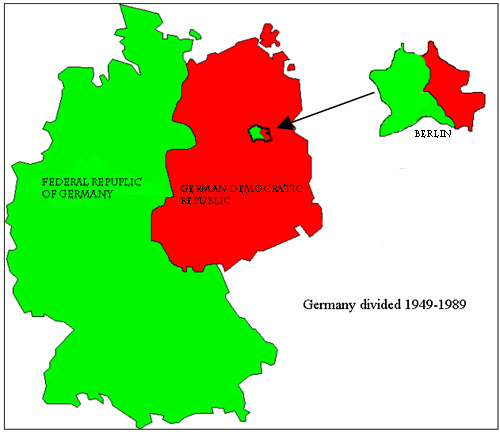
Germany became divided into four zones in 1945, after the collapse of Germany at the end of World War II. These zones were controlled by the Soviet Union, France, Britain, and the United States. In 1947, the French, British, and American zones were merged to form West Germany in hopes of reviving the economy. The Soviet Union did not approve of this because it gave the combined West more power. It responded with the Berlin Blockade in 1948, blocking the West’s railways, roads, and and canals leading to Berlin. The country was now divided. Over 2.5 million East Germans fled to the West before 1961. In 1961, the Berlin wall was built by the communist East to keep its citizens from moving to the democratic West.
http://fany.savina.net/wp-content/uploads/divided-germany.jpg
The Wall was about 100 miles long, circling the West sector of Berlin, and 15 feet high, topped by barbed wire. It was constantly patrolled by guards with machine guns. 191 people were killed while trying to cross the wall and thousands more were captured and imprisoned. Several factors led to the fall of the wall. These included protests, unloyal police, availability of Western television, reform in other socialist states, and the lack of leadership in the GDR. In November of 1989, the East German government announced on television that it would ease travel restrictions to the West. So many people tried to get through that evening that the guards became overwhelmed and opened the border. The next day, the wall was taken down. The country was officially reunified on October 3rd, 1990.
Today, the Day of German Unity is celebrated in nearly every major city with speeches, live music, fireworks, traditional food, and cultural presentations. Many people do partake in the celebrations, but many more take the day off from work to sleep in, have a picnic with family and friends, and reflect on the country’s past.