
Sometimes, in the art world, you come across a piece—a play, a painting, a photograph—that both intrigues and alienates you. Such was the case for me with The New York City Players’ Isolde, playing at NYC’s Theatre For a New Audience. This being my first foray into “experimental” theater, I was unsure what to expect. Every movement the actors made seemed deliberate—every moment calculated and immaculately planned to force the audience to be aware of what they’re witnessing. I never forgot that I was watching a play, and I think the production wanted it that way. When Isolde, played by Tory Vazquez, stared out toward the audience at the beginning of the play, and quietly asked her husband, played by Jim Fletcher, “line?” I was hyper-aware of my position as audience member, watching an actress play an actress with failing mental faculties. And that was not the only moment in which the “fourth wall” was broken, or if not broken, then cracked.
The play itself, written by Richard Maxwell, deals with Isolde’s slipping sanity, and her husband Patrick’s wish to give her the perfect home. Enter Gary Wilmes as Massimo, the pretentious and questionably genuine architect enlisted for the job. I wish I could say I understood what was happening when these three characters were together on stage. But alas, I spent the majority of the play trying to discern whether or not there was a plot. I was expecting a narrative structure and the play was not delivering. My attempts to draw a narrative arc from one scene to another kept me preoccupied, and prevented me from really paying attention to what was happening in the moment. The dialogue alternated between moments of profoundness and unexpected humor. But the profound moments were not explored deeply enough to make an impact on me, and the humor was intermittent and jarring. The scenes jumped haphazardly with nothing in the way of transition, and sometimes there seemed to be no connection between what had just happened and what was now happening.
Because I was distracted and aware of myself watching a play, I was unable to determine what the play was actually about—not just in terms of plot, but in regards to themes as well. The play attempts to address several issues: memory, identity—how a person’s memories influence their identity, infidelity, and happiness. Yet there are no answers, no happy resolution to any of the proposed issues in the play. Isolde and Massimo have an affair; Patrick fires Massimo when he fails to deliver his house design; Isolde continues to lose her mind. There is no grand blowout between Patrick and Massimo over Massimo’s affair with Isolde. There is no climax at all, in fact. The characters just cope with their problems without solving anything. Perhaps, actually, that’s what the play is about. Real life does not neatly resolve itself. Why should a play?
I would not see this play again. Though a second viewing may grant me a better understanding of the production, I am not interested in wrestling with a work with no plot, no conclusion, and little to no character development. While innovative and certainly different, it was not enjoyable for me. However, I must admit that Isolde received widely stellar reviews from The New Yorker, The New York Times, and The Village Voice. My differing opinion, I presume, is due to my ignorance of non-traditional theatre styles. That being said—it is still my opinion.
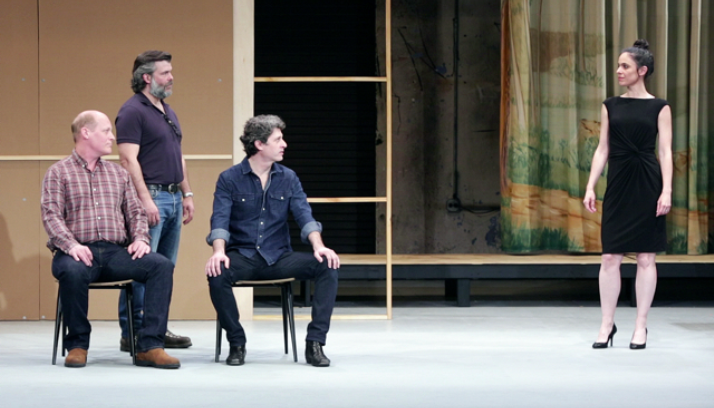
(c) New York City Players