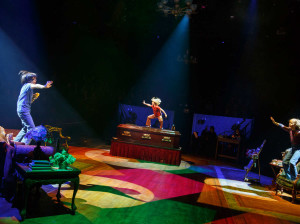
 Fun Home, the musical tragicomedy showing at Circle in the Square Theater, truly hit home, bringing the audience to its feet last Tuesday as the final poignant notes faded and the lights dimmed to black. While most audience members likely did not identify with the main character on every point, most have experienced the feeling of looking back at a memory with new eyes and seeing it warp, the glowing veneer cracking before your eyes until a new truth is revealed underneath.
Based on the graphic novel by Alison Bechdel, Fun Home tells the true story of Alison’s relationship with her father, from growing up in Beach Creek, Pennsylvania, to her own coming out and the revelation that her father, too, was gay, and finally to her father’s suicide and the realizations that followed. Told in a non-linear fashion, this memory play—book and lyrics by Lisa Kron—is revolves around a current-day “big” Alison who serves as the narrator and fulcrum around which the memories move. As the memories play out big Alison gets drawn further into her own story and the removal of a lifetime of facades put in place by her father and upheld by her mother.
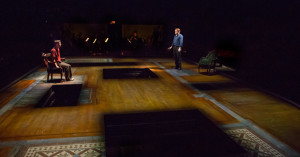 Director Sam Gold and scenic designer David Zinn have staged the play in the round, placing the action in the center of the audience. This created a greater feeling of intimacy and immediacy, causing me to feel that I was either part of the scene or peering over the character’s shoulder. The staging allowed big Alison to move freely about the space while the memories took place around her. In addition, specific places and moments could be given specific locations on the stage that could be referenced at later points in the show. This was mainly done by the brilliance of Ben Stanton’s lighting design which confidently balanced the comedy of numbers such as “Come to the Fun Home,” a musical commercial written by small (young) Alison and her brothers advertising her family’s funeral home, with the emotional intensity of the material and moments such as “Telephone Wire” in which Alison struggles to speak with her father about their mutual homosexuality. Stanton’s design also served to enhance the story’s original medium, the graphic novel. At several different points in the narrative Alison connects the current action with a previous scene. Stanton shows this by creating a thick yellow square outline around the physical location in which that moment took place, just as a single drawing in a comic strip is enclosed within its own boarders.
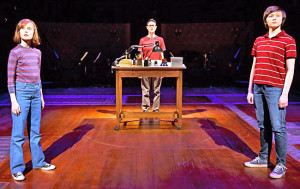 Costumes, by designer David Zinn, subtly enhanced the characters qualities. Red striped t-shirts and jeans united small, middle and big Alison (played by Sydney Lucas, Lauren Patten, and Beth Malone respectively). They weren’t identical—each fit the time period and that Alison’s age—but they were similar enough to visual represent that they were all the same person. Alison’s father, Bruce, played by Michael Cerveris, had two main looks. The first was casual but the second was more formal, generally a pair of nice trousers, a button up shirt, and a velvet jacket, mostly in darker hues. This second look he put one for guests or to go out. In a show about a life of hidden truths and facades, this was Bruce’s more polished self, put on for the world. In contrast Alison’s mother, Helen, appeared in relaxed clothes- pants, t-shirt, and sweater. She did not fit into the antique décor of the house, as Bruce did, paralleling the separation between Helen and her life. In the life Bruce has created, she is there to fill a crack in his façade, to hide his homosexuality. Bruce shuts her out and she in turn is portrayed as shutting out her children. In general, it was remarkable how similar the actors looked to their graphic novel counterparts. Great effort and meticulous care was clearly taken with the costume and hair (Paul Huntley) design.
The combined efforts of the director, choreographer Danny Mefford, and designers were brought to life by the actors; particularly the outstanding performances of Beth Malone, Sydney Lucas, and Michael Cerveris. Malone’s grounded performance provided the ideal foundation for the whirl of memory storytelling that occurs. A source of comedy for the audience as she reflects on past embarrassments, she also shows great emotional depth as she becomes drawn into her own storytelling. Near the end she is actually pulled into a scene, replacing middle Alison, in which she struggles to broach the topic of her and her father’s shared homosexuality. Cerveris creates a sympathetic yet disturbing picture of a man in denial of his own nature. His physicality in particular is notable as he uses minute gestures at precise moments to shows slips in his façade. Finally, Lucas both opens and closes the show with a pure sense of childlike innocence and the reminder, despite her father’s shortcomings, she did love him.
The show ends with Alison saying that, “every so often there was a rare moment of perfect balance” with her father. In Fun Home, however, those moments are not rare. The entire production is in near-perfect balance, juggling different time streams, realities, and truths. Regardless of sexual orientation, age, or personal background, the pure emotion of the characters touched every audience member.