
How Far Will You Follow Your Faith?
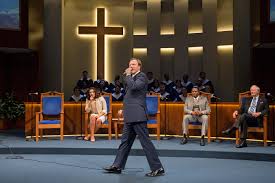
What is your relationship with God and at what sacrifices are you willing to make for him? This year that same question of faith is asked on the MainStage Theater in Lucas Hnath’s The Christians. This intimate theater is transformed into the mega church of Pastor Paul (Andrew Garman). As we become mesmerized by this performance we must remind ourselves, that those to our left and right are audience and not congregation members.
The plot is constructed meticulously, each scene carefully created to display the fall of Pastor Paul. The play begins with the voices of the church choir singing a hymn, a scene of jubilee. Pastor Paul proclaims introduces his interpretation of the bible; the idea that hell itself is not a literal afterlife, and may in fact not exist at all. This declaration stirs up many issues between believers and explores the internal struggle attached with faith.
Lucas Hnath’s writing poses theological questions about the teachings of the bible. The most powerful moments of this play’s performances come from the questions of belief itself. The play is successful for many reasons, two of them being prop choice and the actors themselves.
Microphones are used throughout the play. Both Pastor Paul and his wife (Linda Powell) have their own microphones during their scene together. In the beginning the microphones seemed necessary in portraying the volume of a megachurch. Additionally they bring an element to the drama.
One conversation in which highlights the dramatic element of the microphone takes place in the middle of the play. The conversation is between Paul and his wife. At first it is very civil. Then the discourse shift to their differences in beliefs, their voices rise and echo throughout the theater reaching a level of sound only available when amplified. The microphones gave an added power to the character’s words. Their rhetoric became equally as powerful in their faith as its volume.
What hindered this scene for me however was the performance of Linda Powell. I was moved by the development of Pastor Paul’s character. The scene was so hard to watch for the same reasons it was impossible to pull my attention away. At first we see how passionate he feels about his faith. He is even willing to lose members of his congregation. Then his wife proposes her ultimatum in which he must chose between his faith and his family. The conflict between his need to follow his faith and his desires on earth was true to his performance. His character’s conflict between pastor and father was evident in his performance. I found that Linda Powell’s acting was subpar in many respects. It was as if this battle was not as important or as disturbing to her. Her struggle was less apparent in contrast to Garman’s performance. While his lines were spoken with passion hers seemed to only be loud. Additionally there was in absence of presence when she exited the stage. As if she was simply leaving an argument and not the love of her life. In this way I was pulled out from the magic of the show.
Assistant Pastor Joshua was played by Larry Powell. His performance was everything Linda Powell’s was not. Pastor Joshua was the first to leave the congregation and he, like Pastor Paul’s wife, has a conflict in beliefs to Paul.
Larry Powell’s scene with Garman takes place towards the end of the play. Larry Powell’s character Joshua has started his own church separate from Paul. However he has been offered to return to the mega church to take Paul’s place as Pastor. In this scene Joshua reveals this information to Paul and attempts to explain his own struggle attached with his faith. While he believes in a literal hell that exists outside this life, he explains that this does not come easy. He describes watching his mother dying and how he begged for her to accept christianity so that they one day might be reunited in heaven together. He explains that his mother rejected his pleas and now he must live knowing that because of what he believes his mother rots in hell. While his faith differs from Paul’s, the audience is able to find the similarities between the two actors.
The acting in this scene was beautiful. Both actors sat there, caught in their separate yet equal catch 22. Joshua describes the immense pain he has been burdened with. He speaks for what could be hours, revealing the pains of his faith to Pastor Paul. He too faced the struggle of choosing between loved ones and God. He admits that in the end he chose his faith. This scene displays the humanity of these characters. In many respects it also humanizes the church. While they are public figures of power, they are also men of God. While they preach answers they too are kept awake at night with questions. The acting in this scene was superb because both actors were able to display the emotional toll that comes attached to their separate faiths. In this way they the scene was exceptional and one that stuck with me.
Lastly the most powerful scene is at the end. Garman is alone on stage. The lights are dimmed. Seated, he cups the microphone in his hands. While the microphone heightened the drama in scenes with passionate yelling it just as effectively heightens the intimacy of Paul’s inner thoughts by projecting his whispers. It is in this scene we hear the internal battle in Paul’s mind. While he knows his faith to be innate, the most real aspect of him, he cannot help but to question why this is so. How in fact does he know it is the direct voice of God? Garman questions the very piece of himself he has known to be true his entire life. Here he is just a man. Here his answers consequentially are also his concerns. Here his faith is also his doubt. With tears rolling down his cheek he delivers something that touches both devote believers and those who may never have set foot inside a church. How far will he follow his faith? Can he keep both his family and his faith?
Lucas Hnath creates a hypothetical world that indulges in the theological issue of faith. It is the same question that Jesus himself had to face on the cross; how far will you follow your faith? While we are taught that true believers will be reap their rewards in the end, Hnath explores what hell the truly devote face. The fall of Pastor Paul displays beliefs’ complexities and the suffering that comes with faith. Even though he and Joshua interpret the bible differently they both encounter similar tests of their faith. The Christians is a play about the complexities intertwined with following ones faith and displays that the truly devote believes do not do so blindly.