
Culture is essential to a country and we cannot learn in a country without also knowing something about its culture. When I first got to China, I was shocked by the cultural differences between China and America again, even though I had been in China before. I had forgotten the differences in culture and I was judging China from an ethnocentric point of view, I knew Chinese culture wasn’t the same as American culture but I still placed everything I saw in an American perspective. When we had classes in the university, one of the first lesson was media and network of China. This was a memorable class because it was our first introduction to the differences between the two cultures. This topic illustrated the transition from old media to the prominence of new media. Some of the traditional media were newspapers, magazines, radio stations, and news agencies. Despite the name of the media, traditional media is still an integral part of Chinese culture and a method of delivering news.
The new medias include mobile networks (23.9 % of the media market), pc networks (23.3%), T.V./film (17.3%), and printed media (15.9%). Within the mobile network is micro-communication such as Twitter, Facebook, QQ, and WeChat in which viewers can get information from multiple sources while at the same time be the reporter. However, the government also utilizes micro-communication to spread their ideas. Micro-communication allows people to quickly write and view articles/news without the necessarily telling the truth. As with any internet-based communication, once the information is sent, it’s difficult to retract the information. Due to the prominence of micro-communication in China, such as WeChat, there is a need for an enhanced legal system of cyber space.
The media, traditional and new, is supported by the government and it functions not as a commerce but as public service. With that concept in mind, it is meant to relay reliable information quickly instead of inaccurate rumors. However, many media institutions are still operated as the government so the distinction between the people and the government becomes blurred. Also, Chinese media is excellent at reporting domestic news but when it comes to international news, they are slow to report them.
Even something that I took for granted, freedom to report whatever we wanted, is such an important part of Chinese culture. The government involvement is very evident in the media and the production of news is backed by government support. It surprised me that people were accustomed to the government monitoring them but then they’ve grown up with this kind of custom so to them, it’s not abnormal. I use WeChat to communicate with Chinese people I meet at school and to stay in touch with my friends in the States. I noticed that two of my friends in the U.S. had the same photo of a mountain with Chinese characters on it. At first, I thought it was a clever picture since I was in China and should know the words, but when I questioned them on their choice of photos, they were surprised to discover the mountain picture as their profile photo. Later, I learned that they had originally had pictures of themselves but the government had censored the photo. From my perspective, the government’s intervention of the photos was unnecessary and uncalled for but I understood that they do intervene in transmitting information via micro-communication and that was my first example of their intervention.
Another important aspect of Chinese culture is their education system. China has a Nine-Years’ Compulsory Education Law sponsored by the government. The law requires students to attend six years of primary school and three years of junior middle school, after that, students can either decide to continue their education or not. Like American schools, China has kindergarten, primary school, middle school, and high school. However, the competition to get into good school districts is very high in China. When a school is built in an area, the housing market rises as parents want to live near the school; the demand for housing near the school is high while the availability is limited. As a result, there’s an increasing amount of pressure for the students and the parents.
In elementary school, kids learn Chinese, math, science, and other activities (English is added to the curriculum in third grade). The students learn a variety of different things and it appears to be more diversified. Despite the apparent well-roundedness of the curriculum, many schools focus their classes on Chinese, math, and English while the other subjects (art, physical education, music) are ignored. When the students are in middle school, they mainly focus on the core subjects such as Chinese, English, Math, and History. Then following middle school, students decide which path they will pursue, sciences and math class or arts and humanities class. After their decision, they will be placed in classes designed for their choice in addition to the core classes. The reason students decide either science or arts is because they have to study for their specific College Entrance Exam (CEE). The College Entrance Exam is the most important test in a student’s life because it will determine which school they will attend.
The CEE is a composite of everything they’ve learned in their academic life and the test is three days long. Most high school students study for three-four years for this test-there is tremendous pressure on the students to score high and some students cannot withstand the pressure and break under the weight. As a result, the month of the exam (June) is often nicknamed the “black month” and it is like a “stampede of 100,000 horses trying to cross a single log bridge”. At the end of the exam, only 2/3 of the students will attend higher education.
The CEE is such a cultural event that taxis are required not to honk and construction is halted for the week of exams. In addition, many parents and students pray for success and offer gifts with their prayers.
![IMG_20150906_111703626[1]](/archive/overseas/wp-content/uploads/sites/109/2015/11/IMG_20150906_1117036261.jpg) The red ribbons represent the peoples’ wishes and prayers for the higher power to help them.
The red ribbons represent the peoples’ wishes and prayers for the higher power to help them.
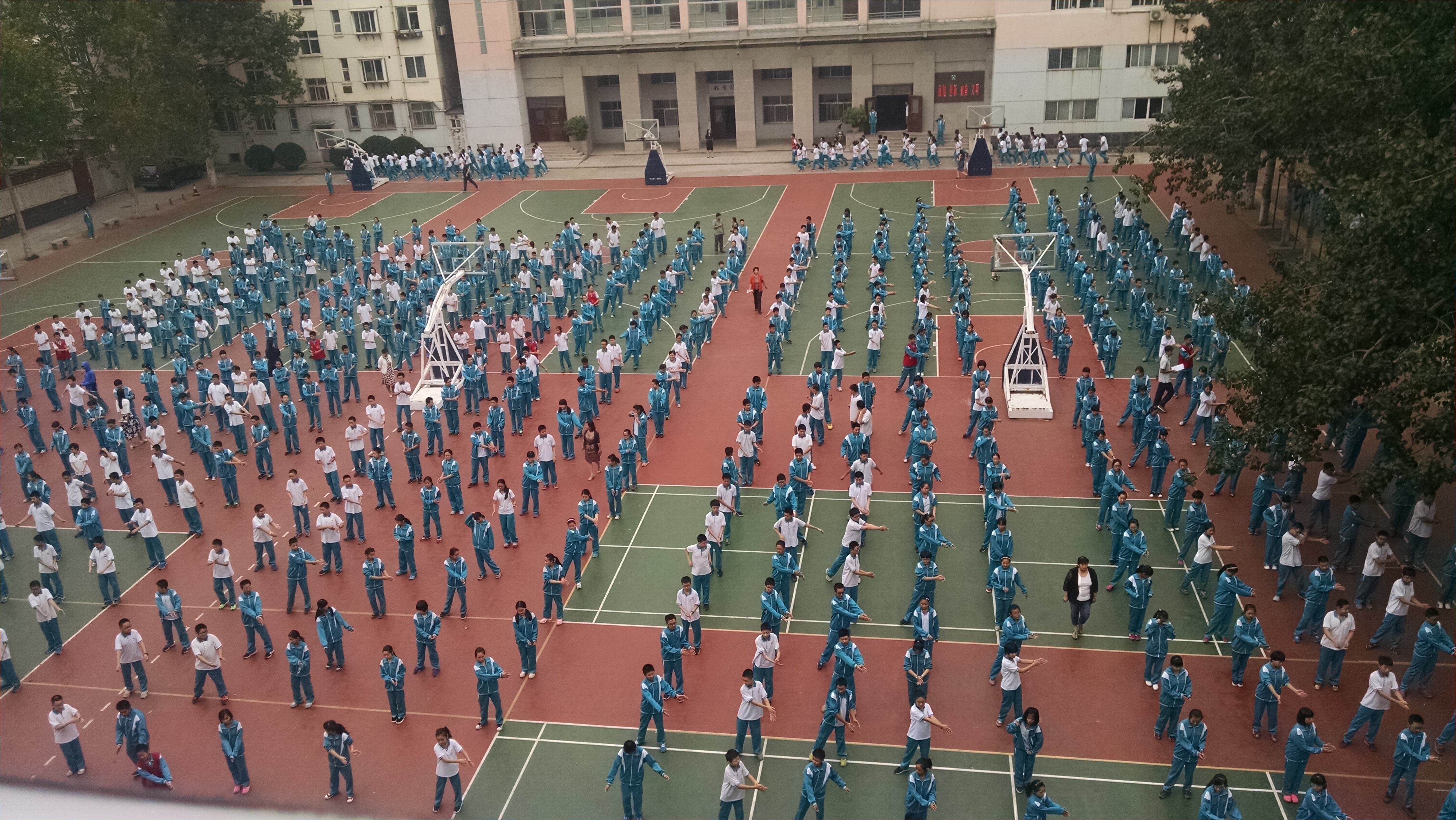 Middle school students preparing to do their daily morning exercises.
Their education system is much more rigorous than the American system and the students endure more stress and pressure. When we visited the middle school, the students were all very disciplined and respectful towards their teachers but it made me wonder how many of them will pass the CEE. They seem very energetic and happy but they will have to study for the entrance exam soon and their life will change after that, it made me realize just how lucky I am to have had my education in America. Although the students at Shandong Normal University all seem happy and eager to talk to us, I now know what they went through to get into the school. The stress and pressure they all endured and yet, they’re still very friendly.
Another essential part of China is their tea culture. While we were in Qingdao, we learned about tea and everything about tea-including the health benefits, the different kinds of tea, and the process of cultivating tea. Originally, tea used to be exclusively cultivated in the south due to the ideal climate. However, it was later discovered that other parts of China also cultivated tea, such as Qingdao. With 20 million acres dedicated to the cultivation of tea in China, it’s no wonder tea is still such an integral part of Chinese culture. In addition to having a long history, tea is well-known for its health benefits including promote the immune system, helps block against radiation, anti-cancer properties, lose weight, etc.
In addition to the health benefits of tea, tea ceremony is also an important aspect of tea culture. There are tools used during the ceremony that must be clean and handled with care. The spouts must never face the guests (otherwise the guests are offended) the towel must be folded a certain way, and the general countenance of the person must be elegant and graceful. There are so many aspects of the tea ceremony that is difficult to master, especially when the gender of the host plays an important role in the way the tea is served and drunk.
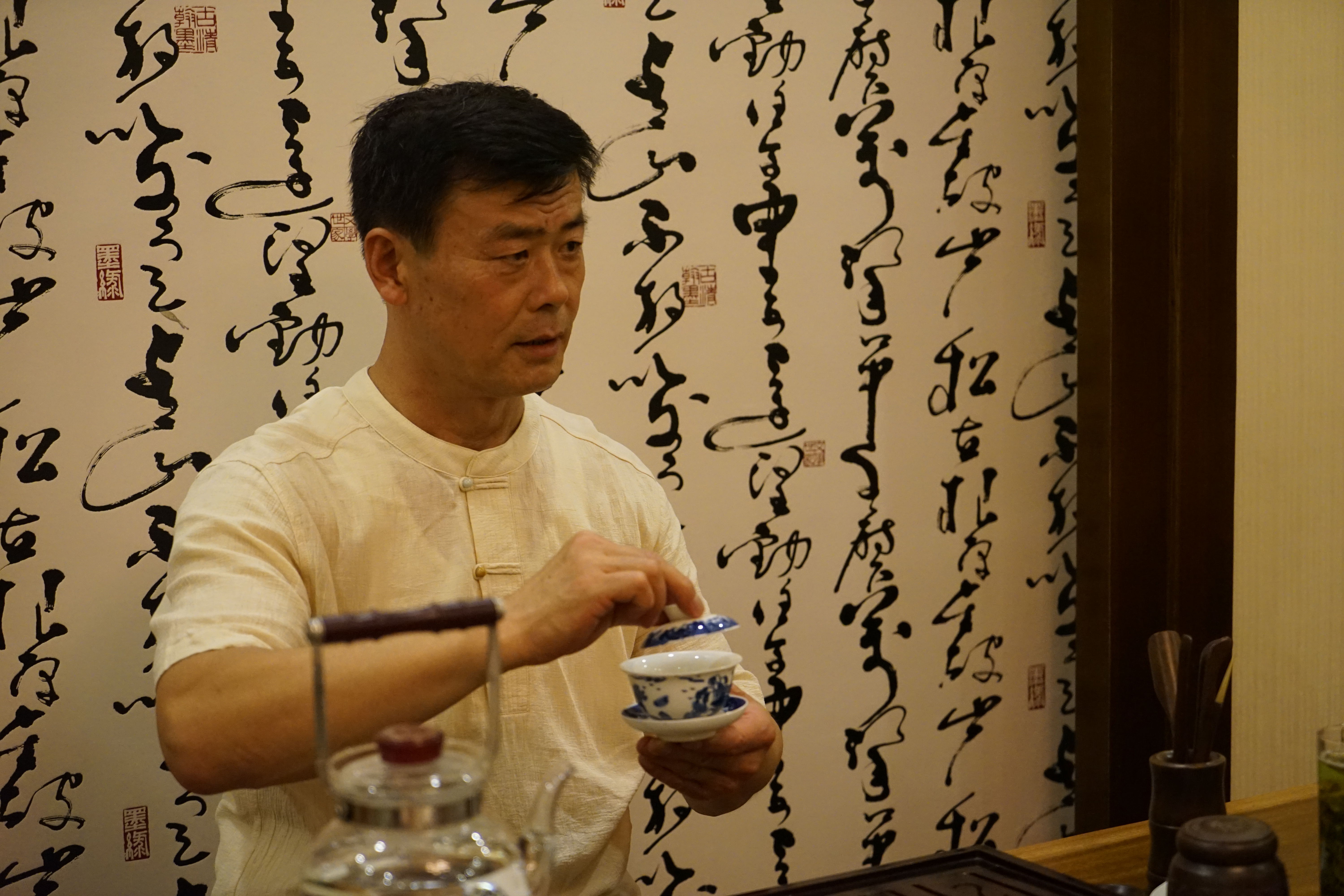 The tea master shows us how to properly hold the tea cup and how to smell the tea the right way.
I never thought too much about how important tea is in Chinese culture-I simply took it for granted that people in China drank tea, but I never understood the significance behind it all. After spending time in Qingdao and learning about tea, I have a different understanding and appreciation of tea.
For the first month or so of this trip, we learned a variety of different aspects of China but afterwards, we see how it influences the lives of the people. With the media, government and non-government have a symbiotic relationship with each other in which the government censors what is available to the people while supporting the media businesses to deliver the news. The students at Shandong Normal University have passed the rigorous College Entrance Exam and pursuing their degree. Tea is ingrained in Chinese culture and is a profitable merchandise that is easy to keep. Just as coffee is important to Americans, tea is essential to the Chinese people.