As my time in India is nearing the end, I’ve been reflecting on what I want to bring back with me (besides colorful scarves and small trinkets). What lessons have I learned? What stories do I share? What customs do I continue to practice? How do I respectfully and openly share this culture with my communities in the states?
Soon after arriving in Varanasi, better known as Banaras by the locals, a couple of Indian students took a small group of L&C students to visit a home. We were brought to a family of 5 children (ranging from age 7 to 24) and two parents– all sharing a small, one-room living space, with a tiny entry way that served as a kitchen. The space had a concrete floor and dim lighting, but felt warm because of painted-pink walls. Their one room serves as a puja room in the morning (a place for ritual worship), a living room and dining room during the day, and at night they unroll blankets and mats from the corner and sleep on the floor and table all together.
When we entered, the sisters greeted us (only one could speak English) along with the father and some interested neighbors. We sat on the table/bed as everyone stood around us, and the dad sat in a plastic chair. The oldest sister brought in chai for us to drink, samosas for us to munch on, and my favorite dessert– Gulab Jamman. There wasn’t enough of the snacks for everyone in the room to have some, so I only took half portions so the kids could have some too. Despite the language barrier, I felt everyone in the room beaming with care for us, wanting to offer us anything to make us comfortable. I felt so honored and grateful that this family was opening their home to us and sharing their precious treats, but also overwhelmed that I had nothing to offer back– not even words they could understand.
Throughout my time in Banaras, there were many instances where I felt the heart-warming yet overwhelming feeling of Indian Hospitality. Every home and school I visited always welcomed me with honesty, openness, the most comfortable place to sit in the vicinity, and chai & snacks. Our hosts have been from different classes, castes, occupations, religions, and ages, but all find ways to offer us above and beyond accommodation.
The first time I heard the phrase “Guest is God” it was off the lips of a boisterous auto rickshaw driver as he handed me chai that he bought off the street before driving me back to my hotel in sundar Nagar, Delhi. Since then, this phrase has continued to echo in my mind throughout my time all over India. In broken English, the auto driver, smiling wildly, asked questions about the USA, wanted to know my thoughts on India, and insisted that I not pay him for the tea because as a visitor to India, he wanted to treat me like he would a visit from a deity in the Hindu pantheon– with the utmost respect and caring attention. “In India, Guest is God! Guest is God!” He repeated in a sing-song, silly tone. As playful as the interaction was, the chai was a powerful gesture to me, especially coming from someone that works long days driving others around for small sums of rupees.
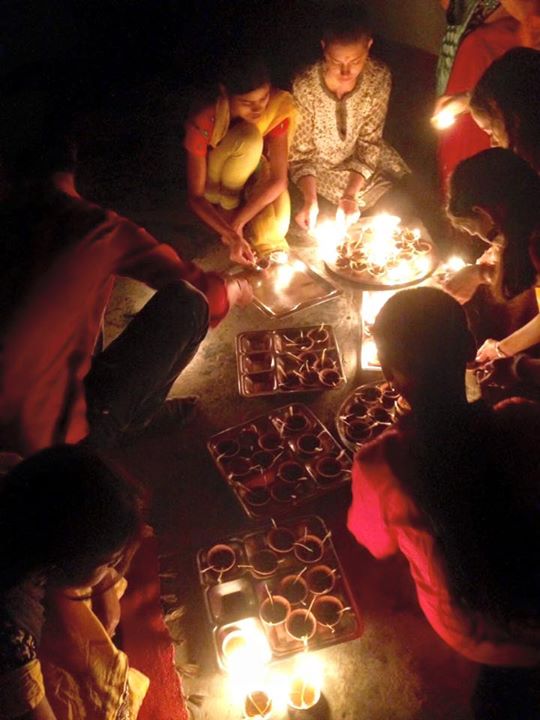
Months later, November 11th, 2015 to be exact, gave me a chance to treat guests as gods, and have gods as guests! This was a special day for Hindu India: Diwali, the Festival of Lights. This holiday represents homecoming for the Goddess Laxmi, the triumph of good over evil, celebration of the return of the divine couple Ram and Sita, and overall a fresh beginning and new year for Hindus. Our class was told that we would be hosting the Diwali celebration for students and families at Southpoint school. We were divided in groups to organize different aspects of the festival– preparing the puja for the gods, leading games, setting up lights and fireworks, and distributing food and sweets. My group was in charge of the lanterns, known as diyas, used traditionally for Diwali. We ran around town to bargain for the supplies– 200 clay pots, candle wicks, mustard oil to fill the pots, and matches to set them all aglow. Once we had the supplies, we set up the lanterns before the party, and then after the ritual puja, lit and handed them out for the guests to place on the steps of the campus. It was so special to be able to host part of the celebration.
Since being in India, I have continuously been a guest, and have been met with divine graciousness because of this. To be able to help, give, organize, and create an experience for others was something I didn’t realize I was missing so much. This is one thing I want to take home with me– the spirit of hospitality. I am deeply inspired by the kindness that has been shown to me and excited to be able to offer whatever I can to others: maybe a nice place to sit, an open ear and heart to conversation, or a cup of chai.