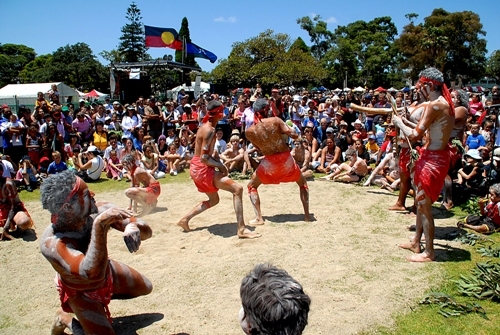
On January 26, Australia Day, I attended two festivals in Sydney. The first was the Aboriginal Yabun festival, held in a park with vendors, food, music, and performances embracing Aboriginal culture. The second was a “traditional” Australia Day celebration in Darling Harbor, with fireworks and patriotic enthusiasm. While the majority of Australians celebrate January 26 as the day in 1788 when Europeans first colonized Australia, Aboriginal Australians view this day as the tragic beginning of the oppression of their people by white settlers and instead refer to is as “Invasion Day” or “Survival Day”. The difference between these two celebrations demonstrated a palpable rift between two cultures; it was as if we were celebrating the holidays of two entirely different nations instead of two groups within the same country.
The Yabun festival had a fun, energetic vibe, with an emphasis on cultural pride and awareness. It was a good chance to learn more about Aboriginal culture. As an outsider, I felt welcome to take part in the festivities and respectfully observe customs. Taking a 180 degree turn, the festivities in Darling Harbor were patriotic and brash. It was fun and laid-back, a chance for many people to take a day off work and drink. I had a good time, but after attending Yabun, it was hard keep the harsh historical realities of the holiday out of my mind. These experiences brought my attention to the fact that not everyone identifies with their country the same way, or even at all, and assuming that everyone feels the same can be problematic.
In his article, “Nations and National Identity: Too Much or Not Enough?,” David Carter raises questions about what constitutes Australian national identity. Citing Benedict Anderson, who describes a nation as an “imagined political community,” Carter notes that even though we will never meet most other members of our nation, we develop a strong sense of community and camaraderie with them, forming a shared “national identity”. This identity is not necessarily the same for everyone, or for every group within a country, but requires in all cases the idea of boundaries defining “insiders” and “outsiders.”
The article addresses how Australia has been perceived as a predominantly white, male society, which is powerful even though it does not actually represent the identities of many Australians. In Carter’s words, “Race, ethnicity, gender, and sexuality have been the key boundary lines through which the process of inclusion and exclusion have functioned.” National identities are constantly shifting and adapting, and they are not always defined in the same way by different populations within a nation. Australian national identity, in this view, is a social construction rather than a natural fact.
Cavan Hogue explores this same idea in his article, “Does Australia Have a National Identity?” He argues that there is no clear answer to the question of what constitutes Australian identity. A mix of people with diverse cultures and backgrounds makes Australian national identity difficult to define. Hogue states that Australian national identity is “a work in progress where the future is more important than our past”, and concludes by saying, “perhaps the best we can do is to define an Australian as one who lives here, is a citizen and accepts certain core values which characterize Australian society.”
In light of these experiences, and reading these articles, I concur with Hogue in thinking that Australian national identity can be defined by those who live here, though I do not think that it necessarily means accepting certain core values. I do not think that 24 million people can agree on the same values (and I don’t think it would be a good thing if they did). I think the same goes for any country’s national identity. This does not devalue someone’s nationality, it just highlights the notion that nationality is not as concrete as I previously thought.