Lewis & Clark Around the World

Programs associated with Lewis & Clark College, Portland OR

  • About
    • About Lewis & Clark Around the World
    • Contact Information
  • Programs
    • Featured Overseas Programs
    • View All Overseas Programs
    • View All Program Sites
  • Participants
    • Posts
      • Featured Student Posts
      • View All Posts
    • Projects
      • Featured Student Projects
      • View All Student Projects
      • Map of All Projects
  • Help
    • Participant Orientation
    • Post Reminders
    • Your Dashboard
    • Your Overseas Project
    • Setting Up a New Program

A Beginner’s Guide to Harvesting Fog

February 26, 2017 By Sarah Madsen

Right now, I’m sitting in a café with two of my classmates, both named Emily. The two Emilys are researching for paper that we will be writing for our class on sustainability and development in Morocco, taught by Dr. Jamila Bargach. I tried for a while, but feeling stuck, was just now reflecting on the class in general when I realized that I could write about it for the blog.

The class, as I mentioned, focuses on sustainability and development in Morocco, but specifically water. Even more specifically than water, the class pays close attention to fog water, something that Jamila knows a lot about. Jamila works for the organization Dar Si Hmad, whose main project is fog water, or water collected from fog.

I know what you’re thinking. How does one harvest water from fog? I once thought the same thing, sweet reader, but it turns out that the answer is much simpler than we both thought:

It’s literally a net.
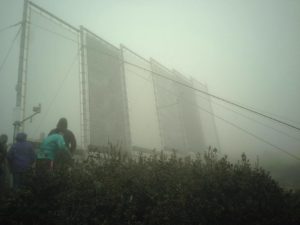
The practice is actually very old, but today, nets with three-dimensional properties have been developed to sit at the top of a mountain and wait for the fog. The wind in the mountains causes the fog to flow through the nets, and if the fog particles are big enough, they cling to the netting and drain into a gutter. The water from this gutter is mixed with groundwater for nutrients, filtered, and used in villages affected by drought.

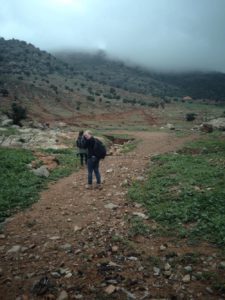
Recently, our class visited the fog project near Sidi Ifni, where we witnessed fog collection in action. After what for me was a death-defying hike, we arrived and were able to not only see the fog collection nets, but speak with a woman who made the transition between gathering water to using fog water herself.
Perhaps the most interesting part of this class is the social affects of the fog water. The use of fog water allows women who would normally have to travel long distances to gather water several times a day to do it in a very short amount of time. Some people like this, and others don’t. This is where the situation becomes complicated and people like Jamila come in. Her expertise is in anthropology, so her research has to do with the cultural complications that come with “modernization,” a word even more complicated perhaps than the technology behind fog collection itself.

Overall, the class has been invaluable to our time here in Agadir, and as I sit watching Emily 1 and Emily 2 actually work on their papers, I can’t help but feel immensely grateful for the opportunity we have before us in Jamila’s class.

Filed Under: Morocco Spring 2017, Posts

For more information on Lewis & Clark Overseas & Off-Campus Programs, visit our website.

Featured Programs

  • Fuji Summer 2017
  • Morocco Spring 2017
  • Cuba Spring 2017
  • Germany: Berlin Fall 2015
  • India Fall 2015
  • Fuji Summer 2014

Recent Posts

Diving Deeper into Coral Reef Ecology at Lady Elliot Island

Diving Deeper into Coral Reef Ecology at Lady Elliot Island

Another day in paradise. Today marked our third day on Lady Elliot Island, and it’s easy to see that we’re all getting used to this. Waking up early isn’t a challenge with the bright sun and the cacophony of seabirds, but for once no one is upset, as our first activity is a quick snorkel […]

Journey to the top of Queensland – 5/4/18

Journey to the top of Queensland – 5/4/18

Today marked our last day at Carnarvon, with our next stop to be the Great Barrier Reef. Although we’ve stayed at Carnarvon Gorge longer than expected due to the cyclone off the eastern coast, it allowed us to explore even more of the beautiful park. We were woken again by the sounds of Laughing Kookaburras, […]

Great Times at Great Kepple

Great Times at Great Kepple

April 7, 2018 Our first full day on Great Kepple Island! We spent the morning in lecture learning about coral, coral reefs (there’s a difference!), conservation and the general weather trends that can dictate the biogeography of the ocean. While some had come into this program with invertebrate knowledge from classes at Lewis and Clark, […]

Planes, trains, automobiles and the amazing reef!

Planes, trains, automobiles and the amazing reef!

On April 10th I woke up to the sound of the train wheels clacking. It was 5:30 in the morning. I was so tired but also so thrilled to be traveling to a new destination. Soon after we woke from the comfy and unique accommodation of the train, we all gathered our belongings and hopped […]

Under the Milky Way Tonight

Under the Milky Way Tonight

  On April 3, 2018 we stayed at the Takarakka bush resort in Carnarvon Gorge. One of the many highlights of Carnarvon George is the sky. Specifically, the entire Milky Way. Which, as our tutor brought up, used to be a sight that everyone could see. It is because of our cities light pollution that […]

Digital Scholarship Multisite © 2018 · Lewis & Clark College · Log in