
Four days ago, twelve undergraduates (myself included) moved into a thatch-roofed house with sprawling tatami mats and no air conditioning. When we return from our fieldwork or lectures, we trip over ourselves trying to follow the traditions and customs that come with the house: taking off our shoes in the entryway, sharing the bathwater, cooking local cuisine, and sleeping on futons on the floor. However, when we leave the house, we confront the anachronism of our environment: a snapshot of the past is preserved as a commodity for the present. We access internet at the Fujisan Club in what was once a schoolhouse. The friendly obasan and ojisan (auntie and uncle) in the cottage down the street sell us soft-serve ice cream. The village fishpond is filled exclusively with rainbow trout, a species native to North America. In truth, the original Nenba Village was destroyed by a debris flow decades ago, and it was only relatively recently rebuilt as a rural tourist attraction. You even have to pay a 350-yen entrance fee to walk around or eat lunch in the village. Most of the people who work here during the day live in the nearby town with still-rural but much more modern accommodations.
Sociologist Anthony Giddens wrote in his 1990 treatise, The Consequences of Modernity, that “tradition is not wholly static, because it has to be reinvented by each new generation as it takes over its cultural inheritance from those preceding it.” The evolution of Japanese traditions has been beneficial if not vital to the survival of the “old ways of life” envisioned in romantic daydreams of Edo. One of our first experiences outside of the classroom in Tokyo was an Otakiage, or fire-based ritual, held especially for our program at Fusōkyo Shrine to pray for a safe journey when we climb Mt. Fuji. The fire ceremony was performed in the front courtyard of the shrine, but it was essentially held privately with our program as the sole intended audience. The experience felt “authentic,” despite the fact that we were sitting on foam pads, taking GoPro videos, and drinking from store-bought plastic bottles of tea. Although the cult of Fuji worshipers is aging and shrinking, performing these rituals for interested individuals such as students allows their practice to continue relatively unchanged and true to tradition.
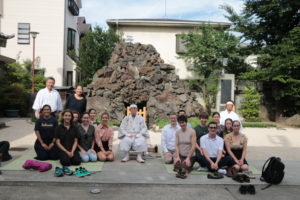
Despite Nagano Shishino’s efforts to purify the Shinto practices at Fusōkyo in the early twentieth century, Buddhist influences such as esoteric gestures, chanting of sutras, and offering of incense were included in the ritual carried out under the sixth head priest of his lineage, Fumio Shishino (back left).
On a later occasion, we viewed a goma fire ritual in Murayama that was well-attended by religious professionals, local politicians, the winners of this year’s Miss Fuji pageant, a British ambassador, and dozens of junior high school students. This public ceremony is held annually to open the climbing season from the south side of the mountain. Although ceremonies like this exclusively involved only mountain ascetics long ago, they have since become open enough to attract foreign tourists. To accommodate the larger audience and more public setting, the fire was considerably bigger at the Murayama Otakiage than the Fusōkyo one. Despite the broadening of the audience, the ritual activities are, like those at Fusōkyo, very similar to those performed in generations past.
Even while maintaining certain rituals, the circumstances of those rituals has changed over time. A community’s knowledge of an activity and of its social context returns to affect the practice of that activity (Giddens, 1990). It is certainly feasible that a shrine or temple’s knowledge of decreasing numbers of followers and of growth in tourism might lead it to redirect its efforts to survive in a modern capitalist economy. However, this is not to say that the link between modern commercialism and traditional rituals is new nor that it necessarily damages the credibility or sincerity of such rituals. Religious professionals have worked to maximize their profits for years, as demonstrated by the competitive struggle of oshi (innkeepers and pilgrim guides) to allow women to climb Fuji in order to attract more paying customers during the nineteenth century (Umezawa, 2005). The ritual we attended in Fusōkyo was carried out with extreme sincerity, and at the end, the priest told us with great conviction and satisfaction that now we would have a good climb. Although the number of “real” practitioners seems to be decreasing according to Fusōkyo head priest Fumio Shishino, religious professionals maintain their beliefs and continue their traditions by allowing others into their circle (Shishino even invited us to create our own Fujikō, or Fuji cult confraternity).
In her article “A Global Sense of Place,” Doreen Massey stresses that while the ability of a place to have “multiple identities” can create conflict, it also nurtures richness and diversity (1991). Fuji-related rituals support cult worship for Fujikō while providing entertainment and education for tourists both from Japan and from abroad. Similarly, Nenba Village, our current residence, fills multiple roles for the people moving within and through it. To tourists, it is a fanciful historic replica and an escape from the city; to the nearby residents who labor here, it is an economic way of life; to us, it is an educational experience in local historical culture. Through the various identities assumed by places and practices around Fuji, traditions from the past are given constancy as well as relevancy in a constantly evolving present.