
In Nemba, my morning routine consists of waking up in the farmhouse, cooking breakfast with the eleven other members of the Fuji 2017 Summer Program, and walking outside to meet our professors at the Fujisan Club Building. As I walk out the door on clear mornings, Mount Fuji towers over me. Its magnificent presence leaves little doubt as to why people have worshipped it for hundreds of years. Fuji’s presence is hypnotizing; its size is astonishing. During my Fuji hunt in Shinjuku, Tokyo I found many depictions of Mount Fuji. The mountain was used as a symbol to attract tourists and sell products such as bath salts, face masks, pens, golf tees, tissue boxes, scarfs, beer, and towels. These cheap commodifications of Mount Fuji stand in contrast to the impressive mountain I see every morning. How can a single icon be so holy and also so cliché?
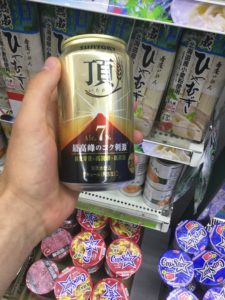
A can of Suntory beer with Fuji on its cover.
In her article “Making Mountains: Mini-Fujis, Edo Popular Religion and Hiroshige’s One Hundred Famous View of Edo,” Melinda Takeuchi writes that beginning in the eighteenth century over one hundred Fujizukas, or mini-Fujis, were constructed around Japan (Takeuchi 2002, 25). Mini-Fujis allowed all Fuji pilgrims to access the mountain. For a number of sexist reasons, women were prohibited from climbing Mount Fuji until 1860. Women were said to pollute the mountain with their menstrual blood and were thought to bring bad luck to the villages below the mountain. In addition to women, elderly, young, and handicapped people also had difficulty climbing all 3,776 meters of Mount Fuji. Mini-Fujis allowed all these people to worship and make pilgrimage to Fuji without needing to actually summit the mountain. As Takeuchi writes, mini-Fujis were “surrogates that receive and deflect defilement” (Takeuchi 2002, 44). Mini-Fujis were holy places in their own right.
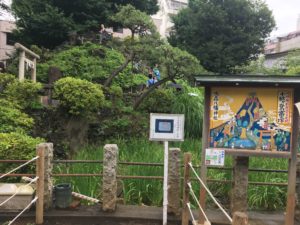
One of the remaining Mini-Fujis, located in Tokyo.
The process of replicating Fuji during the Edo period did not stop with mini-Fujis. Both Utagawa Hiroshige’s One Hundred Famous Views of Edo and Katsushika Hokusai’s Thirty-Six Views of Mount Fuji are evidence of this. Hokusai’s paintings of the landscapes around Fuji were so popular, he actually added ten more to his thirty-six.
In many of his pieces, Hokusai portrays Fuji as the powerful and inspiring mountain I see every morning. However, in Thirty-Six Views of Mount Fuji, Hokusai did not limit his attention to Fuji. He also spent time depicting human landscapes. While Fuji is the binding factor in all of his views, the way Hokusai depicts the mountain varies from piece to piece. For each painting, Fuji’s framing, shading, and coloring affect the sensation it evokes for the viewer. While these factors change, Fuji remains an immovable and eternal backdrop regardless of human action. The people laboring in Watermill at Onden, for example, show no awareness of Fuji’s presence in the distance. They are much more concerned with their work. The most spectacular aspect of Watermill at Onden is not Fuji; it is the intricately detailed stream running through the watermill. However, it is impossible to miss Fuji high above the clouds in the background. Hokusai’s artwork not only serves to illustrate Fuji’s magnificent presence; his paintings also characterize Fuji’s omnipresent existence. For Hokusai, Fuji is sometimes a towering mountain. In other instances, it is simply pretty scenery. In Thirty-Six Views of Mount Fuji, regardless of whether or not Fuji’s presence invokes the numinous, its presence still exists. Hokusai shows that Fuji has the ability to be both ordinary and divine.
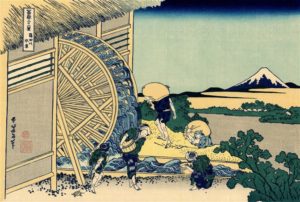
Katsushika Hokusai, Watermill at Onden
Mini-Fujis and artwork by Hokusai and Hiroshige are exceptional replications of Fuji. In my eyes they serve to emphasize the mountain’s holiness. The replications of Fuji I found during my hunt through Shinjuku, on the other hand, were very unimpressive.
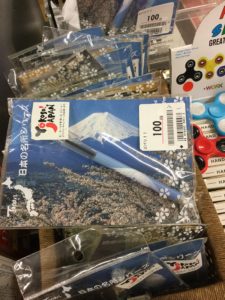
A Fuji pen from a golfing store in Shinjuku.
Are the red Fujis on a Suntory beer can or the plastic Fujis on a golf tee comparable to the mini-Fujis created in the Edo period? What separates the Fuji depicted in Hokusai’s Fine Wind, Clear Morning from the Fuji on the side of a tissue box? Even though commercial replications of Mount Fuji support the commodification of a holy mountain and consumerism in general, they do not detract from Fuji’s impressive presence. Similar to how Hokusai can paint Fuji as both a normal backdrop and a numinous masterpiece, Fuji can also be printed on beer cans, pens, face masks, and bath salt containers while simultaneously attracting hundreds of thousands of visitors to its slopes annually. The commodities which utilize Mount Fuji to promote their consumption have no effect upon how I experience the mountain’s presence. Fuji’s essence is simply too unique and impressive. The depictions of Fuji by Hokusai and Hiroshige are testaments to the mountain’s beauty. Hokusai in particular illustrates Fuji’s ability to be viewed in many different ways. The construction of over one hundred mini-Fujis throughout Japan is proof of Fuji’s holiness and popularity. The cheap and pervasive commodification of Fuji is confirmation of the mountain’s existence as an everlasting cultural icon.
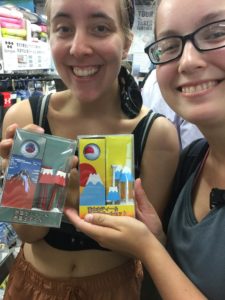
Fuji golf tees from a store in Shinjuku.
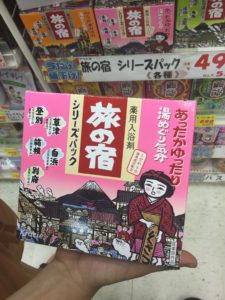
Fuji bath salts from a drug store in Shinjuku.
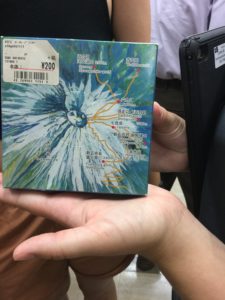
A box of tissues with Fuji pictures on all sides.
Takeuchi, Melinda. “Making Mountains: Mini-Fujis, Edo Popular Religion and Hiroshige’s One Hundred Famous Views of Edo.” Impressions, no. 24 (2002): 24-47. http://www.jstor.org/stable/42597928.
Hokusai, Katsushika. Watermill at Onden. WikiArt. Accessed July 23, 2017. https://www.wikiart.org/en/katsushika-hokusai/watermill-at-onden.