The greatest areas of biodiversity have varied landscapes to provide a range of habitats for the species that live there. Japan’s satoyama, or countryside, has high levels of biodiversity. The human involvement creates a range of habitats which support many different species. Habitats found around traditional rice paddies include the paddies themselves, which maintain water at various levels throughout the year, surrounding forested areas, and ponds at the top that provide a constant water source.
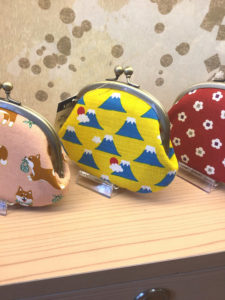
Fuji on a coin purse in a display case in a shop in Asakusa.
Similarly, Tokyo hosts a plethora of environments: religious sites, shopping districts, residential areas, and an extensive transportation network – to name a few. Each type of environment has many incarnations due to the varying social networks therein. Diverse social habitats make for diverse Fuji imagery. Fujis can be found in countless forms, from photographs to geometric representations.
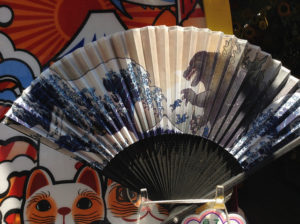
A fan with Hokusai’s Great Wave and Godzilla at a souvenir shop in Asakusa.
Fuji images have adapted extremely well to tourist hot-spots. Here, visitors are searching for a part of Japan – the symbol of Fuji has evolved to be just this. Further, many “species” of Fujis have evolved to be cute or colorful,
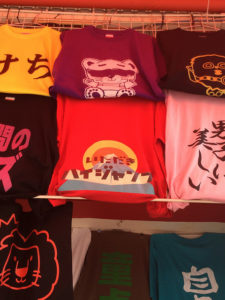
T shirt with Fuji on it found at a store in Shibuya called New York New York.
or to incorporate other Japanese symbols such as Godzilla. Images of Fuji have adapted to coexist with locals as well. In commercial environments, Fuji images appear in advertisements, murals, and clothing—seemingly without irony. Fujis can be found around religious sites; the Fujizuka, or miniature Fujis, are themselves religiously significant. However, the population of Fujizuka has declined sharply; where there were once hundreds across the city, only a handful remain. Happily, the communities surrounding such sites are actively working to preserve this endangered species.
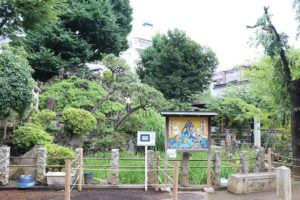
A Fujizuka at Hatonomori Hachiman Shrine.
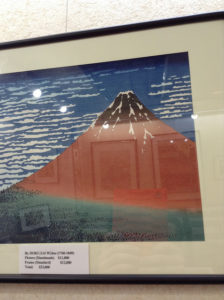
Fuji featured in Hokusai’s “Red Fuji” in Sakai Kokodo Gallery.
Just as distinct habitats of biological organisms exist in close proximity, so too do different representations of Fuji. A museum, such as the Sakai Kokodo Gallery, is home to one family of Fuji image: high art. The giftshop in the same building, however, hosts a completely different set of images, like craft tape decorated with the mountain. In both contexts, individual ecosystems can affect surrounding ecosystems. There is a pond at the top of the field that sustains the rice paddies below. Similarly, customers from the museum flow into the gift shop. This ecosystem, and some of the Fujis within, would not exist without the museum.
Just as some habitats are suitable for certain species but not others, some social environments are suitable for certain Fuji images and not others. Foreign tourists aren’t going to buy a Fujizuka in a souvenir shop. Critics won’t find tee-shirts with the mountain in art galleries. And yet, life finds a way.
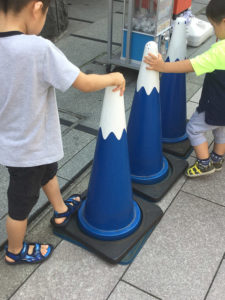
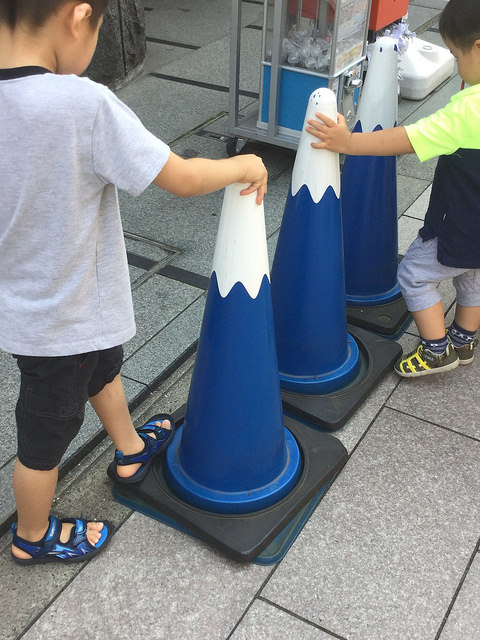
Fuji as a traffic cone in Asakusa.
Or rather, Fuji finds a way. Representations of Fuji appeared in even the least likely of places such as the middle of the road; traffic cones have been reimagined as miniature mountains topped with snow. Fuji persists in the most modern places in Tokyo, even if it’s only in advertisements or logos. It adapts to the demands of the modern setting, as the symbol is continuously reimagined by the people who share the social environment.
The general movement for conservation in Japan is concerned with preservation of biodiversity over preservation of wilderness. Instead of preserving a (fabled) version of nature untouched by humans, the general goal of conservationists is to combat the extinction of species and allow for diverse life to thrive. There is a particular interest in the satoyama—so much of the natural space in Japan is rural, shared between humans and nature. As the satoyama disappears with the aging populace of Japan, this unique environment is being lost and biodiversity is decreasing.
Like the biodiversity of organisms, the diverse Fuji images rely on the interplay between the human and the nonhuman worlds. Though the natural world seems distant in the urban metropolis, it is never far away. If the sky is clear, Fuji can be seen on the skyline.