Tourism can be, and has been, seen as one of the black ships in the armada of globalization “spreading cultural homogeneity and consent” (Raz, 12). This conception feeds on the perceived inequity between the visitor and the visited, the watcher and the watched. This perceived inequality is reinforced by the commodification of the spaces and symbols visited. Commodification, here, is inherently negative as it obscures all noncommercial value. Thus the tourists take something away from the communities they visit (besides souvenirs). In this view, the plethora of Fuji images on tourist fodder is taking away from the majesty of the sacred mountain. When this logic is taken to the extreme, the conclusion that follows is that any tourism is a form of cultural voyeurism that reinforces capitalist values and is therefore damaging to communities. There might be some element of truth to that, but the conclusion seems absurd. There must be some way to interact with other cultures without destroying them. This blog post raises two points which suggest that the tourism and commercialization surrounding Fuji are not as destructive as this view suggests (though it would require a much longer response to argue this fully).
Tourists have climbed Mount Fuji since the Tokugawa period.
Under the rule of the Tokugawa Shogunate, travel in Japan was restricted (Gottardo, 2017). Roadblocks kept the common people confined to their domains. One way to circumvent these was through pilgrimage. With a letter of intent signed by the head of the family temple, pilgrims could bypass the checkpoints on the roads and travel to a site of worship. And as pilgrimage was the way to see Japan, it became a leisure activity as well as a religious one. Villages around temples developed thriving tourism industries to accommodate the pilgrims.
Many of these villages still cater to the needs of tourists today, though the demographics of the tourists have changed. While religious pilgrims still summit the mountain, they are the minority. Whereas Japan was largely isolated from the West during the Tokugawa period, foreign visitors now flock to Fuji.
This change in demographic is welcomed by the Japanese government. Tourism in national parks, after all, provides jobs and keeps people in rural areas, which are declining as the population ages and younger generations move to the city. Foreign tourism, in particular, draws foreign money into Japan’s economy. The Ministry of the Environment is actively trying to increase the visitation by foreign tourists.
Images of Fuji have been commercialized for at least 200 years.
Consider Hokusai’s 36 Views of Fuji. Today, these images are high art. They are housed in a museum built by an award-winning architect, praised for the impact they had on French Impressionism. When they were first released, these prints were an element of popular culture (Oge, 2017).
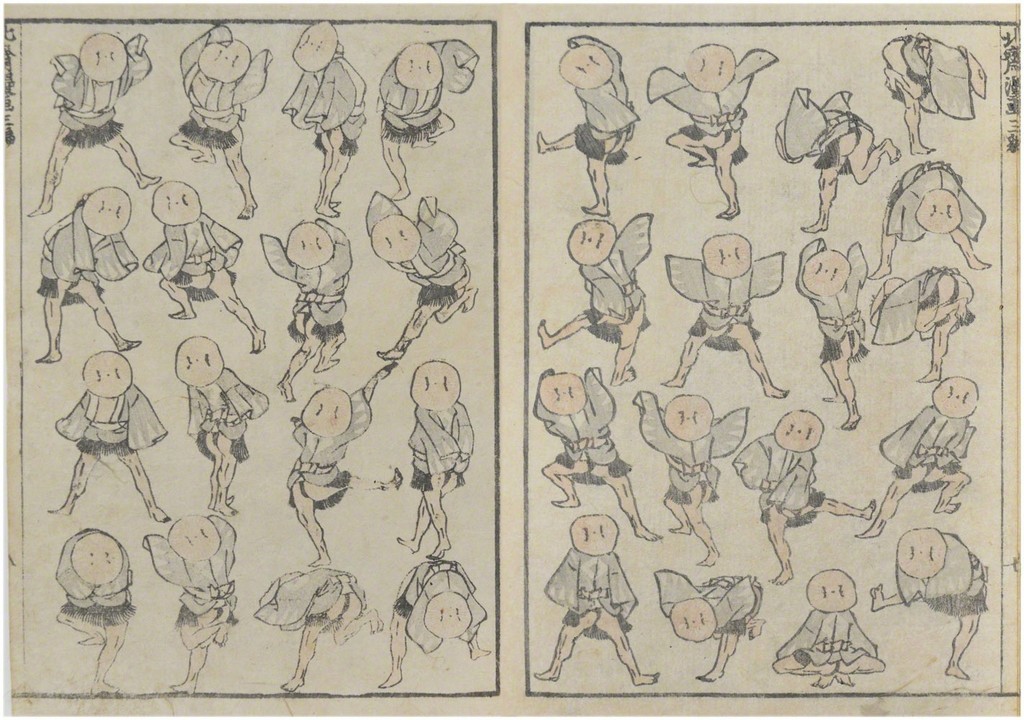
Katsushika Hokusai: Yakko-odori (Happy Dance)
Not only were they widely available, the artist was a rogue. He was kicked out of his family of painters, though resourceful enough to make connections in multiple families and thus continue his artistic career. He was discredited for his habit of depicting the crude and obscene in his works. Hokusai was famous for not only his art, but for the shows he put on to promote it. He painted on colossal canvases and on grains of rice. Of course, his disregard of the rules, including those of scale, allowed him to make art which influenced that of the world. But this disregard would not have been compatible with the creation of high art of the time. And yet his works were widely circulated. Thousands of prints were made, they were inexpensive – they were ephemera.
200 years later, these works are still highly circulated. Now, however, they have significantly more clout as serious art. They also have accumulated layers of meaning. The Great Wave and the Red Fuji are symbols of the nation. These images are seen throughout Japan, and not just in tourist heavy neighborhoods. While they are exportable, they are still appreciated by locals. Their value is much more than commercial.
These two counter examples provide historical president for dismissing the view of tourism as black ships of imperialism. Hopefully, this will help us all to get off the black ships and find a more nuanced view.
Work Cited: