
Before I came to Japan I had the perception that the country had an intimate relationship with nature due to films and anime I had seen during my childhood. Our assignments and site visits, however, changed this view soon after I arrived. What really caught me off guard was when one of our speakers, Seiichi Kondo, a man acclaimed with helping Mt. Fuji become a Natural Cultural Heritage site, gave a lecture about how Japan loves nature. He claimed that Japanese gardens strive to be in harmony with the natural world and how nature is a teacher for human designs. In contrast, he said Western gardens, like the Garden of Versailles, are an example of a finely manicured, controlled, unnatural environment. Kondo seemed to be describing a fictional, but wholly real to him, version of Japan where humans and nature were equals. This lecture raised eyebrows everywhere, because we had all learned that Japanese views towards nature are centered around aesthetic beauty and selectivity for human practices, not what Kondo was describing.

To better understand Japan’s appreciation of nature for human utility, we read a study that surveyed Japanese, Americans and Germans for their attitudes towards nature. Stephen Kellert, the author of the study, described Japan’s relationship as “emphasizing control, manipulation, or contrivance” over nature (Kellert 1993). Japan does appreciate nature, however, just in ways different from Western nations. An example of controlling nature for human purposes is the bonsai tree. Here, the growth of the tree is intentionally stunted for home decoration and aesthetic beauty. Kellert summed up Japan’s relationship most eloquently when he noted that Japan often has the desire to “isolate favored aspects of the natural world, and then “freeze and put walls around it” (Kellert 1993). This concept is particularly evident at Tenryu-ji, the Zen garden I visited in Kyoto. The garden had groundskeepers plucking individual weeds from the mossy floor, a koi pond with a manmade creek flowing gently into it, and a handpicked diverse collection of various fauna and flowers. Zen gardens like this one are a contemporary snippet of Japan’s cultural history and possibly an example of how nature is seen through a Shinto and Buddhist perspective.
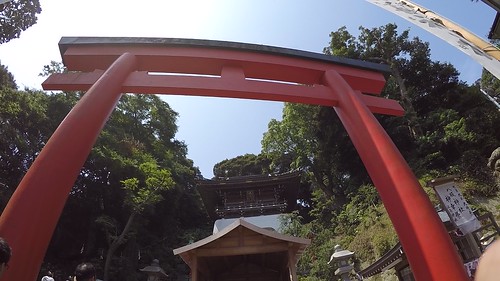
Apart from made-made creations such as gardens, Japanese cultural texts and religious values place importance on natural formations for worship. This process, however, is selective, since only certain formations are deemed sacred. For instance, this is especially true regarding the Sengen Shrine’s ownership of the peak of Fuji, since the deity, Konohana Sakuya Hime, lives there (Bernstein 2008). Oddly, the most densely forested area below the peak is not a special protected area, but the peak is due to its religious significance. Again, this selectivity does not encompass all of nature, only the parts that are aesthetically pleasing enough or worthy of calling sacred. Framing nature in a certain light can also be motivated by political considerations. In the Man’yoshu, a book of poetry from the Nara period, courtiers surrounding the Yamato clan (the imperial family) used poetic verses to describe the beauty and grandeur of the sacred Yamato lands for the purpose of bolstering imperial sovereignty. (Tucker 2003).

Although Japan does have an attitude towards nature that prioritizes aesthetic beauty and selectivity, it makes sense that this is the case since Japan has been blessed with its unique topography and biodiversity. Japan might treat nature differently from countries such as America and Germany, but Japan has a different history of land use and a culture that has deep roots in the natural world. Although I now know my original perception of Japan was not true, Kondo’s presentation did strike a chord in me. He was speaking about a time that never existed, and yet it made me think fondly about the period of my life where I believed Japan thought of nature as an equal.
References:
Bernstein, A. (2008). Whose Fuji? Religion, Region, and State in the Fight for a National Symbol. Monumenta Nipponica, 63 (1).
Kellert, Stephen. (1993). Attitudes, Knowledge, and Behavior Towards Wildlife Among the Industrial Superpowers: United States, Japan, and Germany. Journal of Social Issues.
Tucker, John A. (2003). Nature Across Cultures. Nature Across Cultures: Views of Nature and the Environment in Non-Western Cultures, 161-81. Vol. 4. Springer Science.