
There’s something electric about Japan. Amid our ceaseless moving, the endless influx of sensation and the hyper speed of modernity, almost nothing seems constant or steady about the culture. But having left Tokyo and settled in at the base of Mt. Fuji, the focus of our study, I can’t help looking each day in awe at the constant, seemingly immoveable mountain around which people have developed their traditions. Religions have formed to worship it, geologists are flummoxed by its behavior, and paintings have been made to capture its elegant power. It’s viewed both here and abroad as the ultimate symbol of Japan. While it has come to be a constant presence around the country, traditions and symbolic meanings have no doubt morphed with modernity. Massey (1991) describes places as processes, or collections of relationships that “interact with and take a further element of specificity from the accumulated history of a place, with that history itself imagined as the product of layer upon layer of different sets of linkages, both local and to the wider world.” Today, Fuji worship groups are losing numbers, and fine art depictions of the mountain are outnumbered by commercially produced images. However, Fuji’s historic and contemporary significance undoubtedly intermingle as this constant mountain symbolizing Japan continues to be reinterpreted.
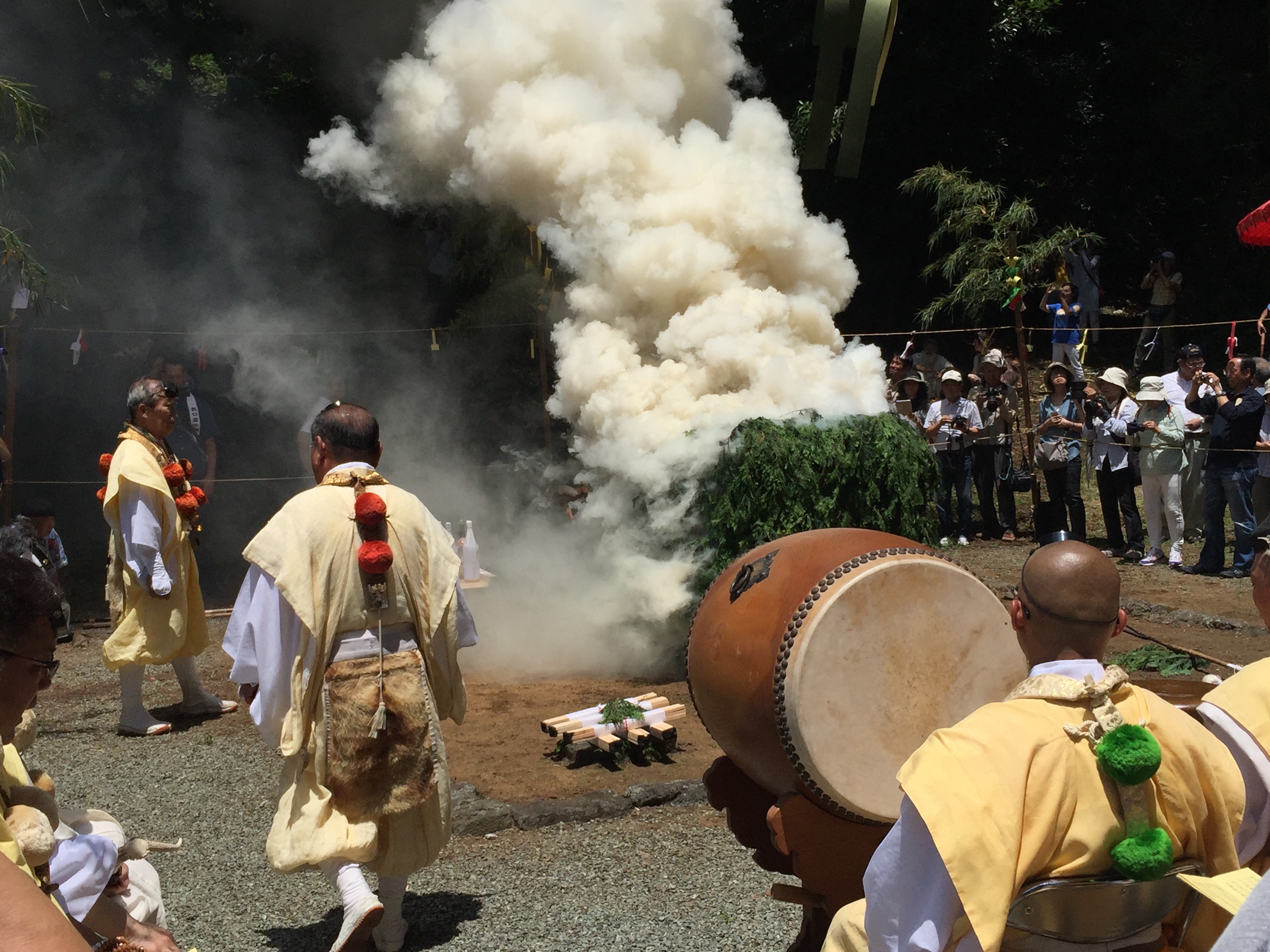
This was made evident to me after watching a Shugendō (mountain worship) ceremony. This event marked the season’s opening of a climbing route up Mt. Fuji. Members of the Shugendō group dressed up in traditional attire and chanted along to the rhythm of conch shell horns and large drums. Many locals came to watch. Among these were a number of primary school children, park rangers, a British ambassador, and a slew of other typical-looking folks, with their cameras at the ready. Towards the end of the ceremony we followed the parade to an intricately stacked tower of wood, the peak adorned with green branches. After a series of symbolic motions of an ax and bow and arrow, meant to dispel malevolent spirits, the heap was set ablaze. The fire emerging up through the wet wood, kept damp as Shugendō members poured water over it, made for quite a show. The smoke and steam intermingled, creating a mesmerizing white eruption that drifted into the thick forest up the slope of the mountain. The movements were all so precise, yet somehow casual. I wondered how long this ritual has been practiced, how many iterations over the years people have witnessed, and how important it still is to welcome an auspicious climbing season.
People have not always rushed there with their cameras, trying to capture the images of the striking white steam and their children running after shot arrows. Nor have British ambassadors always had the front seat to the show. While mountains can appear so constant and immovable, this mountain does move. It carries with it constant threats of eruption, rock slide, and slush flows. These are the reasons people began to worship it from afar in the ninth century. Today people continue to worship it by climbing it and enacting rituals like the ones we’ve witnessed. As absurd and lofty as it sounds, simply by looking at this mountain, I’ve come closer to understanding the feelings related to religious experience. How could this mountain go unworshipped?
But Mt. Fuji is not just a religious symbol in Japan today. Three hundred thousand visitors climb the mountain each summer, mostly for recreation, and many of them are foreigners. They come in mo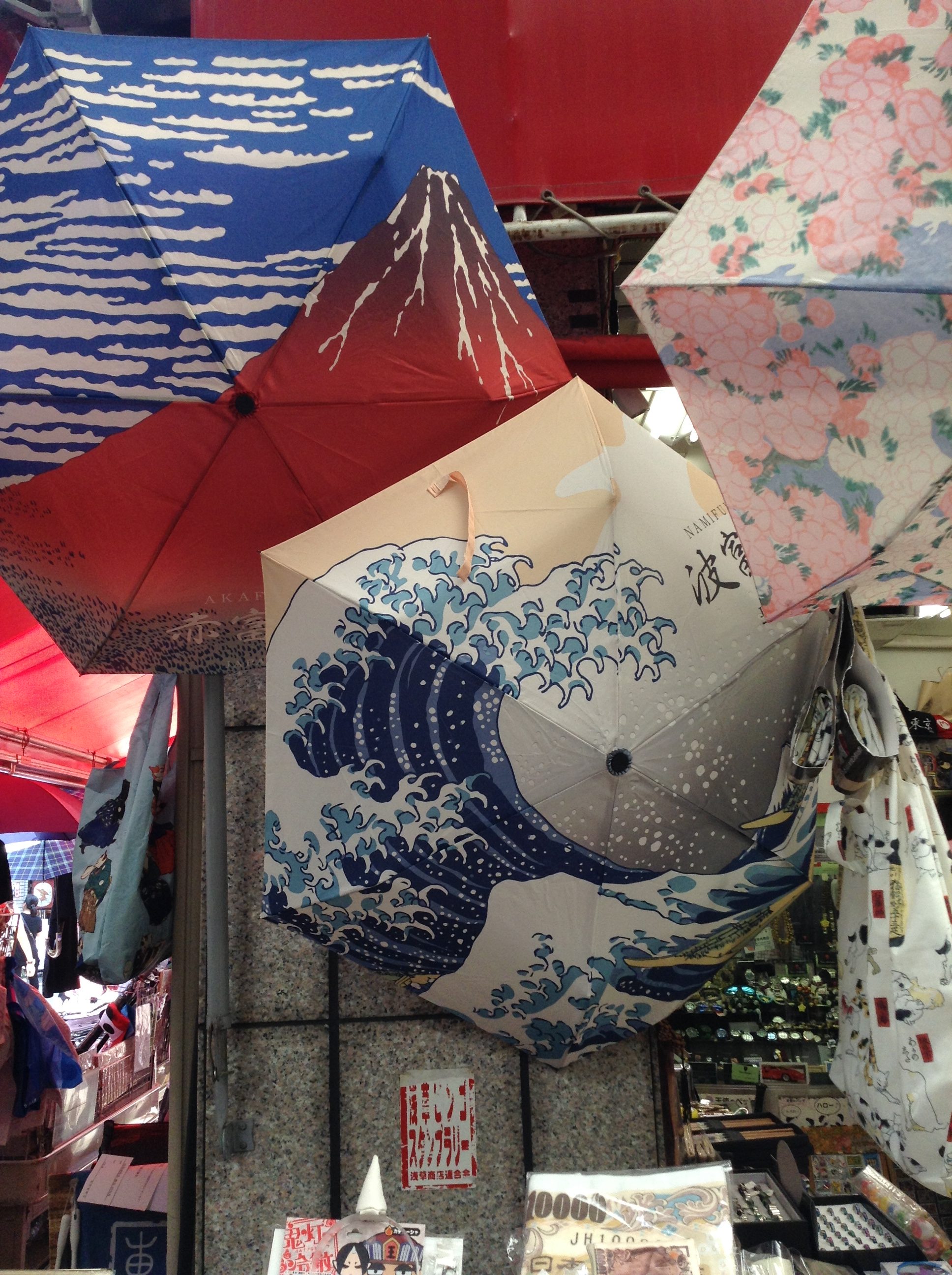 re numbers each year, especially since Fuji’s designation as a World Cultural Heritage Site in 2013. One of our lecturers, Seiichi Kondo, was a key figure in designating the mountain on the basis of it being a “sacred site and source of artistic inspiration” for the Japanese. The most obvious example that fits this description is Hokusai. According to Guth (2011), Under the Wave off Kanagawa (and other works in 36 Views of Fuji) came to represent the uncertainty brought on by coming foreigners coming to the isolated island of Japan. Hokusai depicted this by contrasting the rough waves at the shore with Mt. Fuji, the symbol of Japan. When Hokusai’s prints were first circulated, he was not a popular artist, but was rather eccentric. He was just another artist creating images of Mt. Fuji. Yet now his work is ubiquitous and synonymous with Japanese culture. His pieces adorn everything from gallery walls to umbrellas, yet the original symbolism relating to foreign influence is missed by the ordinary viewer. Here again we see how the lens through which people view Fuji changes over time.
Mt. Fuji is a process. Each iteration of the place is dependent on what came before. While elements of old traditions and attitudes remain, Mt. Fuji continues to be an active part of Japan’s landscape, both physical and cultural. Though Mt. Fuji is perceived as a constant symbol of Japan, we’ll continue to see this national icon reinterpreted and experienced in new ways that builds upon its history.
Guth, Christine M. E. 2011. “Hokusai’s Great Waves in Nineteenth-Century Japanese Visual Culture.” The Art Bulletin 93 (4): 468–85.
Massey, Doreen. 1991. “A Global Sense of Place.” Marxism Today 35 (6): 24–29.