
In Japan, the term satoyama describes both a feeling and place. It is a situated feeling of nostalgia associated with life lived in the countryside before the influence of contemporary technology. Centered around agriculture, satoyama encompasses rice paddies, orchards, woodland forests, grasslands, and thatch-roofed farmhouses that became the culmination of culture and biodiversity in the area (Sprague July 3, 2017). Although it romanticizes nature and the past, the relationship between people and nature in these settings is codependent and important. With rural towns downsizing due to decreased agricultural demands and migration to cities, satoyama lands are now diminishing and facing new ecological problems.
Upon arriving in Nemba, a small village on the skirts of Mt. Fuji, my romanticized image of the countryside in the movie My Neighbor Totoro finally became realized. Comprised of coppice woodland, plantation forests, gardens, and waterfront sites, Nemba felt like a time capsule isolated from the fast pace and glamour of Tokyo. Yet, influences from the city were still apparent. Outside of the historically restored portion of the village that charges entrance fees for admittance, Nemba has an assortment of modern looking homes and cars. Even in front of our two-week home—a 150-year-old farmhouse—we had two vending machines at our disposal within less than ten meters.
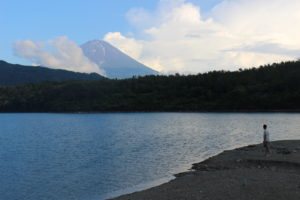 Like many small towns, Nemba has incorporated these conveniences as a part of its economic conversion from dairy farming and charcoal gathering to tourism (Watanabe Toshiyuki, July 21 2017). And like many small towns, decreasing town sizes and agricultural demands have resulted in diminished maintenance of the surrounding grasslands. This relationship between grasslands and humans run deep. According to Yuji Maejima from the Institute for Agro-Environmental Science, human maintenance was essential for the development of arable soils (July 3, 2017). Dating back to the Jōmon period (14,000-300 BCE), people regularly burned grasslands to prevent forest succession, collect herbs, and create charcoal.
Watanabe Michito, a butterfly researcher from the Mount Fuji Nature Conservation Center, has concerns about the decreasing maintenance of these satoyama lands. Using aerial photo mapping from the 1950s to present, we compared the differences between current and past grasslands in the Nojirisōgen, Nashigahara and Motosukōgen areas with him. By the present day, we saw that as people stopped maintaining the lands, mass forest succession inevitably took over the grasslands. In the Motosukōgen and Nashigahara, we were able to count more butterfly individuals and species in the zones still maintained by humans. Our observations mirrored Watanabe’s research. He argued that there are more butterfly species and individuals in these well-maintained areas because there is more disturbance which leads to greater plant diversity, including important food sources for different butterflies (July 12, 2017). Going further, he believes that these diverse butterflies populations are good indicators of grassland health and are strongest when human maintenance is consistent (July 12, 2017).
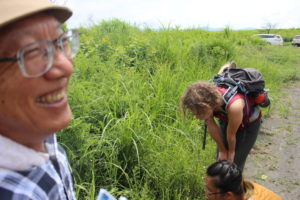
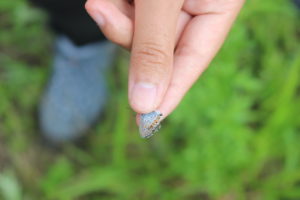
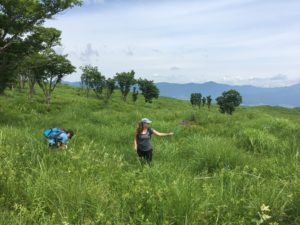
Even though parts of satoyama are becoming obsolete, these places still hold deep emotional significance for those who grew up in the countryside. Although my time in Nemba was brief, I also developed an emotional attachment to the area. Seeing the widespread green of the forests, feeling the summer warmth, and waking up to noise of the cicadas made me feel like I was reliving a memory I had never actually experienced. And I have a suspicion that as these lands become increasingly lost, satoyama will only be longed for more.
Works Cited
Sprague, David. “Spatial Frameworks of land Use and Soils in the Kanto Plan, Japan.” Lecture, Institute for Agro-Environmental Science, Tsukuba, July 3 2017.
Watanabe, Michihito. “Biodiversity hot spot Volume 2: Crisis of the Satoyama Environments.” Lecture, Mt Fuji Nature Conservation Center, Nebma, July 12 2017.
Watanabe Toshiyuki. Lecture, Nemba, July 21, 2017.