
I wish it were easy for me to feel at ease as a tourist. However, no matter how I try, I am always slightly embarrassed by group photos, sight seeing, and other obvious signs of tourism. While I am aware of the blatant consumerism that usually accompanies the tourist industry, I think the main reasons I feel uncomfortable as a tourist are more straightforward. I can’t help feeling superficial and inauthentic. I feel conflicted when I bow at shrines with no real connection to Shinto beliefs or dress in yukata as a white American. I do not mean to imply that being a tourist in Japan is unenjoyable. In fact, I’ve loved going to new neighborhoods, wandering through markets, praying at shrines, and gawking at giant Buddha statues. However, I must admit that I am constantly nagged with slight embarrassment for being an obvious tourist. To make myself feel better about my sightseer activities, I began to re-imagine how I thought about tourism in Japan. A moment of consideration led me to realize that the Japanese tourist industry has a long and spiritually connected history.
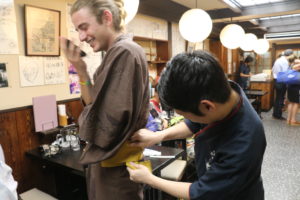
This is me reeling in embarrassment after the belt of my yukata became untied in a restaurant in Kyoto. A kind waiter fixed the belt for me because I had no idea how to.
Aviad Raz, author of Riding the Black Ship: Japan and Tokyo Disneyland, writes that tourism and consumption has played “an important role in Japanese life, shaping tastes, desires, lifestyles, and ultimately identities.” Raz claims that most scholars see Japanese consumer culture as a product of Japan’s postwar economic boom. He argues to the contrary, asserting that instead, consumer culture should be conceptualized “as part of the larger, continuous history of popular Japanese culture since at least the Edo period” (Raz, 17).
Marco Gottardo, one of our guest lecturers, stated that pilgrimage was the first major tourist industry in Japan (July 2, 2017). During the Edo period, the Tokugawa bakufu heavily restricted travel between provinces. However, travelers could easily pass through checkpoints if they were pilgrims carrying a seal of approval from their local temple. Thus, pilgrims were able to utilize the highway system and travel Japan visiting shrines, temples, and holy areas. The oshi were religious specialists who made a living off these pilgrims. Oshi constructed inns and restaurants around holy areas in order to benefit economically from an influx of pilgrims. Every tourist area I’ve been to in Japan has been surrounded by stores and restaurants. Perhaps some of them were initially established by oshi.
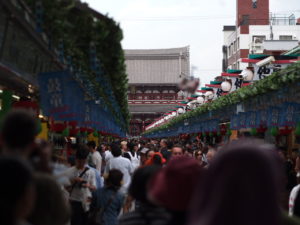
Food and souvenir stalls in front of Sensō-ji temple.
Due to the Shogun’s parishioner household system samurai retainers from all over Japan accounted for roughly half of Edo’s total population during the Tokugawa period. It’s easy to imagine a samurai retainer from the from Osaka spending his evening visiting Sensō-ji temple. Just like I did, he might have dressed up, bought a manjū bun, and gawked at Sensō-ji’s massive gates before proceeding to its shrine to make pilgrimage. In this way, modern tourism can be seen as an extension of pilgrimage. The actions that I take as a tourist which cause me embarrassment are an evolution of the pilgrimage Japanese people have been making for centuries. My presence as a tourist makes me feel uncomfortable. However, tourists in Japan have been courted for financial purposes for centuries. Though tourism in Japan revolves around shrines, temples, and holy mountains, it is no longer solely a spiritual affair. In many regards, the spirituality of pilgrimage has vanished during its transition to tourism. However, many aspects of pilgrimage, such as crowds and consumption, remain the same in modern tourism.
Aviad E. Raz. Riding the Black Ship: Japan and Tokyo Disneyland. Cambridge, MA: Harvard University Asia Center, 1999.